Historical article note: This article was originally published on September 2018; the original collection did not retain the exact day. Rates, policies, home prices, statistics, product names and qualification standards reflect the environment at that time and may have changed. This archive is for historical record and general education only. It is not mortgage approval, investment, legal or tax advice.
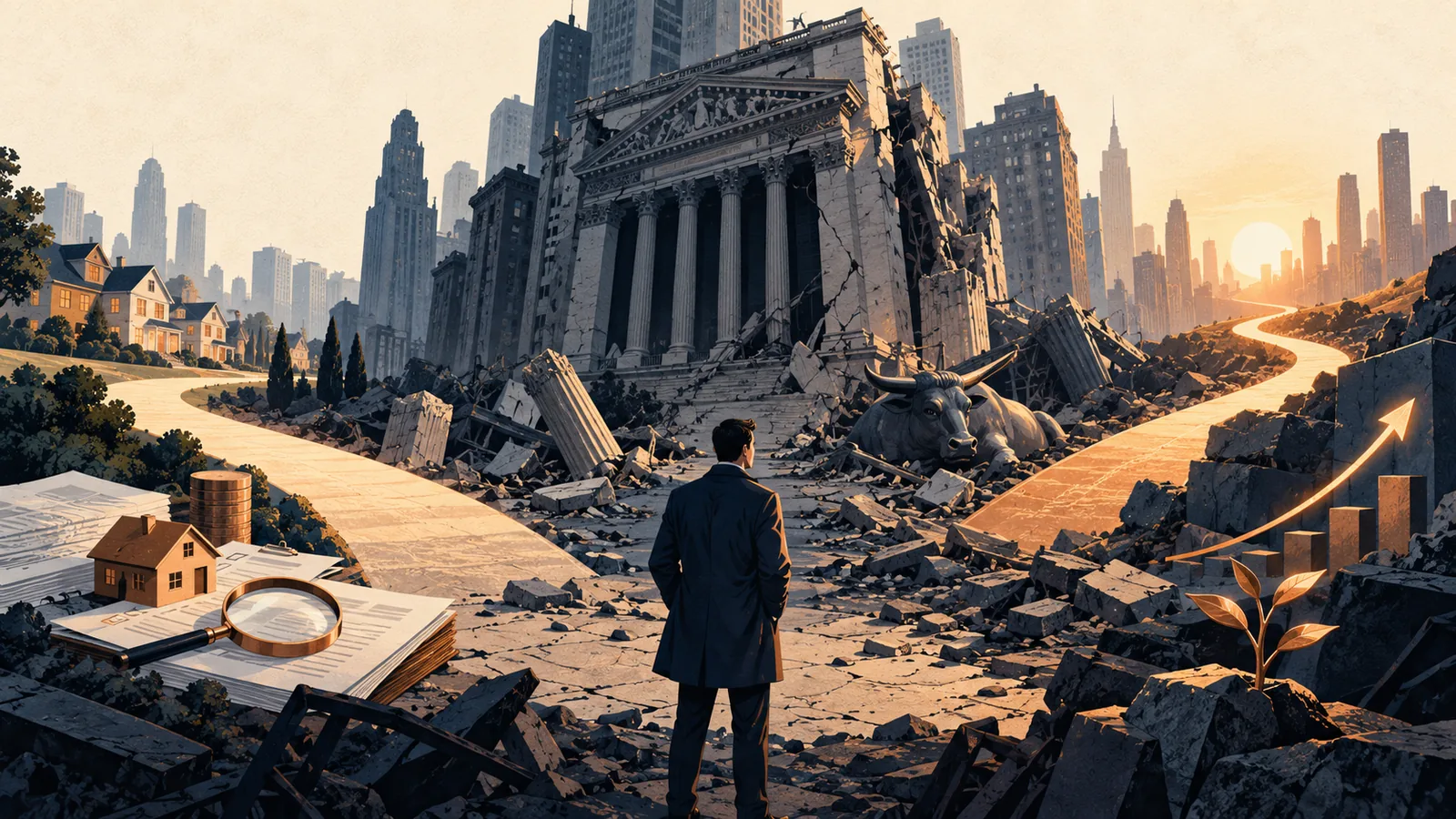
First, when banks approve mortgages without looking at income, stay away from real estate. Commercial banks have many functions, such as being a medium of exchange. At that time, the purpose of Rishengchang Bank was to "connect the world", but it was later replaced by commercial banks. Now WeChat Pay and Alipay have taken away half of the commercial banks. Another main function of commercial banks is to provide financing, that is, rich people deposit their money in banks, and banks then lend money to people in need, and the banks earn interest differentials. The mortgage business of commercial banks has been "lending and holding" since ancient times, that is, lending 100,000 yuan with a contract period of 30 years. The borrower will use his youth and sweat to repay the loan with interest, and the bank will recover all the principal and interest. Throughout the process, the bank "held" the loan on its books and took 30 years to recoup the funds. Americans made unprecedented innovations in this ancient business: they created the "originate and sell" mortgage business model. That is, after issuing a mortgage business, the loan will be used as collateral to make bonds and sold to investors. After the funds are recovered, the next loan will be issued. You do not need to wait for 30 years, but only need 30 days to recover the funds. The loan will only stay in the bank's account for a short time. After the sale, the loan will no longer be in the account, and there will be no credit risk. The borrower's credit risk has been transferred to the investor who bought the bond. Does the person buying the bond know the borrower? NO, bond investors only need to see the bond rating. The people who turned the worst-quality subprime mortgages into bonds were Wall Street. They needed a large amount of loans as raw materials to make bonds. These bonds needed to be rated. Whichever rating agency gave a higher rating would rate these loan-backed bonds. In order to compete for business, the ratings given by the rating agencies were all BBB or higher. What does BBB grade mean? It is the rating of treasury bonds issued by the Chinese government, which means "guaranteed payment" of principal. Good-quality mortgages, that is, prime mortgages, are asset-securitized by the “two mortgages” in the United States. Only subprime loans with poor borrower qualifications are asset-securitized by Wall Street. What are subprime loans? There is a description in "The Big Short": the loan for a $700,000 house bought by a Mexican strawberry picker with an annual income of $10,000; the loan borrowed from the bank by a professional dancer at a nighttime leisure venue to invest in 5 houses... Simply put, it is a three-no loan with no job, no down payment, and no assets. Not to mention, in order to create a huge amount of mortgages, American mortgage lenders invented a fixed interest rate for the first two years. In the first two years, you can only pay interest and not repay the principal. For the next 28 years of floating interest rate loans, the teaser rate can be as low as 2% in the first two years, and the interest rate rises to 12% after two years. This has attracted those who have dreams in their hearts and have no money in their pockets to take out loans to buy houses. The One-Eyed Man found that the first half of 2005 had the largest amount of such loans. By the end of 2005, the Federal Reserve had raised interest rates 17 times, with the overnight interest rate as high as 5.25%. At the same time, U.S. housing prices began to stop rising. This means that borrowers who enjoy the sugar-coated interest rates will be in trouble two years later in 2007. To add all the sugar coating and reveal the shell, it was impossible to refinance the mortgage for the house that had appreciated in value and borrow new money to repay the old one. Therefore, the one-eyed man could tell at a glance: there would be large-scale mortgage defaults in the United States in 2007, and the principal and interest of the loan bonds collateralized by these loans would not be paid in 2008. History proves that the one-eyed man was right. I believe that any country that has lax policies when approving housing loans at any time, condones fake documents, rampant private loans, and highly developed securitization of housing loan assets will all lead to a housing loan bubble; the real estate bubble is just a by-product of the housing loan bubble. Without corruption in housing loans, there would be no real estate speculation. On December 18, 2007, the Federal Reserve proposed regulatory rules that prohibited lenders from granting mortgage loans without considering the ability to repay. The rules were finally implemented in October 2009. At this time, Lehman Brothers had been bankrupt for a year. The ancient rule of "loan disbursement depends on the borrower's income and assets" had only returned to the United States. This shows how absurd the previous American principle of granting mortgage loans had become. Until today when I was writing this article, people still called me and asked me, "How come new immigrant loans are still based on income?", "How do I apply for a home mortgage line of credit and it is also based on income?" "I just loaned out the money I originally paid for the house. How can I pay it back?" "Income?" "My house has increased from 1 million to 2 million, and the original mortgage has been paid off. Now I use the house as a mortgage to borrow 200,000. How can I still depend on the income?" Because no one is doing the old pawn shop industry, so I can only borrow money from the bank. If a bank lends money without looking at the borrower's income, how do you know whether you can pay it back? In Canada, if you have no income and want to borrow a mortgage, please don’t ask for help.
Article 2: Value investing is not the only investment philosophy. Event-driven investing can create huge amounts of wealth under special circumstances. Here's how the four heroes in The Big Short profited from the disaster: None of them believed that the U.S. housing market would collapse and millions of homeowners would be displaced. Such a catastrophe would be unbelievable. If there were an insurance policy that guaranteed Americans could afford their mortgages, the premiums for such insurance would be very low because the likelihood of a disaster is generally believed to be low. For example, if you pay 500,000 yuan in annual premiums and purchase 100 million yuan of mortgage-backed bond default insurance, the premium rate is actually only 0.5%. If no default occurs, the 500,000 yuan premium is the actual loss. If a default does occur, the compensation amount will be as high as 100 million. Faced with the obvious asymmetry, One-Eyed Man, Garage Man, and Mad Man made huge bets that American borrowers would default. And the person who sold them this insurance was the Tug of War Man. There is a scene at the end of the movie where Tug of War earns a commission of 24 million from selling such insurance. There is something that everyone may not understand here. Since One-Eyed Man, Garage Man and Crazy Man did not purchase mortgage-backed bonds, how could an insurance company sell them insurance? According to our understanding, if you find that the child of Lao Wang’s family next door is always doing something to seek death, and you go to the insurance company to buy this naughty child’s life insurance, the beneficiary will be you, but you are not the naughty child’s father, and the insurance company will not sell you the insurance. However, in the financial market, you can buy someone else's life insurance policy. The beneficiary is yourself, and the premium is the bet. The end of the story is this: Wall Street was originally the one who made bonds, and the bonds were supposed to be sold to investors, but due to too much greed, when Americans defaulted on their mortgages in large numbers, these Wall Street companies held a large amount of unsold subprime mortgage bonds. At this time, insurance companies will not insure a burning house. Wall Street turned to the one-eyed man, the garage man and the crazy man who held cheap policies to buy their insurance. The house was smoking and the beams were collapsing, so I had to buy it from three heroes at a high price to offset the loss caused by burning down the house. Who is so stupid as to sell this kind of insurance? When the fire broke out, this fool finally showed up. It was American International Group AIG. Their main business is selling commercial insurance and providing insurance for breach of business contracts in the United States and around the world. Faced with the potential risk of AIG's huge losses, Federal Reserve Chairman Bernanke mentioned a statistic when reporting to President George W. Bush: The commercial contracts insured by AIG involve 140 million U.S. jobs. If the company goes bankrupt, the United States can return to pre-liberation overnight. Even in an election year, George W. Bush still agreed to the Federal Reserve's rescue plan and loaned 85 billion to save AIG. Later it turned out that this decision was correct. While the Federal Reserve recovered the principal of the loan of $85 billion, it also received $25 billion in interest, without losing a penny to taxpayers. The four heroes who profited from the disaster were lonely winners, just like Noah rafting in the flood, looking at the floating corpses and not knowing what to think. Accidents and disasters were not caused by the four heroes, but by the weakness of human nature. People who had difficulty even renting a house were suddenly able to obtain loans to buy a house. Many people could not withstand this temptation, and the seeds of disaster were sown. Buffett studies value investing and finds companies that are lower than their liquidation prices to buy and hold for the long term. This value investment philosophy is regarded as the right path and orthodoxy of investment. Munger next to him studies the motivations of human behavior. The purpose of Munger's research is to discover human mistakes and avoid repeating them himself. To fight against the weaknesses of human nature is to fight against yourself. Therefore, there are no great investments in this world, only great investors who can defeat themselves. Investing is a complex and interesting art, and anyone who simplifies and trivializes it will suffer. There is more to investment than value investment. Speculation driven by disaster events is also a kind of investment. As long as you can overcome your own greed and fear, as long as there is a serious imbalance between losses and gains, and you take advantage of other people's mistakes and weaknesses, you can still win in investment.
When you find that the piers of a bridge have turned into sand and you stand at the end of the bridge and tell the drivers not to cross the bridge, no one will listen to your advice. What you need to do is go to an insurance company and buy an insurance policy for the bridge, and you will be the beneficiary. This is the case given by Taleb in his book Antifragility. The best textbook on profiting from disasters is "Antifragility". It is recommended reading. The best book to study human nature and motivation is "Poor Charlie's Almanac" which summarizes Munger's thoughts. It is recommended reading. When your income exceeds your expenses, it’s time to consider investing. When you sit at the investment table, you may eat the meat in someone else's bowl, or you may become the meat in someone else's bowl. Only by knowing who you are and what you shouldn't do can you avoid becoming someone else's meal. The story of "The Big Short" has been told. Please leave your opinions and insights in the comment area.