Today, February 21, 2025, the Governor of the Bank of Canada’s speech at the Mississauga Chamber of Commerce-Oakville Chamber of Commerce shocked the entire Canadian economic field and deserves our serious treatment. See the full text of the speechhttps://www.bankofcanada.ca/2025/02/tariffs-structural-change-and-monetary-policy/
When the Bank of Canada announced a 0.25% interest rate cut on January 29, it released the Monetary Policy Report (MPR), which provided forward-looking guidance for future monetary policy. However, the Monetary Policy Report on January 29 provided forward guidance based on the fact that Trump’s tariff provocation is only a threat and that a trade war will not occur. The central bank's speech today on February 21st is a comprehensive assessment of the possible impact on the Canadian economy after Trump's tariff threats are fully implemented on February 1st. The content of today’s speech and the charts in it are all based on the situation deduced by the central bank’s model after the tariff war started. This report is not a prediction but a mathematical deduction based on information known as of today.
The main points and conclusions of the full text are:
- The negative effects of tariffs and trade wars are different from the epidemic. The negative effects are long-lasting and difficult to rebound.
- The central bank's monetary policy framework is still to maintain an inflation rate of 2% and promote employment.
- Central banks can do little to mitigate the damage caused by the trade war. The central bank balances the upside risk to inflation from higher costs with the downside risk from weaker demand. The central bank's focus will be on helping the economy adjust smoothly to a lower growth path while preventing rising prices from turning into persistently high inflation.
The main content is excerpted as follows:
“President Trump has announced broad and steep tariffs on Canadian exports. While the new tariffs have not yet taken effect, uncertainty about U.S. trade policy is already impacting our economy.If the United States embarks on a long-term trade conflict, the consequences could be severe.President Trump wants to use tariffs as a tool of U.S. policy. What this means for the global economy and Canada-U.S. trade relations is still very uncertain. We don’t know what tariffs will be imposed, when they will begin, how long they will last, or even their ultimate purpose. We also don’t know how Canada and other countries will respond. Even if we know more, it's difficult to predict the economic impact because we haven't experienced such widespread tariffs since the 1930s.
How will a prolonged trade conflict affect the Canadian economy in the short and long term? What can monetary policy do and what cannot it do? Beyond monetary policy, what can Canada do to at least partially offset the consequences of increased trade friction with the United States?
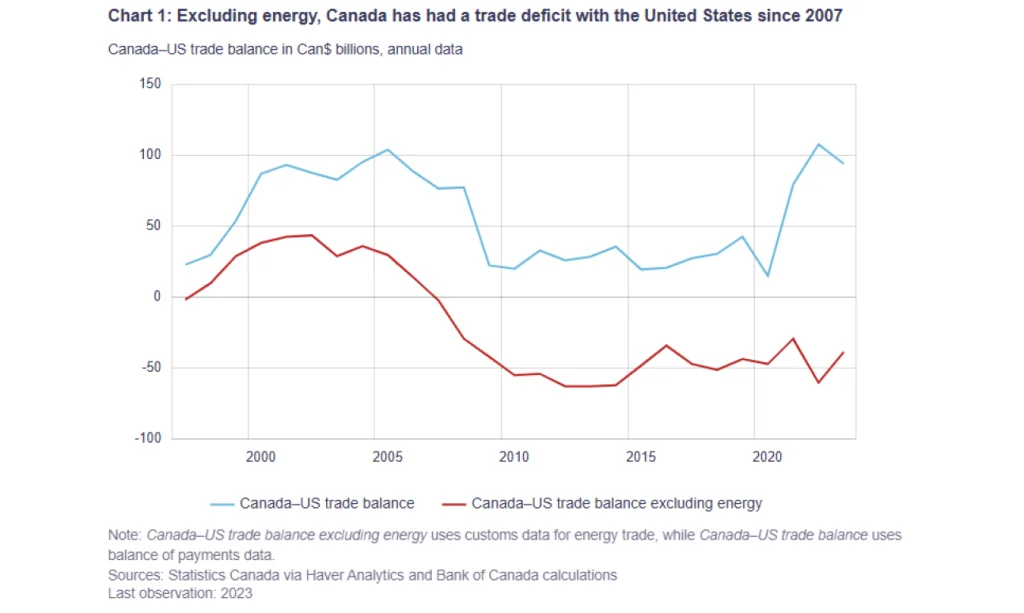
In 1965, Canada and the United States signed the Canada-U.S. Automotive Products Agreement, better known as the Automobile Agreement. Open trade in the automotive industry has enabled economies of scale and specialization. Productivity increased in both countries and the price of motor vehicles fell. The success of the Automotive Agreement has fueled more desire for open trade. The Canada-U.S. Free Trade Agreement signed in 1988 greatly broadened the economic benefits. For example, Canada's manufacturing productivity increased by about 14%. In 1994, trade relations were further expanded with the North American Free Trade Agreement, which included Mexico. In 2020, during Trump's first presidential term, the agreement was updated and renewed. The durability of this trade deal illustrates the benefits for all three countries. Over the past 60 years or so, our bilateral trade with the United States has increased. Today, about three-quarters of Canada's merchandise exports go to the United States. Canada is the United States’ No. 1 export destination—and the top export destination partner for 32 of the 50 states. Canada's largest export to the United States is energy. Canadian oil, natural gas, gasoline and electricity power the U.S. economy at prices no other country in the world can offer. If we exclude energy exports, the United States actually has a trade surplus with Canada (Chart 1). Open trade between Canada and the United States benefits both countries, increasing efficiency, stimulating investment, boosting productivity and raising living standards. A significant increase in tariffs would reverse all that.
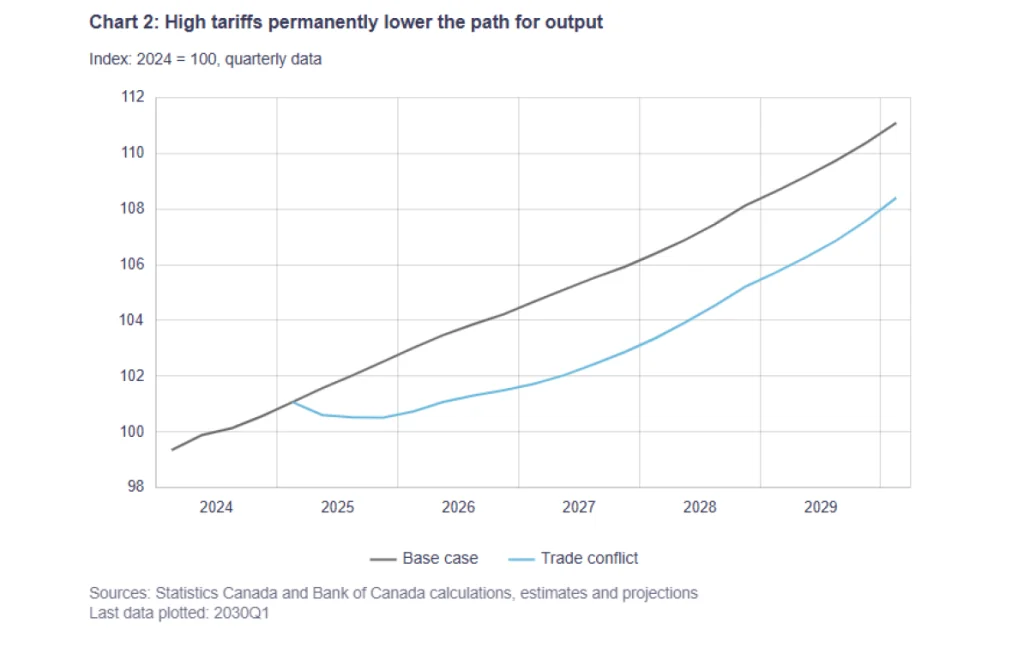
A prolonged trade conflict will have serious economic consequences. But it will be a very different shock than the COVID-19 shock. During the pandemic, we experienced a sharp economic recession, followed by a rapid recovery as the economy reopened. This time, if tariffs are long-term and widespread,There will be no rebound。We may eventually return to current growth rates, but with permanently lower levels of output. This isn’t just a shock – it’s a structural change. Exhibit 2 shows estimates of the long-term impact of higher tariffs. The gray line shows the bank forecast in our January MPR, which is our base case forecast without tariffs. Economic output has risen steadily. The blue line shows the expected impact of tariffs based on the executive order signed by President Trump on February 1, plus Canada’s retaliatory tariffs. The executive order calls for a 25% tariff on exports of non-energy goods and a 10% tariff on energy exports. Based on this scenario, economic output initially declines, then stabilizes and begins to grow again, but on a roughly 2.5% lower path.
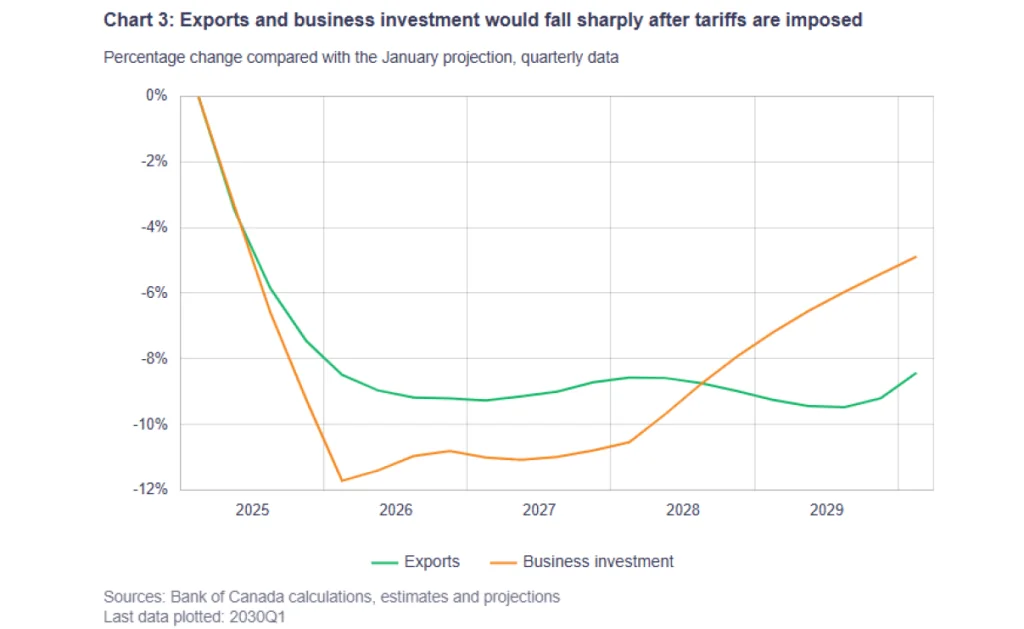
Tariffs hurt economic activity in the short term and push up inflation. The first thing we'll see is a significant decline in exports. As Canadian goods become more expensive, U.S. demand for those goods will decline. The lower Canadian dollar will provide some offset. In our scenario model based on the February 1 executive order, exports fell 8.5% in the year after the tariffs took effect (Exhibit 3).
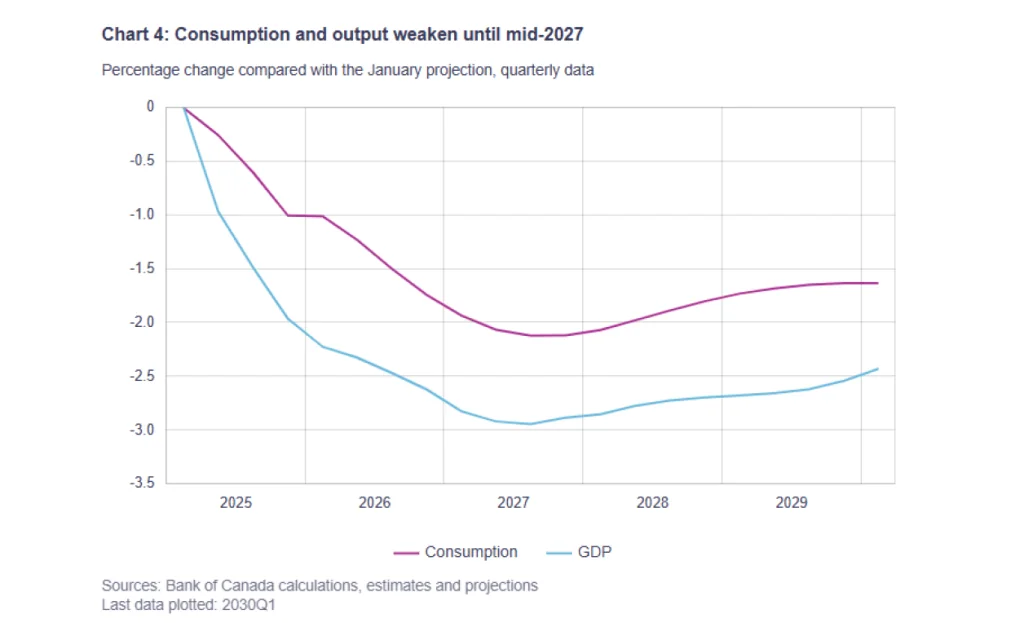
Canadian exporters responded by cutting production and laying off workers. With exports to the United States accounting for about a quarter of our national income, the impact will be felt across Canada. Lower export earnings will reduce household income. And retaliatory tariffs will raise prices for many consumer goods. As a result, consumer spending on everything from cars to entertainment and housing will slow. Under this scenario, consumption falls by more than 2% by mid-2027 (Chart 4).
Canadian businesses will also cut back on their investment spending as exports and consumer demand weaken. And higher costs and lower profit margins will further inhibit investment. Businesses will face higher import costs due to retaliatory tariffs on certain goods and a lower Canadian dollar — Canadian businesses buy about half of their machinery and equipment from the United States. Additionally, margins are being squeezed as higher costs from tariffs on imported consumer goods are gradually passed on to Canadian prices. A combination of falling sales, rising costs and falling profit margins has sharply lowered business investment. Overall, investment fell by nearly 12% by early 2026, one year after the tariffs were implemented (Exhibit 3). Finally, the trade conflict will drive up prices even as demand weakens. Retaliatory tariffs on U.S. exports to Canada would affect the Consumer Price Index (CPI). About 13% of Canada's CPI basket is made up of goods imported from the United States. A weaker Canadian dollar also increases the cost of all imported goods and services. Finally, integrated supply chains mean tariffs can add costs at multiple stages of the production process. In our tariff scenario, factors pushing up prices outweigh the downward pressure on prices from weaker demand, so inflation rises (Chart 5). In January, the bank forecast that inflation would remain close to its 2% target over the next two years. Tariffs will temporarily push inflation above 2%.
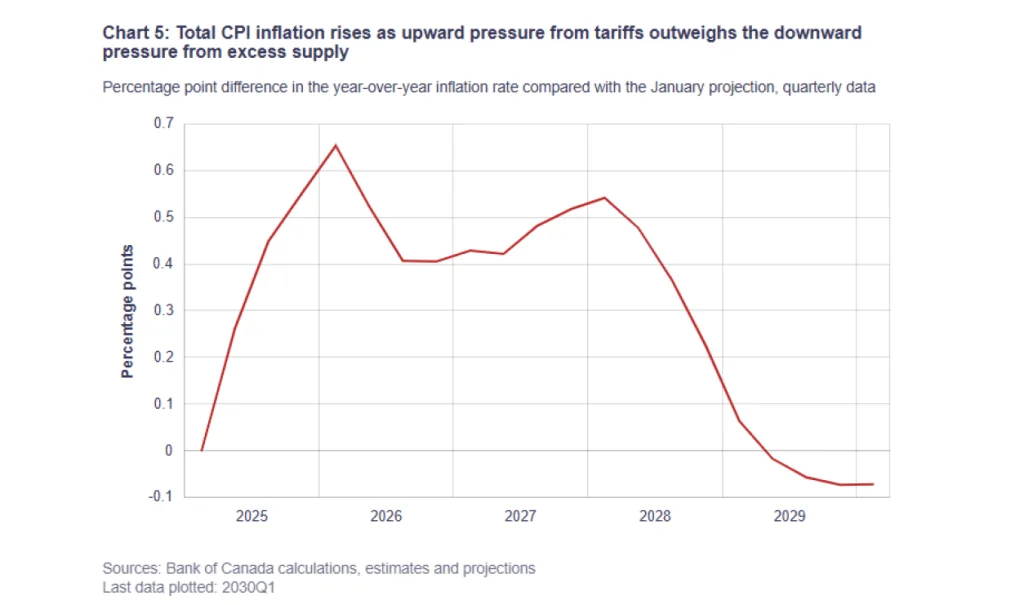
What can monetary policy do and cannot do? If the economy were on a lower growth path and there were upward pressures on inflation, what would be the response from monetary policy and the Bank of Canada? What the central bank can do is help the economy adjust. With inflation now back near the 2% target, we are better positioned to contribute to economic stability. However, since we only have one tool - our policy rate - we cannot deal with weaker output and rising inflation at the same time. When considering our monetary policy response, we need to carefully assess the downward pressure on inflation from a weakening economy and weigh this against the upward pressure on inflation from higher import prices and supply chain disruptions.Unlike the pandemic, there will be no economic rebound if tariffs persist.Long-term tariffs mean lower potential output because our economy operates less efficiently. Monetary policy cannot restore lost supply. At best, it could cushion the decline in demand. The sharp decline in exports and investment when tariffs are imposed, combined with weakening consumption, means that the initial fall in demand will exceed potential output, creating excess supply in the economy. As long as the inflationary effects of tariffs are not too large, monetary policy can help smooth the adjustment by supporting demand so that it does not weaken much more than supply. But how much support monetary policy can provide is limited by the need to control inflation. The initial impact of tariffs is a one-time increase in consumer price levels. Monetary policy cannot change this. What monetary policy can and must do is ensure that rising prices do not turn into persistent inflation. This means ensuring that households and businesses continue to expect inflation to be firmly anchored to the 2% target. In short, monetary policy needs to ensure that increases in inflation are temporary.
Inflation had remained low and stable in the 25 years before the pandemic. But the pandemic has tested this framework like never before. We face huge demand and supply shocks, deep recessions and rapid rebounds. As the economy reopened, inflation rose sharply, reaching 8%. Under the guidance of the framework, the central bank has significantly raised policy rates to reduce inflation. Since last summer, inflation has been close to 2% and we have lowered our policy rate to keep it there. In short, the framework endured – it proved its resilience. The success of the framework will be measured not only by whether inflation approaches 2%. Also included is how the frame performs in the face of impact, especially large impacts.
Conclusion
We've covered a lot and now it's time for me to wrap up. Canada's economic fundamentals are stronger. Inflation has returned to target, interest rates have fallen sharply and household spending has strengthened. But a new crisis is approaching. If U.S. tariffs are implemented as threatened, the economic impact will be severe. A prolonged trade conflict will significantly reduce exports and investment. It will lead to unemployment and rising inflation in the coming years and lower our living standards in the long term. The uncertainty alone has taken its toll.Central banks can do little to mitigate the damage caused by the trade war. Our role will be to balance the upside risks to inflation from higher costs with the downside risks from weaker demand. Our focus will be to help smooth the adjustment to a lower economic growth path while preventing price increases from turning into persistently high inflation.The inflation targeting framework has proven to be both flexible and durable. The five-year review is an opportunity to reflect on what is working well and what can be improved. The framework has proven itself time and time again, so the bar for change is high. But the world economy is changing. At the Bank of Canada, we are committed to ensuring that we are as prepared as possible for the changes that are coming. "
Henry Wang’s work diary February 21, 2025