
The hard days have just begun vs. The hard days are about to end. This is the topic of this month, July 2023, where people have the biggest disagreements about the future economic prospects and the current living conditions.
The view that the hard times have just begun is based on the fact that these people believed the central bank governor's statement that the current central bank interest rate of 5% will be maintained until 2025. Those who firmly believe that the hard times have just begun include families whose incomes are currently reduced and whose financial situation has not yet reached a safe state. Let me remind you that the current situation, the situation of each family can be said to be very different. Polls show that 40% of families welcome the current high interest rates and even think it is best to continue to increase interest rates, the higher the better; 30% of families think they can no longer bear it, and their debt will explode if interest rates increase, and their income will be lower if interest rates increase. Salespeople who make a living by trading, if their field is affected by high interest rates, are the most pessimistic at this moment. The views of this most pessimistic group of people are very narrow and biased. I would like to remind everyone to block out the noise made by these people.
During the epidemic, when interest rates were at their lowest, the central bank governor predicted and even promised that low interest rates would remain unchanged for two years. The statement at that time was exactly the same as the current high interest rate that would remain unchanged for 2 years. Subjectively, I do not believe in the predictions and promises of central bank governors at this moment. I have always believed in one thing: stay optimistic in the short term and pessimistic in the long term. There are solutions to short-term problems such as inflation, high interest rates, and excess demand; but there is no solution to long-term problems such as continuous money printing and currency depreciation. I don't think high interest rates of 5% can be maintained for 2 years, and only the most pessimistic at this moment would agree with the central banker. Today, Canada's Financial Post published an article signed by Ted Rechtshaffen, which shares my personal views. The title of the article is "If 2001 is any example, the Bank of Canada will likely cut interest rates significantly" and the subtitle is "Be prepared to see actions speak louder than words in the year ahead." The author, Ted Reitshafen. Big interest rate cuts ahead from the Bank of Canada if 2001 is any indication Ted Rechtshaffen: Get ready to see actions speak louder than words over the coming year Web link to the article:https://financialpost.com/news/economy/big-bank-of-canada-interest-rate-cuts-ahead. For your convenience, the full text of this article is translated as follows:
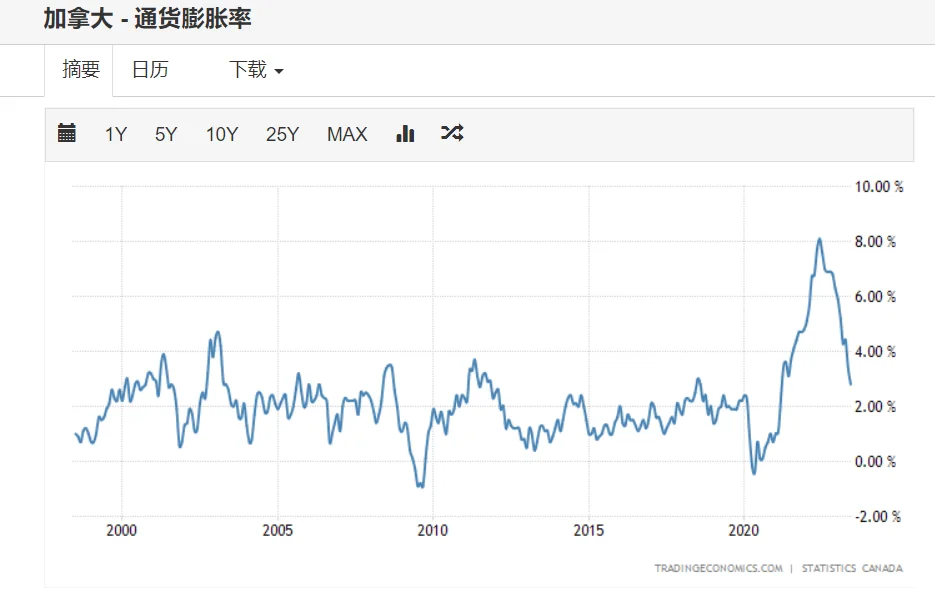
Now, the central bank predicts that the consumer price index (CPI) will rebound to two percentage points by mid-2025. If this two-year forecast has you worried that policymakers won't cut interest rates in the next two years, don't worry. It's surprising that they make such confident predictions for the next two years. Remember, just 18 months ago, overnight rates were still 0.25%. In terms of economic forecasts, two years is a very long time, so we should not make any assumptions based on the mid-2025 CPI forecast. To illustrate my point, let's take a closer look at the last time interest rates were this high, back in 2001. When 2000 turned into 2001, the Bank of Canada's interest rate was 6%. Now it is 5.25%. At that time, real gross domestic product (GDP) growth was 4.7% and employment increased by 2.6%. Rising energy prices have boosted exports. Employment and wage growth, coupled with tax cuts, have boosted consumer spending. In response to the overheating economy, the Bank of Canada began to raise interest rates in 1999, with the highest increase reaching 50 basis points in May 2000, reaching 6%.
However, not everything is smooth. The tech bubble burst in early 2000, and forecasts for late 2001 were not optimistic. Private sector forecasts show GDP growth is expected to decline from between 2% and 3%. Concerns include the effects of previous interest rate increases, higher energy prices and an erosion of overall confidence. As it turns out, Canada's GDP dropped from 5.18% in 2000 to 1.79% in 2001. The unemployment rate reached 6.83% in 2000 (much higher than it is now), but rose to 7.22% in 2001 and 7.66% in 2002. The Bank of Canada kept interest rates unchanged at 6% in the second half of 2000, but as economic conditions worsened, the central bank decided it was time to cut interest rates. Policymakers cut interest rates by 25 basis points in January 2001, and a year later they dropped to 2.25%, for a total of 375 basis points in one year. So, did the Bank of Canada predict these moves in May 2000? Not really. At the time, the central bank was clearly worried about higher inflation.
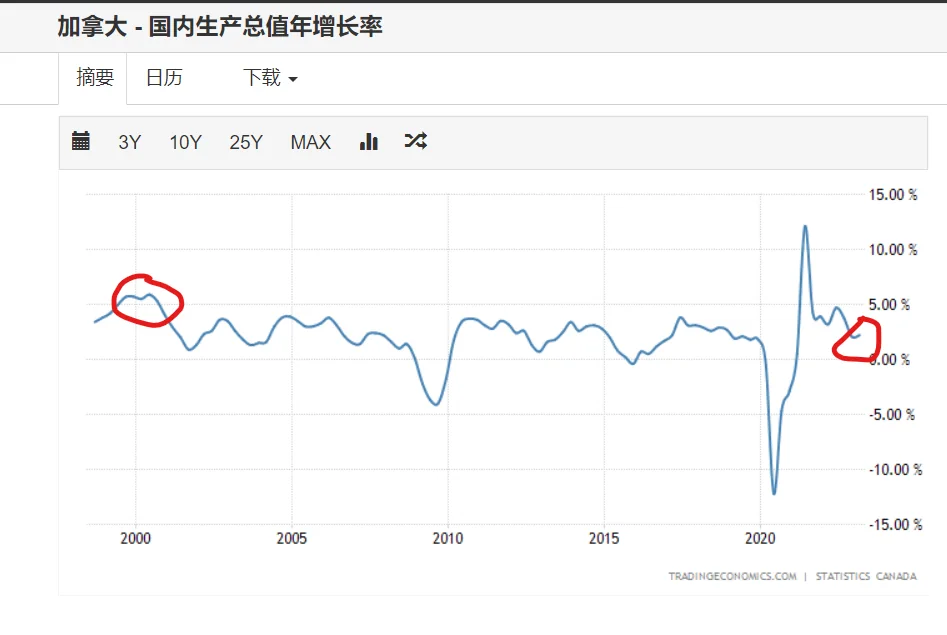
The Bank of Canada's monetary policy report in May 2000 stated: "...(we see) Canadian monetary policy may face several key uncertainties in the coming period. First, demand momentum from both international and domestic sources may continue to exceed expectations. Second, there may be a build-up of inflationary pressures in the United States, which may have consequences for Canada. Third, the ability of the Canadian economy to produce goods and services without increasing inflationary pressures may be greater than previously expected." This is not a negative comment on the Bank of Canada's May 2000 view, although it may illustrate why you might not want to make a two-year forecast of when CPI will return to 2%. The economic outlook was clearly slowing, but the situation became even worse when the completely unpredictable events of 9/11 occurred in the United States. This helped push the apparent slowdown in 2001 into an even worse state. Obviously, there are many differences between 2001 and today. The reasons that caused interest rates to rise in 1999 and 2000 are different from the reasons today. But some of the economic similarities make sense.
In January 1999, the monthly overall consumer price index (CPI) was only 0.66%. As the economy improved, the CPI rose to 2.63% by December 1999 and reached 3.2% in December 2000. At this time, the Bank of Canada raised interest rates to 6% to control inflation. Whatever the cause of the slowdown, the impact is significant. By November 2001, the CPI dropped to 0.62%. At this time, the central bank needed to take measures to stimulate the economy, so it quickly lowered interest rates, eventually stopping the decline in January 2002 and reducing interest rates to 2.25%. Does this have any implications for the Bank of Canada’s next interest rate decision? I think so. The most important thing to me is that things can change quickly. Eighteen months ago, Canadian interest rates were very low. Today, this is not the case. In late 2000, interest rates were 6%. By January 2002, it had dropped to 2.25%.
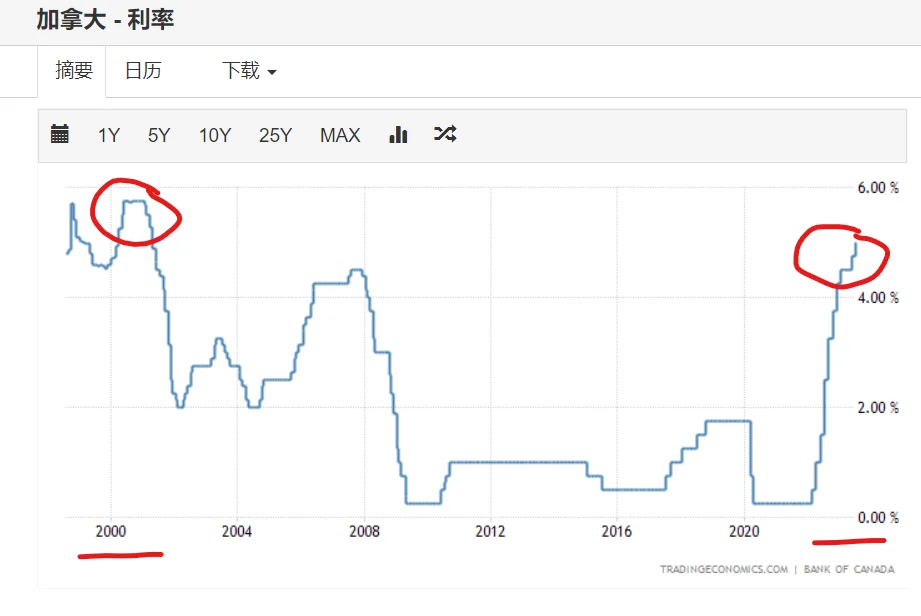
Over the past 30 years, the Bank of Canada has raised interest rates by 1.25 to 3.2 percentage points on six different occasions (prior to the current significant rate increase). Their common feature is that each interest rate increase was followed shortly by an interest rate decrease, ranging from 1.25 to 5.125 percentage points. As the band Blood, Sweat and Tears famously sang in 1968: "Everything goes to the extreme." In the year ahead, be prepared to see actions speak louder than words and rates will respond.