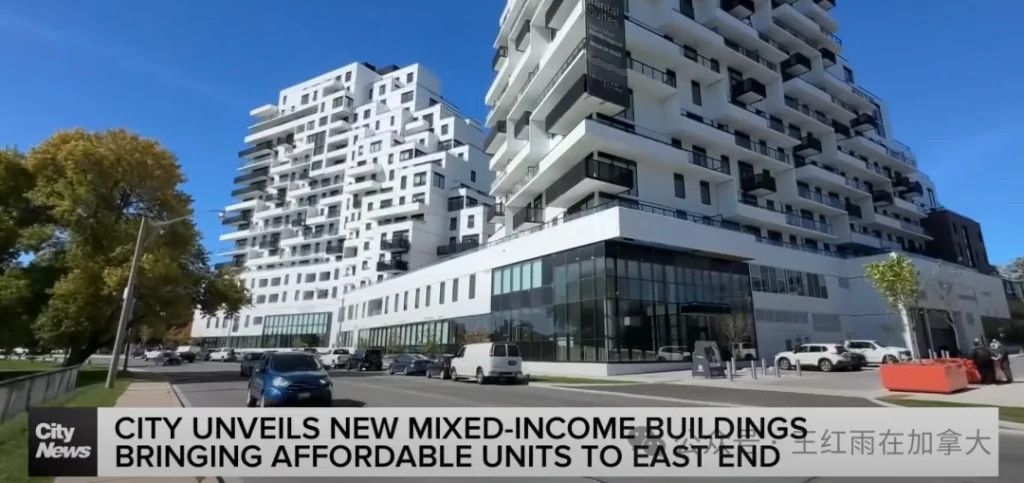
On October 1, the Toronto City Government issued an announcement that the Leslieville project in the Don Summerville community will be transformed into mixed income mixed-income Apartment project. Toronto Mayor Zhihui Zou hopes that these three towers near Coxwell will become a new standard for affordable housing in Toronto. “Every Torontonian deserves to live in a home that they’re proud of, and in a neighborhood where they can thrive, This is a model of what we can achieve,” Chow said in the release.
Currently, there is an oversupply of new condos in Toronto, the market is extremely depressed, and pre-sales of new homes have dropped by 90% compared to the average level of the past 10 years. Even so, there are still people who cannot afford to buy or even rent a house. The City of Toronto actively participates in the construction of low-rent housing, aiming to provide non-commercial housing. Keep more low-income families in urban areas. Most of the low-rent housing provided by the government is owned by Toronto Community Housing (TCHC). Remember the name TCHC, which will be mentioned many times below. The above-mentioned mixed-income housing project is to add commercial housing to the low-rent housing project, with the purpose of allowing low-income families and families who can afford housing to live in the same apartment project. Another low-rent housing policy in Toronto, the “inclusionary zoning” project, is to mix low-rent housing into luxury apartments. The purpose is also to allow high-income families and low-rent housing families to live in the same community. In short, it is the goal of the current Toronto city government to mix families with different incomes in the same community.
The biggest question real estate investors have about the development direction of Toronto's housing policy is: Will the government's vigorous promotion of low-rent housing projects affect the overall level of rents in Toronto? Does real estate investment still have a future in Toronto? These questions need to be analyzed from the specific content of mixed-income projects, inclusive zoning systems, low-rent housing systems, and comparisons between cities that have implemented the same policies.
01 An introduction to the City of Toronto's first mixed-income project
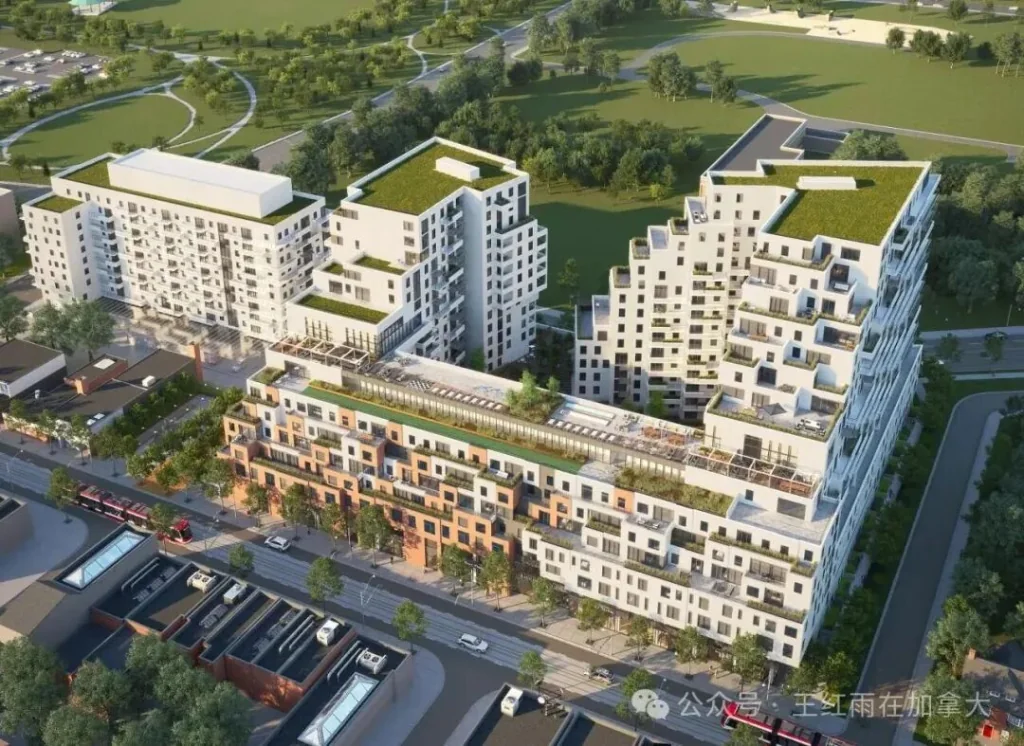
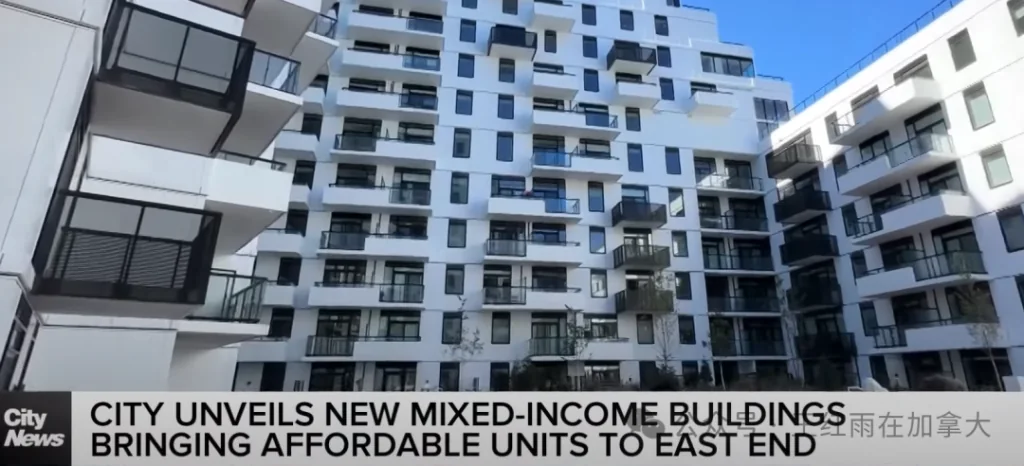
Don Summerville This is a new mixed-income complex located at 1070 Eastern Avenue. The 770-unit project consists of three new buildings on approximately 3.3 acres, which was previously home to two Toronto Community Housing Corporation TCHC buildings with 60 units each. The new buildings significantly increase density in the area, which is currently dominated by industrial warehouses, large parks and single-family homes. The project was developed by TCHC and constructed by Context Development and RioCan.
The planned Don Summerville complex offers a variety of residential units. Among them:
Geared-to-income rentals: 120 units.
Affordable rentals: 100 units.
Market-rate rentals: 183 units.
Available condo units (Condo units): 367 units, including 50 units reserved exclusively for women and their families, and several units reserved for artists.
Unit types range from one to three bedrooms.
Don Summerville is part of a five-year revitalization plan between the city and TCHC. Mayor Zhihui Zou emphasized that Don Summerville is just one of many development projects that will help the City of Toronto achieve its goal of creating 65,000 units of rent-controlled and affordable housing by 2030.
Background Information 1: Identity, scale and history of TCHC TCHC is wholly owned by the City of Toronto and is Canada's largest social housing provider. TCHC represents C$9 billion in public assets and operates on a not-for-profit basis. TCHC was established on January 1, 2002. Currently, TCHC provides housing for more than 41,000 low- and middle-income families. Residents are located in 88 of Toronto's 158 communities. It has 93,000 residents, of which 35% are children and teenagers, 44% are adults, and 22% are seniors over 59 years old. 25% of families are single-parent families. Fifty-four percent of households reported having at least one member with a disability. 55% of TCHC's operating funds come from rent paid by residents, and 39% come from subsidies from the City of Toronto, that is, taxpayer money. The remaining 6% of operating funds come from commercial space leasing, parking fees, laundry fees, cable TV fees and investment income.
Background information two: What is rent-to-income ( RGI ) HousingRent-Geared-to-Income Housing ? Adjusted family net income (AFNI) does not exceed 80% of the Toronto area median income, for example, the upper limit is $105,000 for a family of four in 2025. The monthly rent is 30% of the family's AFNI, for example, the monthly rent for a family with a monthly income of $3,000 is $900. Applicants are required to submit the Canada Revenue Agency’s annual Notice of Assessment form NOA. Applicants need to strictly meet identity, income and dynamic review requirements. The application process is complicated but the subsidies are the largest. Families whose income exceeds the standard must move out within 6 months. The RGI housing construction target approved by the city council is 6,500 units. Since RGI housing requires long-term operations and has high funding thresholds, the actual completion progress is limited. As of 2024, approximately 10-15% of the target progress has been completed, or approximately 650-975 units.
Background information three: What are Affordable Rental Homes? Household income must not exceed housing income limits (HILs). For example, based on 2025 standards, the annual income limit for a family of four is approximately $112,000 Canadian dollars, with the specific value adjusted for family size. The rent does not exceed 30% of the tenant’s pre-tax monthly income. For example, the one-bedroom rent cap in 2025 is $1,404 Canadian dollars, which corresponds to a monthly household income of $4,680. The rent does not exceed 100% of the average rent in Toronto's housing market of the same type. For example, the upper rent limit for a bachelor's studio apartment is $1,109, which is lower than the market average of $1,900. In short, tenants must meet dual income and rent standards. Disabled persons, single-parent families, and those suffering from domestic violence may receive accelerated allocations or additional quotas. There are currently 104,000 families waiting for low-rent housing in Toronto. Without special bonus points such as sleeping on the streets and terminally ill patients, the waiting time for ordinary low-income applicants is 7 to 10 years. The low-rent housing project is a typical project where supply creates demand. It is consistent with Say's Law. The more vigorously the government builds low-rent housing, the number of applicants will increase at a faster rate, and the waiting queue will only get longer and longer, and will never shorten. to 2025 For example, in the third quarter of this year, the city of Toronto resettled 1,360 During the same period, applications for households increased by 11,169 portion. The greater the publicity of low-rent housing projects, the faster the number of applicants will increase, and the city's housing crisis will become more and more serious, and the city government will be able to increase land taxes with more justification and harm the interests of homeowners.
Based on the analysis of the above project information, the general idea of constructing mixed-income housing projects in Toronto is:
Projects that were originally used to build only low-rent housing were proactively converted into mixed-income housing. 34% of the units were still used for low-rent and low-price sales, and 66% were rented and sold at market prices. Among them, deeply subsidized projects and income-linked rental projects accounted for 15.6%. The so-called deep subsidy means that the current market rent of a single apartment (bachelor) is 1,900 dollars, and the government needs to subsidize 1,000 dollars, renting it to qualified tenants at a price of 900 dollars, with a subsidy ratio of 53%; low-rent housing projects account for 13%, and properties with a market price of 1,900 dollars are rented to qualified tenants at a price of 1,100 dollars, with a subsidy ratio of 42%.
The idea of mixed-income housing is not original to Toronto. One of the more high-profile such projects in recent years is the mixed-income housing project in New Orleans. After Hurricane Katrina in 2005, the New Orleans city government took advantage of this God-given opportunity to take back all the low-rent housing and rebuild it into mixed-income housing. This eliminated the urban problems of concentrated living in the city and high crime rates, and turned New Orleans into a livable city in one fell swoop. Compared with pure low-rent housing where the poor gather, mixed-income housing is a relatively progressive approach. Success will depend on how many caring, high-income families want to live in such properties. Toronto's vigorous push for mixed-income housing policies is very similar to New Orleans's approach, but this is not to follow a leading example, but because of a compromise after the failure of another Toronto attempt. Another attempt, also an effort to mix households with different incomes, is the inclusionary zoning program.
02 Mixed-Income Sister Project: An Introduction to the “Inclusionary Zoning Project”
Starting in 2022, I have repeatedly reminded off-the-plan buyers through public account articles and video podcasts that Toronto will promote inclusive zoning policies, and off-the-plan buyers may bear the cost of buying a house that they cannot afford at all. In September 2021, the Toronto city government began to brew and implement an inclusive zoning policy, requiring luxury apartment developers to provide low-rent housing to the city government in projects. Of course, the costs will be shared by apartment buyers. It plans to require the proportion of affordable housing in new developments to be 5%-10% from 2022, and plans to gradually increase it to 8%-22% by 2030. If a luxury apartment building has 600 units, and 10% is used as low-rent housing, that is 60 units. The cost of these low-rent housing is shared by 540 luxury apartment buyers. At that time, some buyers of pre-construction properties paid as high as 1,600 Canadian dollars per square foot. The reason was not only the increase in construction costs, but also the cost of low-rent housing.
Since developers have to bear the cost of low-rent housing, the selling prices of developers remain high. When the market is booming, buyers may muddle through and buy high-priced pre-construction properties, but when the market is down, developers find it difficult to sell pre-construction properties. The City of Toronto's original plan to pass on the cost of low-rent housing by controlling the development of luxury apartments has not been feasible in the past two years. In addition, the ambitions of the Toronto city government are too great. The idea of increasing the proportion of low-rent housing to 22% by 2030 has scared away all developers. A 600-unit apartment building provides 132 low-rent housing. It is impossible for off-the-plan buyers not to feel that they are paying for low-rent housing.
The Ontario government took action to curb the city's ambitions in August this year, stipulating that the proportion of low-rent housing in Toronto's inclusive housing should not exceed 5%. From 2025, the proportion of affordable housing will be gradually increased from 0.5% to 1.5%, with the ultimate goal being 5% of the development volume. Ontario has approved the construction of high-rise residential buildings in 120 important transportation locations, and designated 89 of them as inclusive zoning addresses. As long as apartments are built in these 89 locations, developers need to provide low-rent housing, otherwise they will not be able to obtain building permits. Due to the strong intervention of the Ontario government, the Toronto city government's ambition to build low-rent housing was forced to change course, and the protagonist of this article came into being, the mixed-income project.
It has been decided that in the city of Toronto, new high-rise residential buildings in the future will definitely be developed in the form of mixed housing, either mixed-income projects, with 34% of the housing being subsidized housing, or inclusive zoning housing, with the proportion of low-rent housing being 5%. Citizens who want to choose a neighborhood to live in need to find out for themselves whether the property they are purchasing belongs to the two types of mixed-income projects mentioned above. Whether it is mixed-income housing or inclusive zoning housing, the names are very nice and noble, but buyers need to know the specific meaning.
03 Will building so many low-rent houses and renting out apartments affect rents?
Many real estate investors have doubts about whether the government's decision to build low-rent housing will drive down rents. Because Toronto has begun to vigorously develop low-rent housing construction in the past four years, the impact will not be seen until many years later. We might as well analyze the impact of low-rent housing on market rents in cities with relatively developed low-rent housing, and deduce the possible development prospects of rents in Toronto.
There are 2.56 million housing units in Hong Kong, of which 1.36 million are private housing, accounting for 53%. The proportion of housing provided by the government is as high as 47%. The current market rent of a studio apartment (bachelor) in Hong Kong is HK$8,000, while the rent of low-rent housing provided by the government is only HK$1,500. The rent of low-rent housing is only 20% of the market rent, and the government subsidy is as high as 80%. Currently, there are 1.4 million housing units in Toronto, of which 88,000 are government-owned properties. Social housing accounts for 6%, which is far lower than Hong Kong’s 47%. At the same time, the most in-depth subsidy ratio of the Toronto city government is only 53%, which is far lower than Hong Kong’s 80%. In terms of the proportion of low-rent housing and the intensity of government subsidies, Toronto is far lower than Hong Kong. In Hong Kong, despite the high proportion of social housing, the private real estate market is still active, and government low-rent housing has not affected market housing prices and rents. Private property ownership remains the strongest moat for the wealthy class . Compared with the proportion of social housing in Toronto, which is only 8%, the proportion of privately owned properties is absolutely dominant. Therefore, Toronto real estate investors do not need to pay too much attention to the impact of the government's construction of low-rent housing on housing prices and rents.
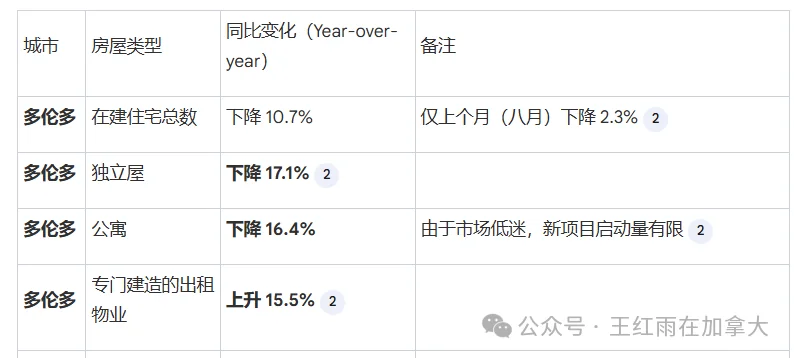
The Canadian federal and provincial governments, as well as municipal governments, are making every effort to promote the construction of rental apartments (Purpose-Built Rentals PBR) and have made great progress in many provinces. However, Ontario, especially the city of Toronto, has achieved little success. The number of housing units under construction in Toronto in 2025 will decrease by 10.7% compared with the same period last year, with the number of low-rise residential projects under construction falling by 17.4% and the number of high-rise apartment projects under construction falling by 16.4%. The number of PBR projects under construction increased by 15.5%. Obviously, in Toronto, the increased supply of PBR projects cannot offset the decrease in the supply of other types of real estate. In Toronto, year-to-date starts total 2,176 units, a 28-year low. The total number of apartments under construction now stands at 59,204, the lowest level since the fourth quarter of 2017 and down 43% from the all-time high of 104,617 units set in the third quarter of 2022. Currently, the number of cancellations of condominium projects in Toronto is surging. In the third quarter of 2025, 10 projects were canceled, involving a total of 2,499 units. Since the beginning of this year, a total of 18 projects have been canceled, totaling 4,040 units. This number has surpassed the previous all-time high: 15 projects involving 3,598 units were canceled in 2018. A total of 32 projects and 6,981 units have been canceled in the GTHA region since the beginning of 2024. In addition, there are 20 projects with a total of 4,187 units that are currently on sale or in receivership, with high likelihood of cancellation in the short term. No matter how hard the Toronto city government and the Ontario government try, the number of new construction starts has dropped off a cliff, and the number of units under construction is decreasing day by day. All types of new homes will see a sharp decline within 2-3 years. Real estate investors must hold on to the properties they own and survive the short period of oversupply. Compensatory increases in housing prices and rents are bound to come.
Conclusion
Jane Jacobs proposed in "The Death and Life of Great American Cities" that rationally planned cities are dead cities, while dynamic cities grow spontaneously and emergently. Lewis Mumford said that cities are containers of culture. Cities have enough energy and space to accommodate residents of all incomes and cultural backgrounds, regardless of whether the government makes deliberate efforts to integrate. Just as we don’t trust the City of Toronto, the City of Toronto doesn’t trust us ordinary people to be loving and courageous enough to embrace other residents of different races and backgrounds. The deliberate integration carried out by the Toronto city government is not only artificially rational planning, but also destroys mutual trust between people and hinders the development of urban construction. Hayek said that the road to hell is paved with good intentions. With the good intentions of the City of Toronto, I don’t know what kind of housing road will eventually be paved.
Over the years, thanks to the efforts of many developers, many dilapidated neighborhoods in Toronto have been revitalized with the birth of new buildings. More middle- and high-income families have moved back to live in the city, thus increasing the tax revenue of Toronto, restoring the vitality of the city, and reducing poverty and crime. This process we call gentrification gentrification . The current mayor of Toronto is doing everything he can to use taxpayers' money to reverse gentrification and try his best to keep more low-income families in the city center. After an inclusionary zoning plan was thwarted by the provincial government, a mixed-income housing project was launched. The integration between people cannot be determined according to the planner's design, but is determined by values, income level, and even wealth level. In Toronto, citizens are choosing their neighbors and the mayor is building a utopia. In the long run, cities around Toronto will become more livable.
Real estate investors are mostly long-termists who have gone through ups and downs and still stick to their values. I believe that with the patience and persistence of real estate investors, we will be able to go further than the interventionist policies of the Toronto City Government. New home construction has hit rock bottom, and the stagnation on the supply side is accumulating energy for rising house prices and rebounding rents of existing properties. It is only a matter of time before it explodes.
Henry Wang in Toronto on October 21, 2025