If housing affordability improves, will people be more willing to buy a home? The answer is no. Yes, you read that right, after affordability improves, people are even less willing to buy a house. This is what is happening in Toronto. Affordability is mainly determined by two indicators: one is housing prices, and the other is interest rates. The central bank interest rate was 4.75% in June last year and dropped to 2.75% in June this year; during the same period, Toronto house prices dropped from 1.164 million Canadian dollars to 1.101 million Canadian dollars. Interest rates and house prices have fallen, but has transaction volume increased? No, the transaction volume in June last year was 6,397 units, and the transaction volume in June this year was 6,243 units. Therefore,When housing affordability improves, people are less willing to buy a home.Data from the past dozen years shows that people’s enthusiasm for buying a home usually increases during periods when affordability becomes worse. On the contrary, during a period when housing affordability is gradually improving, people's willingness to buy is very low.
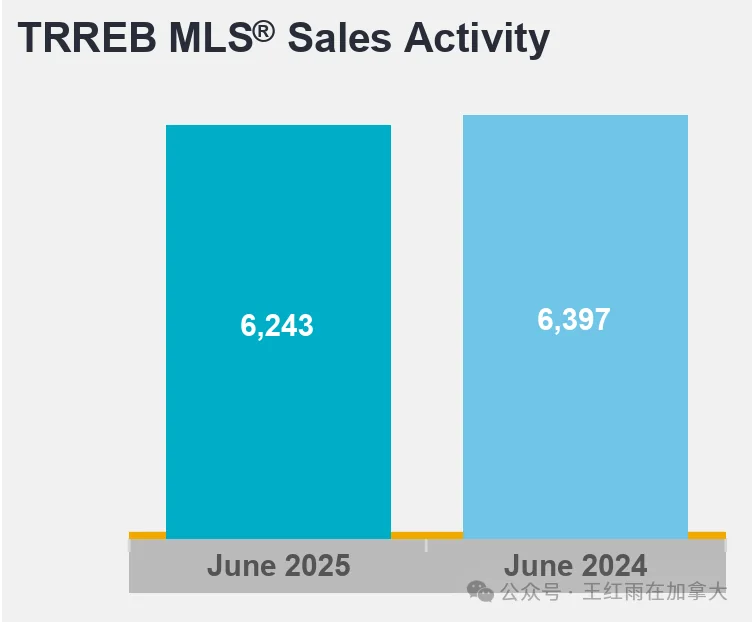
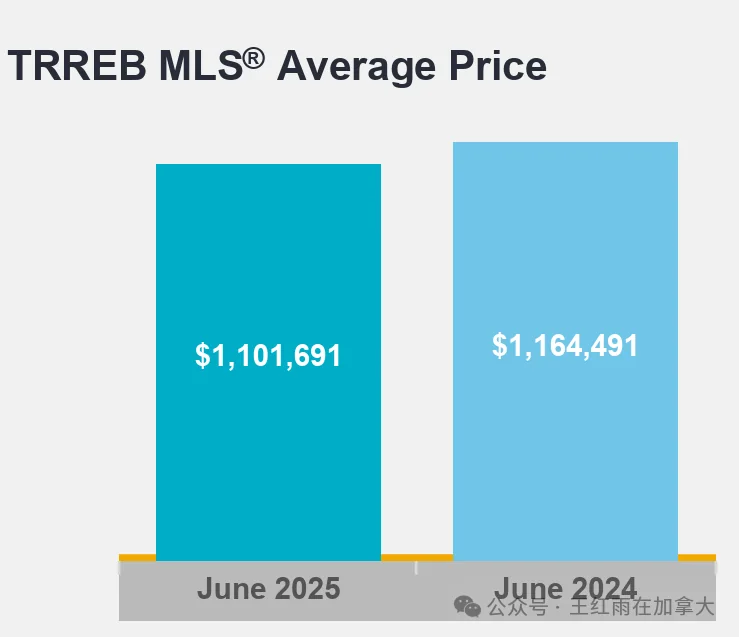
Every time there is an election, whether it is federal or provincial, people will discuss the housing issue heatedly. The housing crisis has been discussed for many years, and the media, academics, politicians, and opinion leaders have continuously offered their opinions and suggestions, mainly discussing how to improve housing affordability. But what we have seen firsthand is that when affordability really improves, people are reluctant to buy a house. Buyers’ response to improved affordability is like a love affair with a dragon. Don’t believe the conclusion of the consumer survey report: I will buy a house as low as the interest rate drops; I will buy a house as low as the house price drops. Ye Gongs don’t really like dragons, and the reason they don’t buy a house is not that it’s too expensive.When people rush to buy a home, they have only one motive: fear of missing out.FOMO。If there are a lot of houses on the market and you are spoiled for choice, if you don’t buy it and there are more choices, will you still buy it? Only when housing is scarce and housing prices are expected to rise are strong, buyers will panic and enter the market, even at the expense of overdrafting their purchasing power. Affordability, therefore, is not the root cause of the housing crisis. Without over-analyzing or coming up with options to improve affordability, simply having fewer homes on the market automatically makes housing more affordable.
"You mean, my entire fallacy is wrong." Please find a reason to refute me.
01Toronto CMA) Market Overview
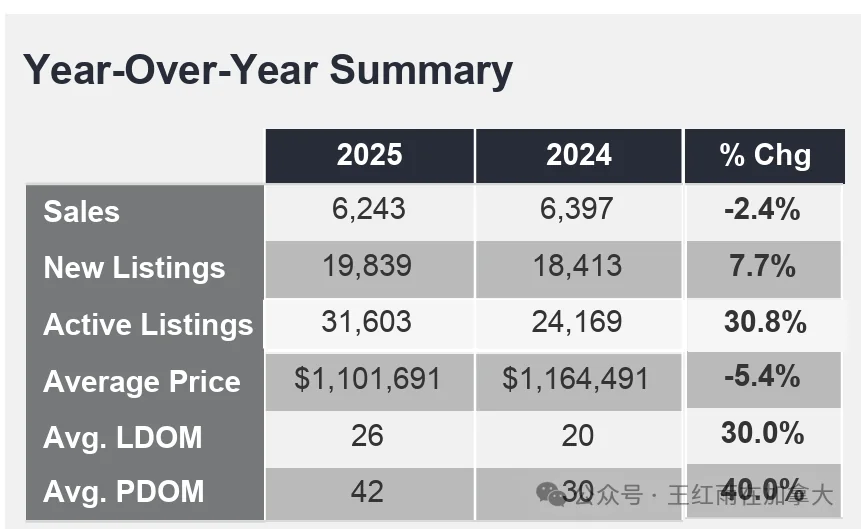
In June 2025, the residential market in the Toronto metropolitan area showed some signs of improvement, but the overall recovery still faces significant challenges, mainly affected by the deterioration of the labor market and historically low sales volumes.
Home Sales:
6Monthly home sales ratio 5Increased 8.1% month-on-month. It was the third consecutive month of improvement and the first increase in two and a half years.Sales remain at historically very low levels. It is 31% below the average since 2008. Compared to June 2024, home sales increased by 0.5%. Cumulative home sales in the first half of 2025 fell 16.1% compared with the same period in 2024, reaching the lowest level in the same period since 1998.
Supply Side:
New listings, 6Month to month ratio 5fell 4.7% in the month. Active listings ratio 5Month-on-month decrease of 2.2%, which is the second consecutive decline.However, active listings remain at historically extremely high levels. Compared with June 2024, active listings jumped 33.8% year over year, reaching an all-time high.
House Price Index:
It was down 0.8% from May. Compared with the same period last year, house prices fell by 6.7%.
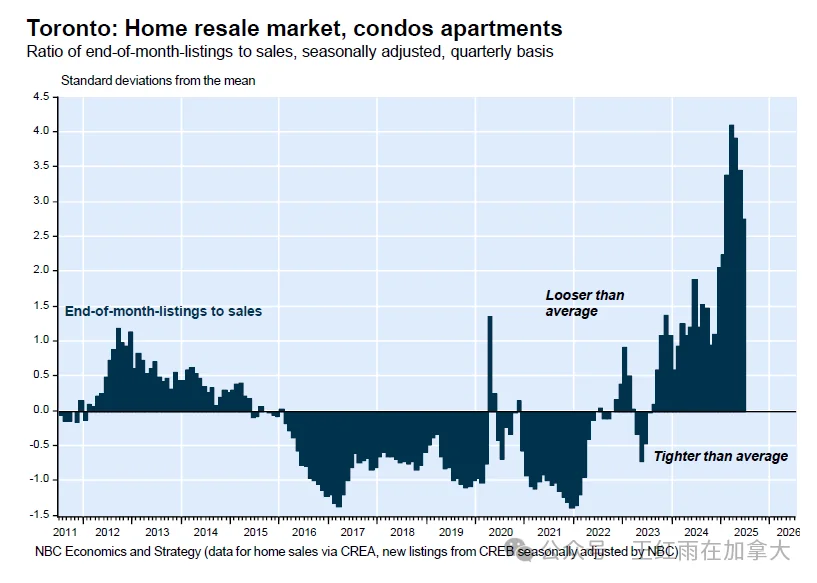
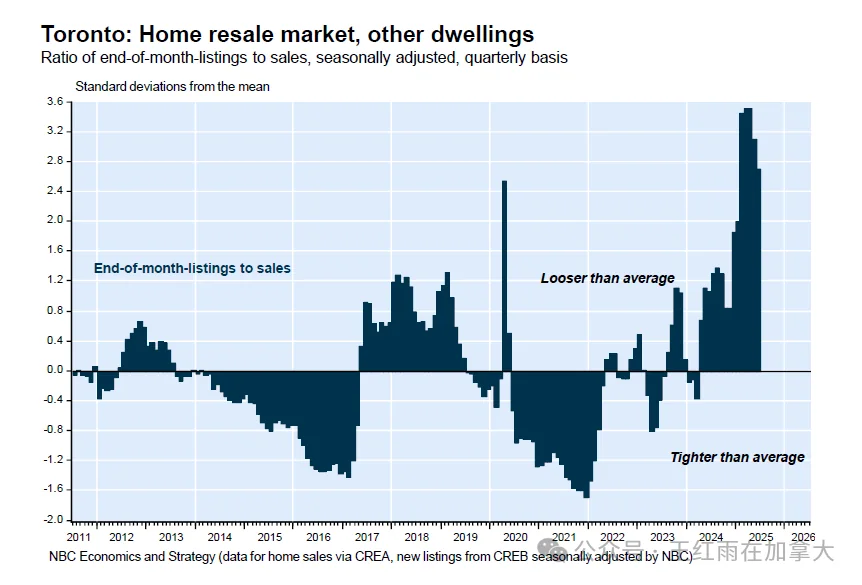
To sum up,The improvement in Toronto's real estate market is due to a decrease in the number of new listings and a gradual decline in inventory.Figures 1 and 2 respectively show the ratio of CONDO and non-CONDO property listings to sales. Since reaching the peak in March this year, it has formed a downward trend month by month. If this trend can be maintained and sellers continue to decrease, the Toronto real estate market will gradually return to balance and transaction volume will gradually increase.
02Toronto Real Estate Market Forecast
CMHC released its real estate market forecasts on July 24, adjusted based on conditions in the first half of the year. Among them, regarding the Toronto market, the forecast data are as follows: data from 2023 to 2027, of which 2025 to 2027 is forecast (F) data, and two scenario forecasts of low (Low) and high (High) are provided.
Second-hand housing market sales volume:
2023: 66,311 units.
2024: 67,985 units.
2025 (forecast): Expected to be between 56,000 and 64,000 units.
2026 (forecast): Expected to be between 67,300 and 82,700 units.
2027 (forecast): Expected to be between 69,000 and 91,000 units.
Second-hand housing market MLS®Average price:
2023: CAD 1,127,426.
2024: CAD 1,118,137.
2025 (forecast): Expected to be between CAD 1,037,000 and CAD 1,103,000.
2026 (forecast): Expected to be between CAD 1,032,000 and CAD 1,168,000.
2027 (forecast): Expected to be between CAD 1,072,000 and CAD 1,288,000.
For more specific data, see Figure 3
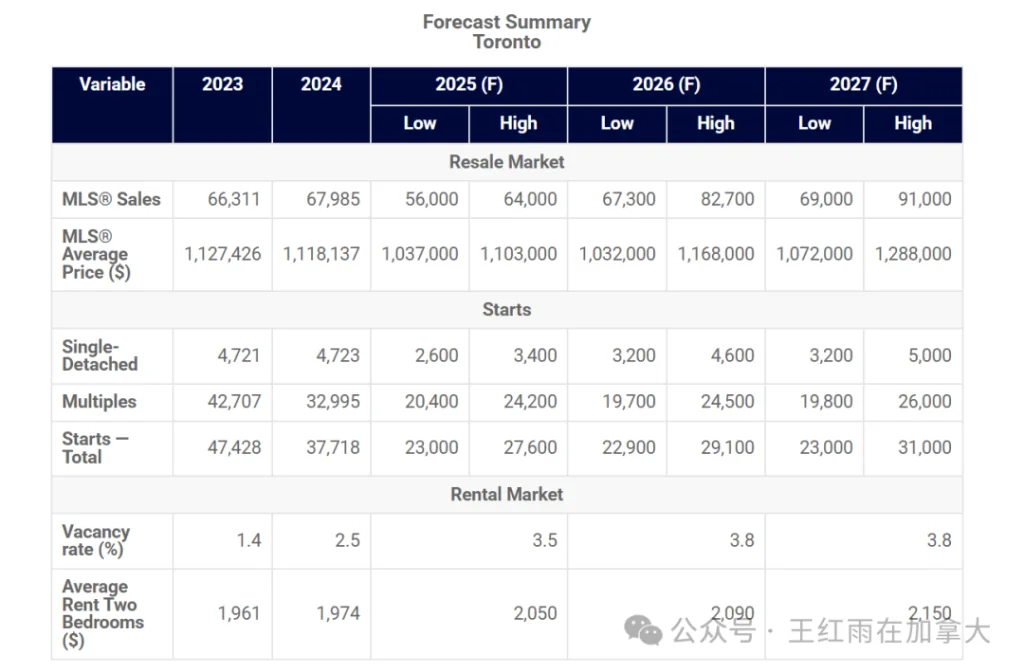
Given that in the first half of 2025, Toronto's cumulative housing sales dropped by 16.1% compared to the same period in 2024, CMHC's latest forecast data shows that Toronto's transaction volume in 2025 will drop between 17.6% and 5.8% compared with last year, indicating that CMHC believes that a rebound in transaction volume in the second half of 2025 is a high probability event. Of course, it depends on whether the number of listings can maintain the current downward trend. Old people who are selling their houses, it’s up to you. Isn’t it better to take it down and list it, and then sell it after the market returns to balance?
03Is my entire fallacy wrong?
After reading this, if you haven’t found the basis to refute my above fallacy, then I will continue to explain why improving the affordability of buying a house cannot encourage people to buy a house.
There is a weird Canadian scholar, Marshall McLuhan, who invented the term "global village" in 1964. Due to his advanced views and his language style that resembled a mantra, he could not be understood by his contemporaries. However, Hollywood director Woody Allen liked him very much, so he arranged for McLuhan to appear in a movie he directed. There were two lines in total. The second sentence was: "You mean, my entire fallacy is wrong? You mean, my entire fallacy is wrong. "McLuhan's" famous mantras include: "The medium is the message", "We shape the tools, and then the tools shape us", "In the electronic age, people will return to tribes", etc. McLuhan was accused by many of his contemporaries as a liar and a madman. But his book "Understanding Media" is now a must-read for many media majors. Some advanced ideas can only be understood by later generations, and advanced thinkers can only be accepted by a small group of contemporaries. I hope that my understanding of housing affordability can also be understood by a small number of readers.
Buyers are usually divided into home buyers and investment property buyers. If it is the first time for a home buyer to buy a home, they will regard buying a house as a major life event. Therefore, even if they can afford it, they should look around and see what other people are doing. It is best if there are others who are actively buying a house, so that they can feel psychologically at ease. So first home buyers are not the icebreakers in the buyer’s market, but followers. It is usually investors rather than downsizing buyers who are eyeing properties in the same price range as first home buyers. Today, most of Toronto’s real estate investors are seriously injured and need some time to recover. Therefore, the market for first-time homebuyers and investors lacks icebreakers, so the number of listings is piling up. Those who want to change their homes may need to sell their existing home before they can change their home. However, in a buyer's market, they need to sell first and then buy. It is difficult to sell, so they are stuck in the moment.For buyers, affordability is not the first motivation for buying a home.Only if you wait until you don't buy a house will the price increase, and when there are fewer houses available as you wait, will you end up buying a house. To sum it up in one sentence: when you wait for FOMO, when do you buy? The solution is actually very simple. Sellers don’t need to lower the price, they just need to take the property off the market.
When home prices fall or stagnate, sellers of existing homes certainly don’t cheer and say, wow, affordability has improved, great, let’s sell. Instead, the reason sellers are motivated to sell their home is likely because of nervousness and anxiety.Second-hand home sellers care least about housing affordability.
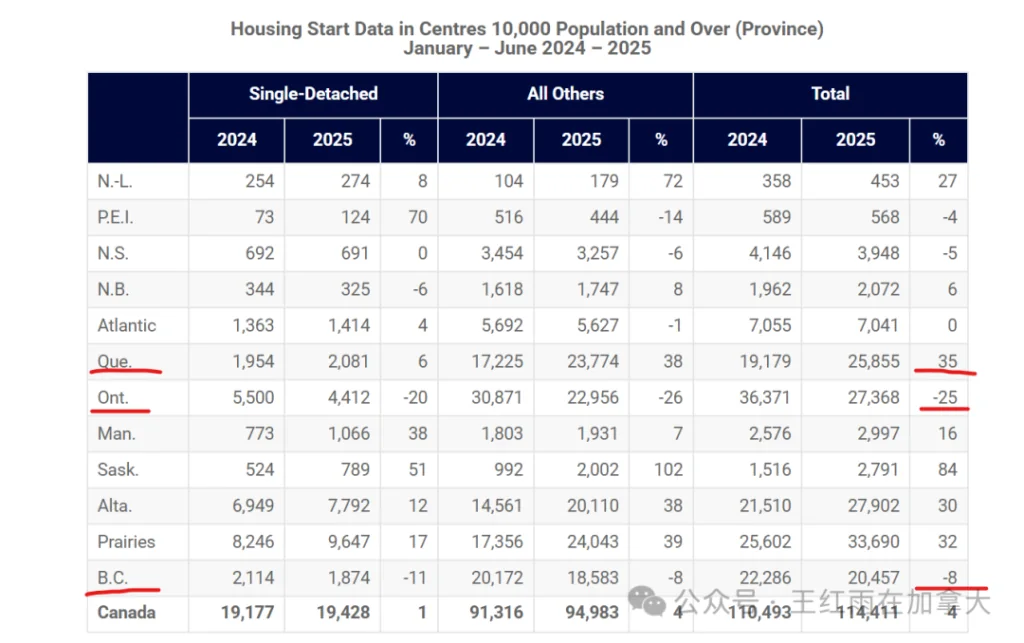
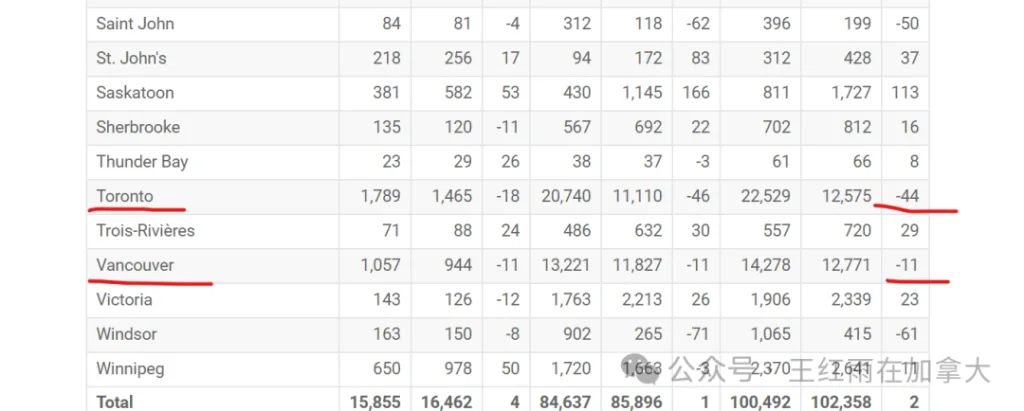
From a developer's perspective, no developer invests in building housing with the goal of improving housing affordability. If housing prices stagnate and investors stay away from the off-the-plan market, developers will not actively invest in building housing in order to improve housing or rental affordability, because the more built, the lower housing prices, and the more built, the lower the rents. The homebuilding industry is not a supply-maximizing business, but a profit-maximizing business. When housing prices stop rising or fall, and profit margins shrink, they cancel projects. It's the same in any country, developers never cared about housing or rental affordability, in order for developers to start construction, they need to make profits. Ontario, which is most in need of new housing, especially Toronto, is seeing a decrease in new housing starts, and the rate of decrease is leading the country. The June new housing starts report showed that new housing starts nationwide increased by 3.6%, while Ontario fell by 25%, with Toronto's new housing starts falling by 44%. See Figures 4 and 5.
Those most concerned about housing affordability are the media, academics, politicians and opinion leaders. They are the most conscientious people who speak out for young people. The people who responded to them were people who wanted to be members of parliament, or people who wanted to be prime minister.The government does not operate like an ordinary business, whose main motivation is to win elections and respond to public outrage over high housing prices and high rents.In terms of housing affordability, the current Canadian government has used a method of "creating alternative facts" to address the calls of conscience groups, that is, artificially distorting housing affordability into the scarcity of rental properties, so the government plans to fund the construction of apartments specifically for rental. I have never seen a housing affordability analysis report that concluded that Canada needs to build more rental apartments. The Canadian government does not care about the facts studied by conscientious groups and what conclusions they draw. The government finds another way to create alternative facts, avoids the issue of affordability, and resolutely spends great efforts to solve the rental problem.The Liberal government is not concerned about the affordability of buying a house, and by "affordability" they mean renting.
The government strongly supports the construction of rental apartments. Will this affect rents? Many people were horrified when they saw the government's plan to build 500,000 new homes every year. In Canadian history, during the peak housing construction period in the 1970s, a maximum of 275,000 new homes were built in one year. This record has not yet been broken. It is worth mentioning that the magical city of Toronto is completely voting with its feet on the Canadian federal government’s plan to solve housing affordability. It is going in the opposite direction. Veterans who invest in real estate in Toronto can rest assured.
04 Toronto market unmoved by rental apartment policy
In its revised real estate market forecast report on July 24, CMHC made the following predictions about the number of new housing starts in Toronto:
New housing construction starts:
2023: 47,428 units.
2024: 37,718 units.
2025 (forecast): expected to be between 23,000 and 27,600 units
2026 (forecast): expected to be between 22,900 and 29,100 units
2027 (forecast): expected to be between 23,000 and 31,000 units
On July 16, 2025, the Canada Mortgage and Housing Corporation CMHC released the June housing starts report. Data show that housing starts nationwide increased in the past six months, reaching an annualized start volume of 253,081 units, an increase of 3.6%. In central areas with a population of 10,000 or more, actual housing starts increased by 14% compared with the same period last year, with 23,282 units recorded in June 2025 compared with 20,509 units in June 2024. The year-to-date total reached 114,411 units through June, a 4% increase from the same period in 2024.Vancouver, housing starts surge this month74%, driven primarily by increased multi-unit housing starts.toronto, with2024Year 6Month-on-month, housing starts fell sharply by 40% year-on-year, mainly dragged down by lower multi-unit housing starts. The total for the year through June was down 44%.Ontario, as of6Annual total housing starts fell 25% in May。In addition to the significant decline in Toronto, annual totals were also down 70% in Oshawa and 55% in London. However, the City of Ottawa's annual total through June was up 82 per cent.
According to the above data and forecasts obtained by CMHC, the biggest difference between Toronto and other Canadian cities is that Toronto refuses to accept the alternative facts created by federal policies and does not believe that building more rental apartments can solve the problem of housing affordability.The Toronto market is indifferent to rental apartment policies.The United States has accused Canada of lax controls on fentanyl and has raised import tariffs. No matter how hard Canada tightens border controls, it will be useless. Because the fentanyl issue itself is an alternative fact created by the United States and has nothing to do with reality."Canada has a shortage of rental apartments" is an alternative fact created by the federal government and has nothing to do with housing affordability in reality.But most provinces and cities, including Vancouver, have no choice but to believe it, because some developers no longer care about profits in order to survive. Only Toronto, miraculously, sees through this affordability issue and refuses to participate in this scam. Toronto veterans, CMHC no longer dares to track completions and only announces construction starts. The average difference between construction starts and completions is 20 months. Toronto's new housing starts are shrinking year by year instead of growing. Good times for Toronto landlords are in the near future. By canceling listings as much as possible, the market can be restored to balance as soon as possible, and happy times for landlords will come sooner.

Conclusion
In director Woody Allen's film, McLuhan's first line is: "You know nothing of my work." This article may also confuse readers. After the affordability of housing in Toronto has improved, the main reason why buyers still do not enter the market is that buyers do not care about affordability. Buyers care more than sellers about whether housing prices rise, not fall. What buyers want to see most is that after buying a house, housing prices rise, not fall again. It’s hard to understand now that buyers don’t care about housing affordability, but once home prices rise and buyers flock in, readers will understand what this article is talking about.
After buyers, other players in the housing market care less about housing affordability. If you take a serious look at the reality of housing affordability, the government will create alternative facts that invalidate all your research. This is an anti-intellectual age. The more seriously you face and study a problem, the more you will find that those serious problems will be quickly deconstructed. The problem is not solved, but distorted. The group of people that the conscientious people are trying to help actually don't care about affordability. Those people will only buy a house when they have FOMO, leaving the conscientious people to continue the discussion. The benefits on paper for buyers only increase the amount of money to discuss houses on paper. Only by reducing the number of houses listed for sale can the market balance be promoted, housing prices rebound, and buyers can make up their minds as soon as possible.

Henry Wang July 29, 2025