Historical article note: This article was originally published on 2018-08-07. Rates, policies, home prices, statistics, product names and qualification standards reflect the environment at that time and may have changed. This archive is for historical record and general education only. It is not mortgage approval, investment, legal or tax advice.
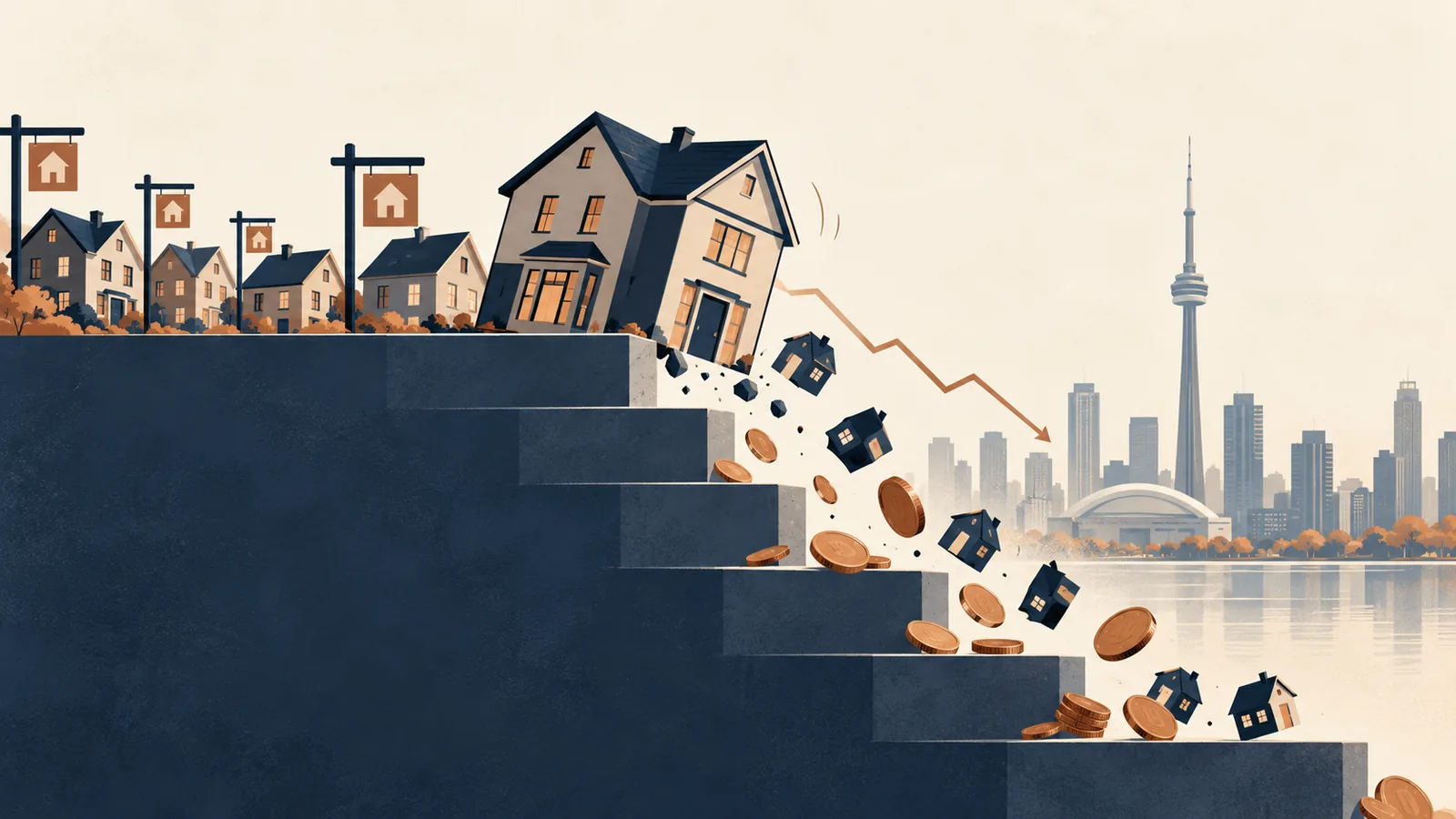
Toronto housing prices suddenly fell on April 20, 2017. According to statistics, in the 135 days after April 20, housing prices plummeted by 18%. A total of 988 transactions were affected throughout the year, resulting in a loss of 135 million. That’s the conclusion of A Sticky End: Lessons Learned From Toronto’s 2017 Real Estate Bubble. The author of the article replayed the precursors before housing prices fell, the mentality and performance of all parties at the moment of the fall, and the scene after the fall. My clients and I went through 4.20 together. After buying a house, we had to sell the original property, but encountered major changes in the market. The real estate market is the market with the longest cycle, and the signs of an inflection point should be relatively obvious. All market participants would have had time to react. However, the market changes in Toronto in 2017 were sudden and drastic, and many parties suffered unprecedented challenges and losses. Never forgetting the lessons of the past, we need to make a careful summary and inventory, and use the data of A Sticky End to summarize some of the characteristics and pain points of the Canadian real estate market to better understand and respond to the future market.
In 2017, there were 866 transactions in the Greater Toronto Area. After being sold, the original seller sold the property again. The second transaction price was on average 140,000 yuan lower than the first transaction price. There were 122 transactions that were sold immediately by buyers, with the average selling price being NT$107,300 lower than the purchase price. A total of 988 transactions were made, with a loss of 135 million yuan. The above-mentioned losses are verifiable in transaction records, and do not include losses such as attorney fees, land transfer taxes, etc., nor do they include losses incurred when a house was changed and the house was purchased and the transaction was successfully completed, but the house was forced to be sold at a low price. Nearly 2,000 families and nearly 1,000 real estate agents and lawyers participated, and they must have gained a lot of experience and lessons from it. As an industry insider, I was also deeply involved in the rescue and disaster relief work at that time. I mainly used additional mortgages on properties that had not been sold in time, obtained cash as down payments for the settlement of new properties, and tried to keep the properties that were originally planned to be sold during the house exchange process. From April to August 2017, house prices fell by 18% in 135 days. This was a sharp drop that had never happened in the U.S. real estate market. Seeing that the results of house price assessments were getting worse and worse, all I could do was race against time to help homeowners avoid the difficult situation of selling their houses in times of disaster and keep the green hills.
What caused such a sharp decline? Obviously, the sharp drop was caused by the sharp rise. March 2017 was the peak of Toronto's housing prices. The average transaction price was 765,000, nearly twice the 392,000 in 2013, an increase of 34% from the same period in 2016, and a doubling in four years! It is a temptation for everyone who plans to buy a house. According to the provincial and municipal real estate bureaus, Toronto's soaring housing prices are due to insufficient supply. However, judging from the number of new home completions, the number of completions in 2015, 2016 and 2017 all exceeded the 10-year average. The supply has not declined, and the increase is stable. Second-hand housing transactions are just the changing hands of different homeowners in the stock. The rise in housing prices is not caused by insufficient supply. Is it caused by population growth? Neither. According to figures from the Bureau of Statistics, the five years from 2011 to 2016 were the five years with the lowest population growth in Toronto in the past 20 years. When traditional economics explains price changes, it usually analyzes it from two aspects: supply and demand. The premise is that consumers are rational and resources are scarce. When price changes cannot be explained by the contradiction between supply and demand in traditional economics, behavioral economics comes in handy, assuming that consumers are irrational and the market is inefficient. From the perspective of behavioral economics, in simple terms, price changes are related to following trends and speculation, and have little to do with other economic variables. Two masterpieces of behavioral economics, "Irrational Exuberance" by Robert Shiller and "Thinking, Fast and Slow" by Daniel Kahneman, explain the characteristics and impact of behavioral economics in a popular way and are recommended for everyone to read.
From March 2016 to March 2017, Toronto’s housing prices exploded, rising unilaterally for 12 consecutive months with almost no respite. Since 2005, the average annual increase in house prices has been 5%. In 2016, the increase was as high as 16%. In the first three months of 2017, the increase was 34%. Transaction volume did not show any weakness. In 2015, transaction volume was 15% higher than the average transaction volume of the past 10 years. In 2016, transaction volume was 29% higher than the average transaction volume of the past 10 years. Toronto home prices and transaction volume reached a fever pitch in 2016 and early 2017. In his book, Robert Shiller found a unified and standardized excuse for the crazy rise in housing prices: "Just not enough land available"; "House prices can only go up in the long run/Nowhere to go but up"; "It's now or never"; "There is no house that cannot be bought, only housing prices that cannot be afforded/pay what the market wants." After reading this, I think all readers have understood that the four sentences above are signs of a real estate market bubble - as long as these four sentences appear in the market at the same time, no matter which country or city it is in, the real estate bubble has been blown up. Under the strong psychological suggestion, and the people around them have proven time and time again that house prices can only rise, and if you don't buy it, you will really not be able to afford it. The most hesitant people and those who have just had the idea of buying a house are coerced into the market. Buy it and rent it out first, otherwise what should you do if your children can’t afford a house when they grow up? The rent is too low and I have to subsidize the housing expenses every month? It doesn't matter. If house prices rise in the future, you can earn back the subsidy money by selling the house. . . These classic thoughts of fear + speculation have pervaded Toronto.
Sellers are becoming more and more greedy, buyers are becoming more and more fearful, and psychological imbalance dominates the market. It has nothing to do with the contradiction between supply and demand, the level of rent, or the inflow of foreign capital. All buying and selling behavior is based on the assumption that housing prices will always rise. Irrational prosperity has quietly approached our lives. The proportion of buyers who do not live in their homes temporarily, leaving their minor children, and enduring negative monthly rent cash flow, accounted for approximately 4.8% of buyers in 2012. By 2016, this proportion increased to 10%, and in early 2017, the proportion of such buyers reached a record high of 16.5%. These people have no experience in real estate investment and should not be classified as real estate investors; they have no intention of renovating or repairing the property and selling it soon, so they are not considered real estate speculators; I classify these buyers as "rookie investors" in the real estate market. They cannot distinguish the difference between investment and speculation. They hesitate during the normal ups and downs of the market and only make up their mind to buy when the bubble is indeed inflated. This phenomenon is exactly the same as the stock market. The last ones to enter the market are all rookies.
The investment areas chosen by rookie investors will become the hardest hit areas of the real estate bubble, and it will take many years and good conditions to return to the past. Unfortunately, in the current housing price fall in Toronto, the Chinese have proven to be the most concentrated group of novice real estate investors, because the two Chinese-inhabited areas of Markham and Richmond Hill are the hardest-hit areas. In the Greater Toronto Area at the beginning of 2017, the average negative cash flow of single-family investment properties was 1,650 per month. Among them, the average negative cash flow in Markham was 2,488 per month, and the average negative cash flow in Richmond Hill was 2,444 per month. It is unsustainable to hold such properties for a long time. In fact, investment in apartment buildings does not have much negative cash flow. In 2016, condo investment in the Greater Toronto Area had a negative cash flow of only 176 yuan per month. By the peak of housing prices in 2017, the negative cash flow was only 427 yuan per month. Unfortunately, Chinese real estate investors (especially rookies) chose to invest in detached houses. From the perspective of hindsight, the Chinese chose the wrong type of investment property. The author of the article "A Sticky End" made a chart to compare the areas with the largest proportion of rookie investment transactions with the actual severity of losses. The result is: the more rookie investors there are, the more serious the losses caused by falling house prices. That’s all for the reasons why Toronto’s housing prices fell. Let’s take a look at what happened at the moment when housing prices fell.
In early April 2017, when the public saw that house prices in March 2017 had increased by 34% compared with March 2016, the first action they took was to search for "real estate bubble/real estate bubble" on GOOGLE. In fact, everyone realized that the real estate bubble had been inflated. From the perspective of sales volume, the highest peak occurred at the end of March 2017. People were shocked when they saw the number of transactions in March in early April, and the number of transactions in early April then plummeted. However, the most eye-catching clown in this housing price fall is the Ontario government, which has just appeared. With transaction volume falling and the bubble inflation coming to an end, the Ontario government believes that the credit for suppressing housing prices cannot be given to the market in vain, but should be attributed to the government's wise regulation. So on April 20, when the transaction volume had dropped significantly, it announced the 4.20 Fair Housing Plan: levying a 15% real estate speculation tax on non-residents and further expanding the scope of rent restrictions. This is how an absurd drama unfolds, in which others lead the donkey while the government pulls out the pegs. 69% of Ontario residents own their own homes, and the fall in housing prices has harmed the interests of most people. Then in the 2018 Ontario general election, the silent majority used their votes to let all the provincial legislators who had pulled out their pegs go home and farm. The government's backhand has put families in the process of upgrading their homes into a financial crisis.
When house prices were at their peak in March 2017, the average house price in Greater Toronto was 765,000. By the end of July, the average house price had dropped to 626,000. In just 4 months, house prices fell sharply by 18%. Regarding the 18% drop, there are two explanations: According to data from the second-hand housing transaction system, the average house price fell by 18%, but according to the National Bank House Price Index (HPI) algorithm, the price drop in Greater Toronto during this period was only 7%. The reason is that HPI considers the comparison of the homeowner's purchase price with the current selling price, rather than simply comparing the market transaction price. Therefore, the "loss" mentioned in this article actually refers to the homeowner's "less profit" rather than the homeowner's actual loss.
From the above analysis, we can see that the most vulnerable place for housing prices is where there are the most investors, especially novice investors. The size of the real estate bubble is measured by the same criteria as the stock market bubble: the stock market is measured by the price-to-earnings ratio, and the real estate market is measured by the rent-to-sales ratio. The stock price is the same 100 yuan. Company A has an annual income of 5 yuan and a price-to-earnings ratio of 20 times. Company B has an annual income of 2.5 yuan and a price-to-earnings ratio of 40 times. B's stock price is frothy relative to A's stock price. The same goes for houses. For houses with the same rent of 2,000 yuan, C’s selling price is 1 million and D’s selling price is 600,000. Compared with D’s house price, C is a bubble. Bubbles are everywhere, but housing prices in areas with large bubbles are fragile. Once there are market changes, housing prices in areas with large bubbles will suffer even greater losses. The rent-to-sale ratio is the ratio of sales price to rent. In the Greater Toronto Area, King City had the highest rent-to-sale ratio in 2017, followed by Richmond Hill, and Markham ranked third.
The title of the article A Sticky End is also the conclusion: housing prices are sticky and will not always fall sharply. When the number of buyers in the stock market drops sharply, stock prices will continue to plummet, while real estate prices are resistant to declines. In real estate markets, a decline in demand is typically accompanies by a rise in inventory followed by a slow decline inprices. Sellers are typically slow to adjust their prices down. When house prices fall, fear and greed reverse: buyers become greedy, hoping that the house price will be sold at half price and they can take advantage of it. But if sellers are not afraid, the situation of continued decline in house prices will not occur. I often go to a forum where people who talk about the real estate market are concentrated. Many potential buyers, like performance artists, find various articles and data, showing that housing prices continue to plummet, and tell viewers with the same mentality: Don't buy yet, or it will still fall. Because there are still people who are eager to buy a house, sellers do not need to easily lower the price to sell. From July 2017 to July 2018, the central bank raised interest rates four times in a row, but market confidence has not been lost; the federal government has tightened mortgage policies, but real estate transactions have become increasingly active; and the inventory of houses for sale has become less and less. All of these have eased sellers' fears. The turning point for the real estate market in most regions will occur when all the bad news is exhausted and sellers begin to squeeze out short positions. Short squeeze means to increase the price if you don’t buy. Toronto's apartment condo market has formed a short squeeze situation: the higher the interest rate, the higher the house price; the tighter the loan policy, the more active the transactions; the more restrictive the rent, the faster the rent rises. It is difficult to rent a house and the high rent forces people to buy a house. Many performance artists simply cannot afford to buy a detached house. Good or bad news in the market does not matter, but the short squeeze in the CONDO market makes them very embarrassed - the houses they can afford are still rising, and the joy of schadenfreude cannot offset the pain caused by high rents.
Toronto’s housing prices have taken a tumble. As an eyewitness and personal experiencer, I have drawn the following conclusions, which I would like to share with readers.
1. When you see that housing prices are only rising but not falling, and you can’t buy them without bidding; when you hear that land is in short supply and you will never be able to afford it if you don’t buy it, a bubble has already appeared.
2. Areas where the housing price is more than 500 per month compared to the monthly rent, there is a real estate bubble. House prices in places reaching 1,000 are very fragile. Properties with a high rent-to-sale ratio are not suitable as investment properties and can only be used for self-occupation.
3. Bubbles are all around us, greed + bubbles + ignorance = disaster. Controlling your impulses is the right way to avoid losses and disasters.
4. If you don’t plan or have the ability to hold an asset for a long time, whether it’s stocks or real estate, don’t hold it for a day.
5. The most dangerous human error is naive intervention by the government. Always pay attention to the government's words and deeds, analyze what stupid things the government can do from the perspective of votes, and try to stay away from it.
6. Real estate comments and news depend on who writes them and who disseminates them. In the era of self-media, noise is 100 times greater than signal. Smart people judge based on signals; stupid people are led by noise.