Bid farewell to 2022, and as Canadians entered 2023, they saw various recession theories making headlines. Anxiety seems to have changed from worrying about raising interest rates in 2022 to worrying about a recession in 2023. In fact, people's short-term anxiety is not because they actually encounter any difficulties, but because they are trapped by imaginary hardships. This anxiety is completely unnecessary and there is an antidote. I have heard a saying before, and the general meaning is that people with confused minds have unclear concepts, and the same applies to people who are worried now, because they have unclear concepts.
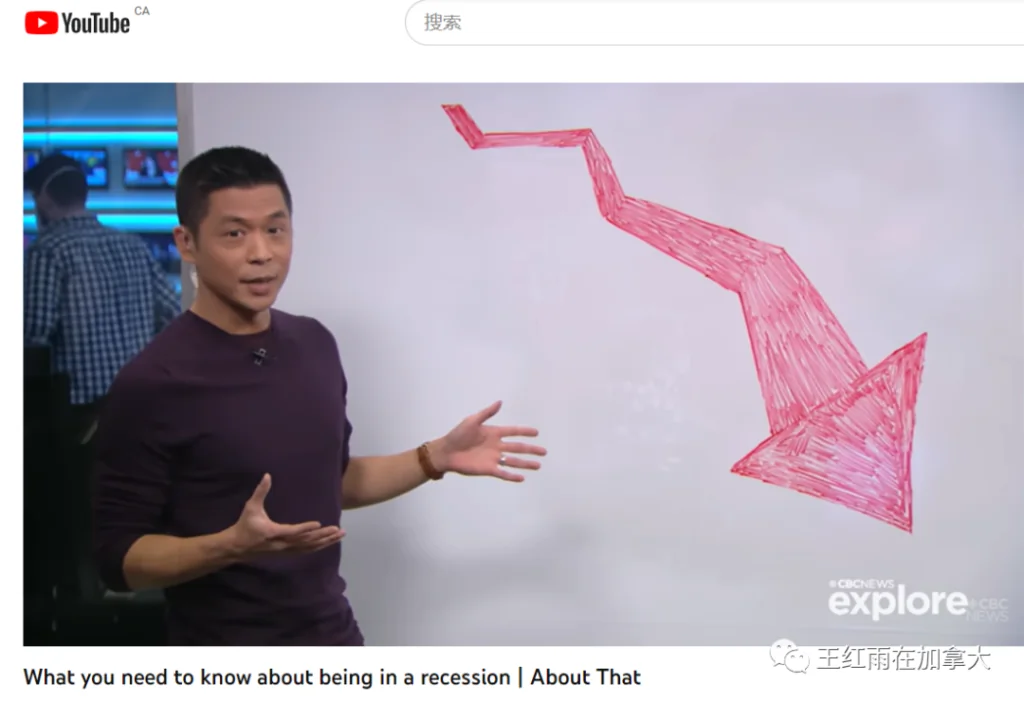
I saw on the Internet that people who predict that housing prices will fall sharply in 2023 all use one word, "recession". What does this word mean? Canada's CCTV, CBC TV, aired a special feature on December 6 last year explaining what a recession is and how to deal with it. It can be found on YouTube. The title is What you need to know about being in a recession. After watching this program, I feel that the recession is nothing to be afraid of. It will not cause a real estate crash, and it will not even cause last year’s correction. If you don’t believe me, go check it out.
Let’s take another example where the concept is unclear. Since the middle of last year, some people have said that borrowers with floating interest rates will be crushed by the bank's trigger rate, and debtors will sell off their properties in large quantities, causing housing prices to plummet. On the contrary, house prices have stabilized since August. What's going on? Let’s take a look at the definition of trigger interest rate: the monthly payment of some banks’ floating-rate loans does not increase with the increase in interest rates. When the interest rate rises to the trigger interest rate, there will be a situation where the interest payable is greater than the monthly payment. At this interest rate, the part of the interest payable that is greater than the monthly payment will be added to the principal. At this time, the bank will send a letter to remind the borrower that the trigger interest rate has now been reached. The definition is so simple. A letter of reminder can cause people to sell their properties. This kind of assumption and reasoning is really illogical. Unfounded rumors do not stand the test of time, and the market soon proved that not only was there no sell-off, but fewer and fewer properties were listed for sale. I wrote an article explaining this definition in the public account on June 26 last year. You can search "Brother Cui is responsible for it" in the public account to review it again. Those who understand it will no longer pay attention to those baseless rumors. Because most people have never experienced it before, the definition of trigger interest rate has been misinterpreted by the media. In November, a piece of news appeared and was widely reproduced. The news said that TD and CIBC followed BMO and adopted the practice of adding interest back to the principal. This is drinking poison to quench thirst. Please, the definition of trigger interest rate has long been written in the loan contract. There is no such thing as a temporary change of mind by the bank. Misinterpreting concepts, confusing concepts, and adding fuel to the fire are social media's most eye-catching tools. If you want to know the truth, read the letter from the bank carefully and read the original signed contract carefully.
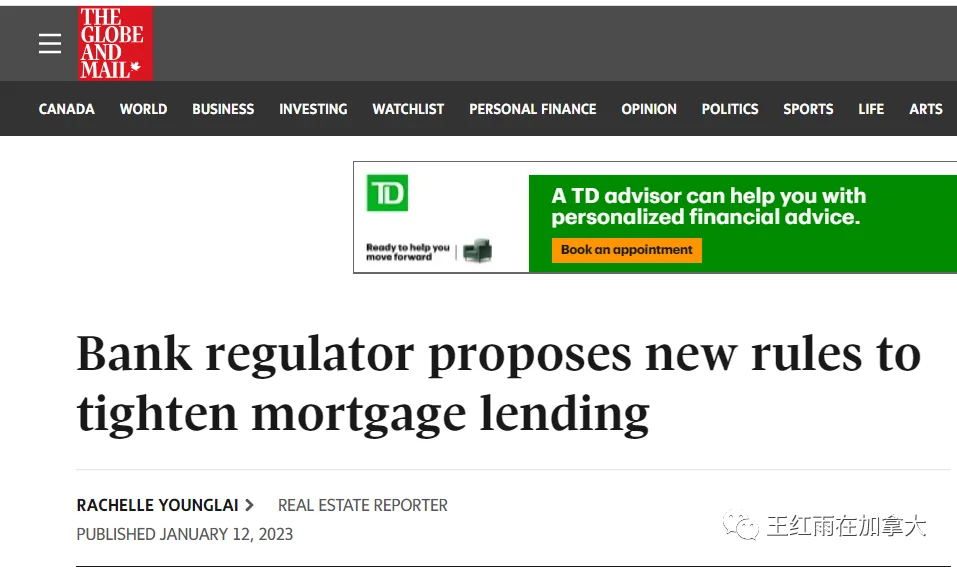
Last year's interest rate hike frenzy is over. What we have to face in 2023 is not just one or two potential interest rate hikes, but also a slight recession. At the same time, the banking regulatory authority OSFI has begun to worry about the risk that debt may surge this year. People who planned to buy a house last year have 40% of people have postponed their plans to buy a house. Last year, the number of new immigrants approved was as high as 470,000. After interest rates are stopped this year, real estate transactions will rebound in a retaliatory manner, triggering a surge in loan volume. Therefore, they have begun to consider how to tighten mortgage policies and let some marginalized borrowers out.
We are forced to invest in order to balance our lifetime income. Investment is to cope with future uncertainties, not to deal with the present. Investment returns will only be seen in the future. The most important thing now is mobility. Many people have lost their mobility due to anxiety and fear. In fact, a lot of the current anxiety stems from unclear concepts. What we really need to face is the uncertainty of the future, not the current rumors. Let’s discuss with you what definitions blur our eyes and delay our preparation for things that are truly worthy of anxiety.
01 Inflation, recession and house prices
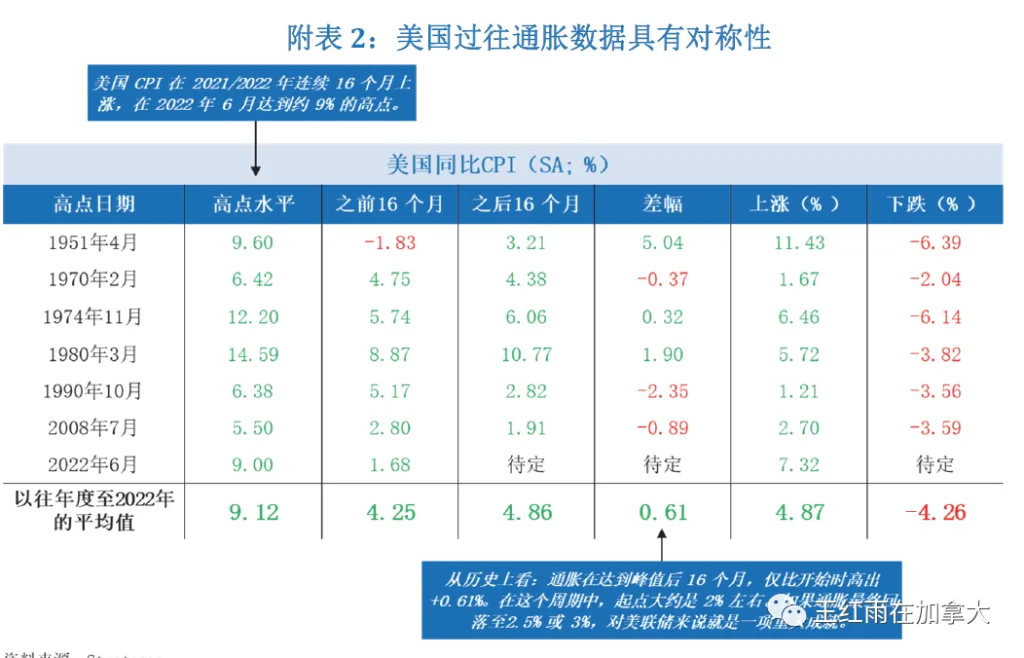
From the central bank to ordinary households, there is a consensus: high inflation cannot be tolerated. Without high inflation, we would not be so desperate to raise interest rates. As a result, we are under the dual pressure of high prices and high interest rates today. What is the definition of inflation? It means too much money chasing limited goods, causing prices to rise. When there is less money, demand decreases, or supply increases, inflation subsides. Therefore, inflation is not a disease, but a symptom of a certain disease. It’s not pneumonia or diabetes, but fever, a symptom of the body’s ability to fight the disease. We have never seen anyone suffer from a high fever for a lifetime, so inflation has not lasted for decades. An internal document from BMO Bank summarized a historical pattern of the rise and fall of inflation, namely,inflationary16 month symmetry characteristics. To give two examples, the inflation rate in the United States in April 1951 was 9.6%, which was the peak inflation rate at that time. The inflation rate in the 16th month before that was -1.83%, and the inflation rate in the 16th month thereafter was -1.83%. 3.21%; the inflation rate in November 1974 was 12.2%, which was the peak inflation rate at that time. The inflation rate in the 16th month before that was 5.74%, and the inflation rate in the 16th month thereafter was 6.06%. That is,before inflation peaksInflation rates for 16 months and 16 months after are at the same level, this is historical experience and can only be used as a reference for the end timetable of this inflation. Both the United States and Canada reached the peak of this round of inflation in June 2022. The U.S. inflation rate in June 2022 was 9%. The inflation rate in the 16th month before was 1.68%. The 16th month after that is October 2023. Let us put on our glasses and wait and see if the symmetry will show up this time. Based on the above experience, the time for inflation to fall below 4% may be October this year. I hope this anchoring time can bring some psychological comfort to everyone, and I would like to thank BMO Bank analysts for their data statistics and analysis.
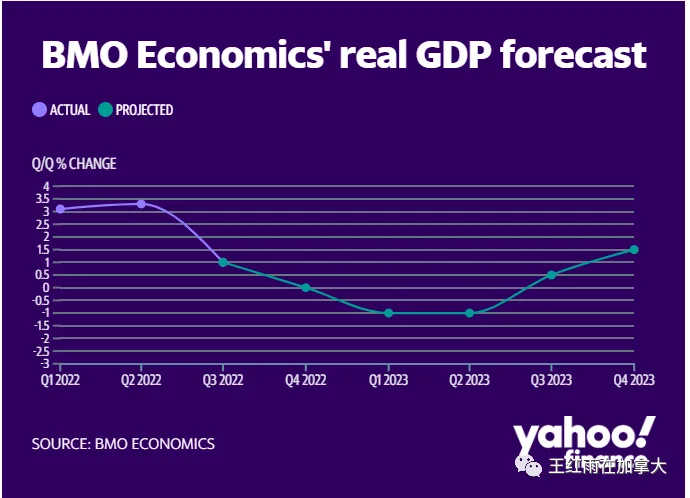
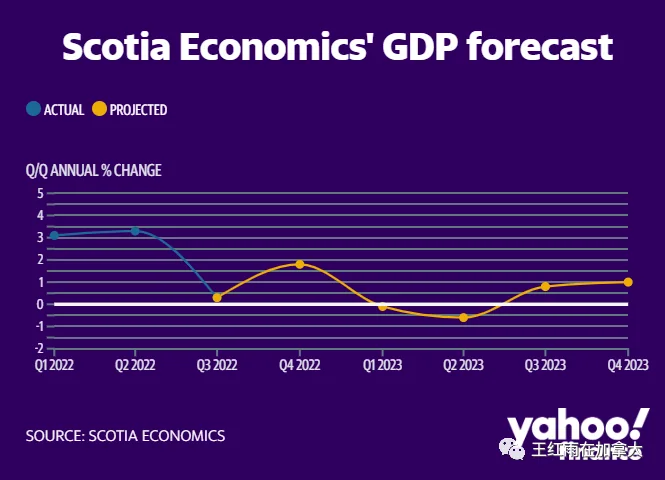
A recession refers to at least two consecutive quarters of negative GDP growth. How deep the recession will be depends on the extent and duration of the continued decline in GDP. Gross domestic product is referred to as GDP. Is it terrible that GDP continues to decline? How much does it have to do with family finances? The CBC video mentioned above has an explanation. Generally speaking, recessions are caused by lack of demand, resulting in slower economic development and higher unemployment. The speed of economic development has little to do with each family, but unemployment will affect the financial status of families suffering from unemployment. Simply put,Recessions affect the lives of families who have lost their jobs, but not those who have not yet lost their jobs.New Zealand economist William Phillips discovered in 1958 that when the inflation rate is high, the unemployment rate is low. He believed that inflation will create jobs. The curve drawn based on the correlation between the inflation rate and the unemployment rate is called the "Phillips Curve". When stagflation occurred in the 1970s, inflation was high and unemployment was also high. At that time, people believed that the Phillips Curve was unreliable and outdated. But the Phillips Curve appears again in 2022 and 2023. In the past two years, inflation has created many jobs that were not available without inflation, thus causing labor shortages in the overall job market. The result of the central bank's unrelenting fight against inflation is bound to eliminate some jobs created by inflation. However, thisRecession and unemployment won't affect every family. There are no Nobel Prize-winning economists in Canada. The so-called economists’ predictions are made by people with the professional title of “economist” in various banks. Therefore, Canadian economists’ predictions must be discounted and can only be used as a reference and cannot be fully trusted. Recently, Yahoo Finance collected the predictions of the economic recession in 2023 from economists at the Bank of Canada. Economists from these two banks predict that Canada will have a two-quarter economic recession in 2023 and then end the recession. In other words, Canadian economists predict a recession period of 6 months, during which the unemployment rate will rise. This conclusion is for reference only. The worst-case scenario is that Canada experiences a deep and long-term economic recession, but the central bank is ready and has 400 points of room to cut interest rates that can be used at any time to save the economic recession.
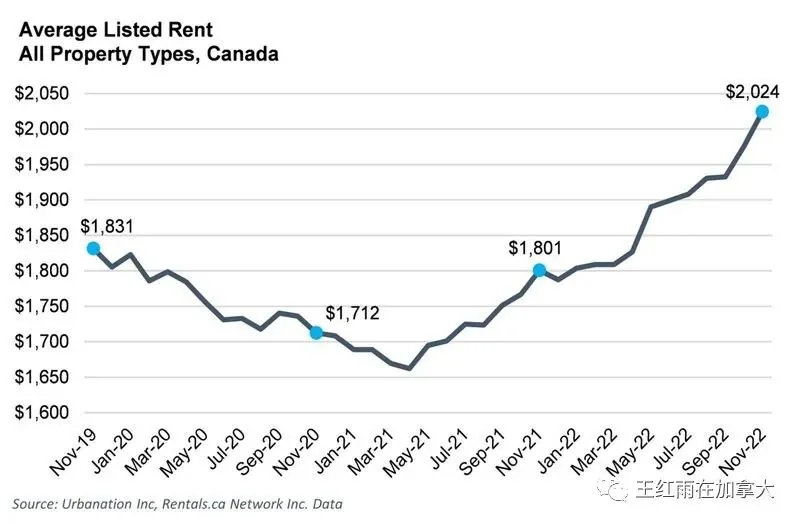
People have been looking for the relationship between housing prices and interest rates, the unemployment rate, and GDP, but so far there is no conclusion. We have not seen the pattern that interest rates rise by X% and house prices fall by Y%. At the same time, we do not find the pattern that interest rates fall by X% and house prices rise by Y%. In the same way, there is no corresponding proportional relationship between unemployment rate, GDP and housing prices.House prices are determined by two factors, one is the intrinsic value and the other is the market price.At this point, the determinants of house prices and stock prices are the same. The intrinsic value of a stock is determined by the company's profitability.The intrinsic value of a house is determined by its rent. The market price of a stock is given by Mr. Market. Mr. Market is sometimes manic and sometimes depressed;The transaction price of a house is also given by Mr. Market. Mr. Market’s emotions determine the price on a certain day or month.Currently, the intrinsic value of real estate in Canada is increasing, which is reflected in rents. In 2022, the average rent across Canada exceeded 2,000 yuan a month for the first time, and GTA apartment CONDO rents increased by 20% in a year. The increase in the intrinsic value of real estate gives investors the confidence to shoulder real estate debt. Even if your tenants do not move and cannot raise the rent for the time being, the market rent of the property is there. Like a stock with rights, it will be reflected in the market price. That is, potential buyers will evaluate how much they can rent the property after buying it.The current market sentiment is very gloomy. Mr. Market is in a depressed state and the price given is on the low side.The seller's reaction to this was a "short squeeze", that is, if they didn't give me the price I wanted, they would delist the stock and stop selling it. In the second half of 2022, many people misjudged the market and thought that homeowners would be eager to sell and sell at a low price after their financial burden increased. However, the actual situation is exactly the opposite.The sharp shrinkage in listings shows that homeowners' actual financial situation is not as bad as some think.The substantial reduction in transaction volume and listing volume has effectively blocked the room for housing prices to fall. Since housing prices stabilized in August 2022, there has been no sharp decline in housing prices. In the first half of this year, buyers who cannot wait or cannot afford to wait will absorb the market stock, further confirming the fact that housing prices have bottomed out. A short-term economic recession and a small number of job losses will have little impact on rents because there are a large number of new immigrants and non-residents who also rent. Rising rents will support the intrinsic value of real estate and even cause a more serious "rental crisis." As early as the spring of 2022, Canada's rental crisis had already occurred. At that time, many potential buyers were hesitant and planned to wait and see, which led to a tight rental market and an intensifying rental crisis. The rent for a one-bedroom CONDO in the GTA has risen to 2,500 yuan a month. I recommend that you watch the video Canada’s rental crisis: Why we’re losing affordable housing shot by The Fifth Estate, a Canadian documentary channel, to understand the severity of Canada’s rental crisis.
02 What are the reasons for being optimistic about Canadian real estate in the long term?
At the end of every year, I have a phone call with a few close friends to talk about the current situation. This year, two friends asked me the same question: Am I really optimistic about the long-term investment value of Canadian real estate? I think many readers also have the same question. Is my view on long-term investment in Canadian real estate because I want to do the mortgage business, or because I am optimistic about it from the bottom of my heart. The answer is both reasons.
When I was working in New York, my wife worked in a trading company. This company was founded by the fathers. It mainly sells household products and is managed by the sons and daughters. The main business model is to obtain product design inspiration from various exhibitions in New York, manufacture it in China and Taiwan, and ship it to the United States for sale by local salesmen in New York. The company gives a small deposit to the manufacturing company in advance, and then pays the balance to the manufacturer and pays the salesperson commission when the payment is recovered. The company's operating costs are mainly warehousing. Their family bought two of the warehouses. They rented out part of them when they couldn't use them. This business model uses operating income to obtain commercial loans to buy warehouses. Like McDonald's, the essence of the business is to invest in real estate. When I was working in New York, I knew what I wanted to do after immigrating to Canada. I wanted to work in a combination of banking and real estate. Because people tend to "Use your wealth to make money, use your roots to keep it". In ancient China, business was regarded as an end of life, and land was regarded as the foundation. The purpose of doing business was to buy land. This is a business philosophy that has remained unchanged for thousands of years. Since I know that everyone works hard to buy a house, then the future of my career will be related to buying a house. Judging from the past 14 years of working experience, this is a job that leaves the lingering fragrance of roses on hand. I like it very much and have a sense of accomplishment. More importantly, through these 14 years of work, I have clearly seen the long-term development trend of Canadian real estate: it is getting harder and harder to get loans, it is getting harder and harder to buy a house, the housing crisis has not yet found a solution, and the crisis should last no less than 30 years. Both real estate investment and this job are very promising.
How to judge the long-term investment prospects of Canadian real estate? I read the real estate special report released by Statistics Canada in detail every five years to study and judge the long-term development of Canadian real estate. I usually do not pay attention to market transaction information. Graham said that the stock market is a voting machine in the short term and a weighing machine in the long term. The same goes for real estate. The price given by the unpredictable Mr. Market every day is not certain. Monthly real estate transaction data is not important at all. Just look at the general situation. Only those speculators who are fast in and out in the short term are afraid of being trapped, so they pay special attention to the transaction data. The long-term value of real estate depends on the balance between supply and demand. In the second half of 2018, I excerpted a large amount of real estate data from the 2016 census in my official account article for your reference in long-term investment. Canada conducts a census every five years. The data is accurate, but the analysis is not necessarily objective. The housing report of the 2021 Census will be released in September 2022. The analysis in the report is quite unreliable. Just look at the data.
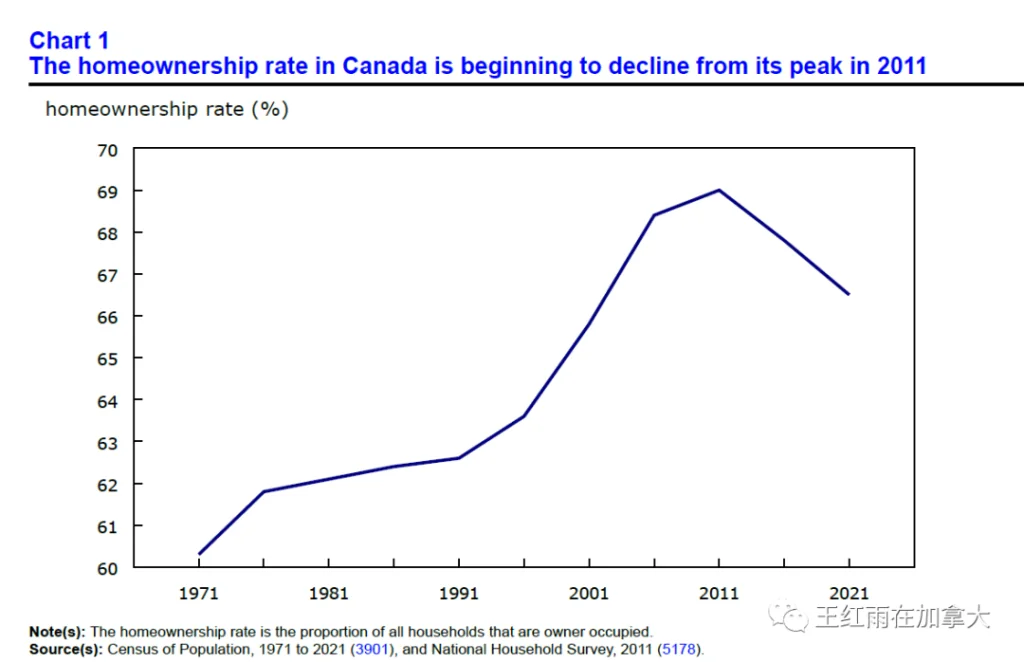
According to the 2021 census, there are 14.978 million inhabited private property properties, the total population is 36.991 million, and the average number of people per household is 2.47. The homeownership rate of Canadians is 66.5%, which is exactly two-thirds. This ratio reached its peak of 69% in 2011. The homeownership rate of people aged 25 to 29 has dropped the most, from 44.1% in 2011 to 36.5% in 2021. According to analysis by the statistics office, the decline was caused by an increase in the number of roommates living together. I believe that the main reason for the decline in this proportion is that housing prices are too high and first-time homebuyers cannot reach the first step. The proportion of CONDOs in newly built properties continues to increase. The proportion of Canadians living in CONDOs has increased from 13.3% in 2016 to 15% in 2021. The proportion of CONDOs in the city centers of large cities has reached as high as 40%. In the five years between the censuses, house prices rose by 39.6%. The following data is very strange. Among household expenditures, the number of households whose housing expenditure exceeds 30% of their income has dropped from 24.1% in 2016 to 20.9% in 2021. Therefore, the report analyzes that the affordability of housing for Canadians has improved. Don't laugh, that's what the report says. If you don't believe me, go read the original text of the report yourself. The improvement in affordability is either singing praises to Trudeau, or Trudeau has issued too many aids in 2021, which has improved the affordability of housing. In any case, we have to thank Mr. Special. The most difficult number to understand is this. The proportion of households with core housing need, in English, has dropped from 12.7% in 2016 to 10.1% in 2021. The definition of "rigorous need" is a living situation in which the living place is crowded, small, unsafe, and undignified, and there is no ability to improve it. The conclusion that housing affordability has improved based on changes in statistics is not consistent with reality.The reason behind this may be that many families are forced to be satisfied with their existing housing conditions due to declining affordability, reducing their expectations of improving their housing conditions.
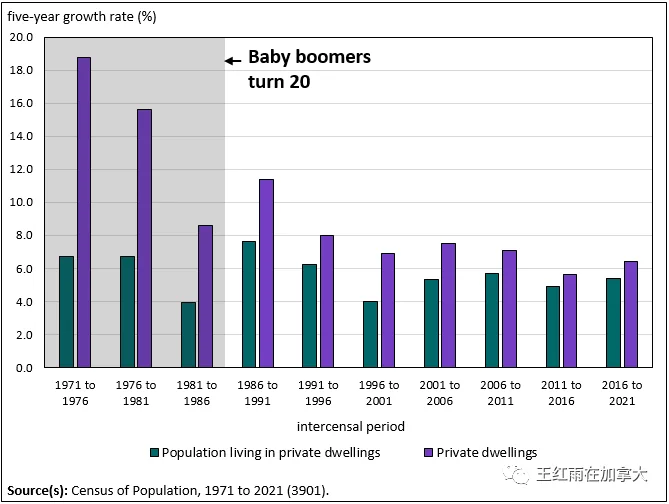
Whether the new population seriously exceeds the newly built real estate has always been a controversial topic, and it is also related to the rationality of long-term investment in real estate. During the election during the epidemic, some people raised objections, saying that Canada’s new housing construction did not lag behind the new population. What is the relationship between the new population and the number of newly built properties? The 2021 Demographics Report has the answers:The increase in newly built properties exceeds the increase in households.As can be seen from the figure above, when the baby boomers entered their 20s, that is, in the 15 years from 1971 to 1986, the number of new properties in Canada was twice the number of new households. Between 2016 and 2021, the proportion of new households was 5.7 %, and the proportion of new real estate is 6.1%. Although in absolute terms, the increase in real estate matches the increase in population, the growth rate of the two is too close. If the apartment types of some newly built properties do not match the number of new households, it will be difficult to meet the housing demand.fromIn the 30 years from 1991 to 2021, the number of new homes just exceeded the number of new households. Compared with the period from 1971 to 1986, when the number of new homes was twice the number of new households, the number of homes built in the last 30 years left families with too little room for choice. This is the fundamental reason why N buyers often bid for a property in the second-hand housing market.The root cause of the housing crisis is the long-term mismatch between demand and supply. Although the quantity matches, the structure does not match. There are too many new one-bedroom properties, but many families need three-bedroom housing; most of the newly built properties are condos in the city center, while some families need bungalows in the suburbs. These contradictions can only be solved through large-scale housing construction in a certain period. The number of houses built must be like the period from 1971 to 1986, when the number of new houses was twice the number of new households. 2021 is a very special year, with many data distortions. No new immigrants landed from 2020 to 2021, and the construction industry, which has been an essential work during the epidemic, was allowed to start work. The epidemic allowed new houses to be matched with new households in the short term. From 2022 to 2023, there will be a large influx of new immigrants. At the same time, construction costs will increase significantly, and pre-sales of new homes are not smooth. These conditions can only be reflected in the 2026 demographics.
Real estate investment is about the housing crisis, including the lack of affordability of buying a house and the rental crisis.Canada needs new immigrants to fill the job vacancies left by the retirement of the baby boom generation. Job vacancies in the construction industry are affecting the supply of housing. The long-term mismatch between demand and supply will take longer to improve. The debts owed in the past 30 years will take more than 30 years to repay. The baby boomer generation is a generation born between 1946 and 1964. Those born in 1958 will enter retirement age this year. There will be a huge labor gap in Canada in the next six years, and the approval and processing of new immigrants must be accelerated. Although baby boomers are rapidly exiting the workforce, few are moving out of their larger homes.futureThe 6 years were the 6 years when the immigration wave filled the retirement wave. They were also the 6 years when housing affordability was the worst and the rental crisis worsened the most.It doesn’t take too long. In 5 to 6 years, we will be able to test the results of today’s real estate investment. I'm very bullish on real estate investing in both the medium and long term.
03 Review of Ontario’s rapid housing construction plan
The housing crisis is always brought up for criticism during elections. The solutions proposed by both the government and the opposition are mostly promises to treat the symptoms rather than the root cause. Many promises cannot be fulfilled because they are unrealistic. Candidates who care about votes can only use their energy on issues that are urgent to solve at the moment. More important issues that require more time to solve will be postponed indefinitely. Elections, promises, elections, promises, over and over again, but the problem remains the same. After the recent federal and provincial elections, there were some initiatives, but after they were implemented, we found that they were either to limit demand or to solve the most pressing rental crisis, while the larger and more difficult to solve supply problems were shelved.
The two new federal measures can be said to have actively and effectively affected the supply of new homes. One is a policy to combat real estate speculation, which applies the HST consumption tax on the transfer of off-the-plan properties to all situations. As long as the property is transferred, HST will be charged, so speculators among buyers of off-the-plan properties automatically retreat. Another new rule prohibiting non-residents from buying houses within two years has also blocked the way for international students and their mothers to speculate in off-the-plan properties. In the case of off-the-plan sales, developers can only apply for construction loans after pre-selling 70% of the units. Speculators who speculate on properties are crucial for developers to quickly complete 70% of the sales. What we are seeing now is that after the new regulations were implemented, pre-sales of off-the-plan properties were severely hampered. Less than 70% of the units were sold for a long time. As a result, developers were unable to obtain loans in time and start construction, and developers' costs increased sharply. I believe that the federal government’s original intention was never to suppress pre-sales of new homes and reduce supply.

Bill 23 also encourages residents to expand their basements, allowing three families to live in one house. This is the bombing of the city, the construction of urban villages, the transformation of a courtyard house where one family lives into a large courtyard house for 14 families, and the large-scale destruction of the urban living environment in order to solve the current rental crisis. British Columbia's solution to the rental crisis is better than Ontario's. British Columbia mobilized developers to build student apartments to separate students from competition in the rental market. At the same time, it lifted restrictions on strata condos that were originally not available for rent, releasing more housing available for rent. Ontario's solution to digging holes in the ground is to let homeowners pay for it and destroy the communities they live in. How effective is it? Let's put on our glasses and wait and see. The Markham City Councilor said that one of the reasons why Bill 23 cannot be accepted is that the existing environment cannot be destroyed. Otherwise, who will be willing to live in Markham in the future?
To quickly increase the number of housing units, two contradictions need to be resolved. First, because increasing housing supply will increase residential density and reduce the quality of life of existing residents around new homes, “NIMBY”ism, the English abbreviation of “don’t in my backyard”, is common in North America. New houses will affect the living environment of neighboring residents. Without compensation, it will be very difficult for new houses to be built in mature communities. Second, real estate development is unattractive to high-quality capital. Development costs are increasing, and costs such as interest rates, labor, and materials continue to rise. It is difficult to make a profit from investing in real estate development. High-quality capital chooses investments with greater returns, shorter cycles, and more reliable returns. On the contrary, some novices do not know the basics and think that building houses will bring huge profits. Some entrepreneurial companies are eager to try in real estate development and have completed many unfinished projects. If the above two major contradictions are not resolved and we blindly go around, there will be no hope of solving the housing crisis.

Solving the housing crisis requires not only political vision, but also economic acumen, both of which are most lacking in Canada's current government. The Conservative Party proposed in 2021 that within two years, owners of multiple houses would not have to pay capital gains tax when selling their houses, in order to encourage the release of second-hand housing. This is a policy that treats the symptoms and the root cause. Unfortunately, the Conservative Party is far away from coming to power. Australia stipulates that non-residents can only buy off-the-plan properties and cannot take out loans. This allows Waiguoren to bear the greatest risk and helps domestic builders develop more real estate. These effective policies can actually be picked up at will. Unfortunately, they are all in ways that the white left doesn’t like, so let’s keep them in crisis. The housing crisis caused by existing policies cannot be solved in the short term, thus creating certainty in the returns of long-term real estate investment. Kick-ass solutions will only worsen the crisis. The rise in oil prices was not caused by Buffett, but he seized the investment opportunities arising from the oil price crisis. The rise in house prices is not caused by real estate investors. Investors only need to seize the opportunities brought by the crisis. "Never let a crisis go to waste" - Churchill
Conclusion:
There is a lot to read in this article, and data controllers can do their own data mining. I clearly saw the four words "housing crisis" in the 2021 Statistics Canada housing report. This is the reason why I recommend investors to "buy, buy, buy" and "not sell" when investing in Canadian real estate. The current inflation, recession, and housing price fluctuations will pass. Those who can understand the basic concepts are not confused by these immediate difficulties and continue to add positions. Seize the opportunities amid economic and housing price fluctuations, and generous returns await investors. Canada needs an immigration wave to offset the decline of the baby boomers from the workforce. In the 15 years when the baby boomers turn 20, the growth rate of new homes in Canada is twice the population growth rate. After the baby boomers retire, they will still live in their existing homes for a long time.In the coming period, Canada will need to build twice as many homes as the number of new immigrants to alleviate the housing crisis.Existing Canadian housing policies are unable to achieve this kind of growth in housing numbers. Due to the many economic doubts at hand, many people are timid and do not dare to buy a house within their borrowing capacity. Stephen, the former governor of the Bank of Canada, predicted this year’s possible recession during Christmas last year. Coming recession seen as ‘easy ride’ compared to past downturns, “Compared with previous economic downturns, the possible recession is just a piece of cake.” I agree with him. I hope this article can help you clear away the clouds, see the distance clearly, remain optimistic about the present, and remain pessimistic about the future. The solutions under ballot politics are all about solving immediate problems, and long-term problems need to be solved by ourselves.
OSFI, the banking regulatory authority, regards this year as the time to tighten housing loan policies. There is a certain reason. Demand has been suppressed for too long, and the problem of insufficient housing supply is accumulating. The top priority is to turn away marginal applicants to ensure the safety of bank assets. We don’t know yet who are the marginalized people with borrowing ability. We won’t know until the newly revised B20 is announced. Time is running out for hesitant buyers who are on the edge of their ability to borrow. In the next article, I will specifically discuss the history and trends of Canadian mortgage policy changes, as well as the relationship between Canada’s social contract and mortgage policy.
In 2023, people with unclear concepts will still wait and see, waiting unrealistically for house prices to continue to fall, praying that while house prices fall, their ability to buy a house will remain unchanged. In fact, all potential buyers are always under the same sky. Under this sky, what is needed is courage and borrowing ability, not luck.
I believe that people who have read this article and people who have not read this article have different mentality when facing recession and other immediate problems. If you think this article has helped you clarify some concepts and feel confident about 2023, please forward it to the people you care about. Thanks.