It has been two years since the interest rate hike in March 2022. Households with heavy debt burdens have experienced the two final interest rate hikes from June to July 2023 and completed the last mile of interest rate hikes. They have begun to have a hard time hanging on to high interest rates. In December 2023, the Federal Reserve put the interest rate cut plan on the table for discussion for the first time, and published a dot plot of interest rate cut predictions by all members of the Federal Open Market Committee. That is, for the option of cutting interest rates by 0.75% (about three times) in 2024, the number of Fed members voting was the largest. With one stone striking a thousand waves, the market still does not feel that the Fed's statement has "quenched its thirst". The most optimistic prediction is that the Fed will cut interest rates seven times in 2024. Now, as the first quarter of 2024 is about to come to an end, there is still no clear timetable for an interest rate cut, let alone the extent of the rate cut. On March 20, 2024, the Federal Reserve once again announced its latest forecast. The dot plot of interest rate forecasts by members of the Federal Open Market Committee still shows that,The median rate cut in 2024 is still 0.75%, please note that this is just a weather forecast, no rain has fallen yet. In my article on December 26 last year, I believed that interest rates would be cut in 2024, but it was not a reversal of interest rate policy, but a preventive interest rate cut. These two methods of interest rate cuts are very different in speed and magnitude. Looking at the past quarter, I still stick to the view I had 4 months ago. The Fed's decision to cut interest rates will heavily affect the Bank of Canada's decision-making. At the same time, the Fed's interest rate trends are more transparent than those in Canada. Therefore, families concerned about interest rate trends need to objectively understand the Fed's stance on interest rate cuts and the actual actions taken by the U.S. Treasury Department in predicting interest rate trends, not just Wall Street's reaction to the Fed's attitude. I personally do not have any predictions on the timetable and extent of interest rate cuts. I believe that interest rates will be cut in 2024, and consider them to be preventive interest rate cuts. For specific views, please see my article on December 26 last year. This article will help you summarize some specific information and operations on the Federal Reserve's "conspiracy" to cut interest rates in the latest quarter. It mainly hopes that readers can avoid the risks caused by excessive expectations for interest rate cuts.
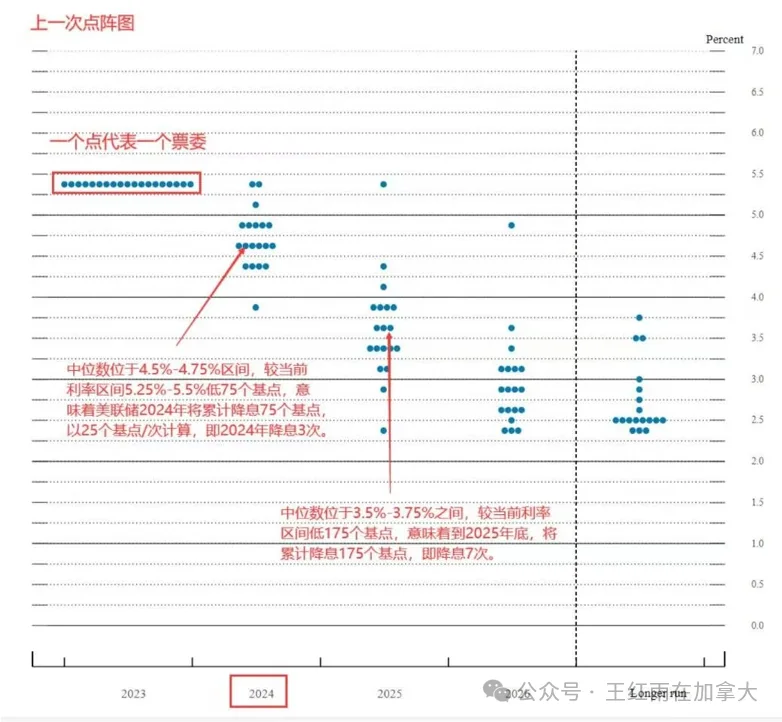
Figure 1 Fed Dot Plot in December 2023
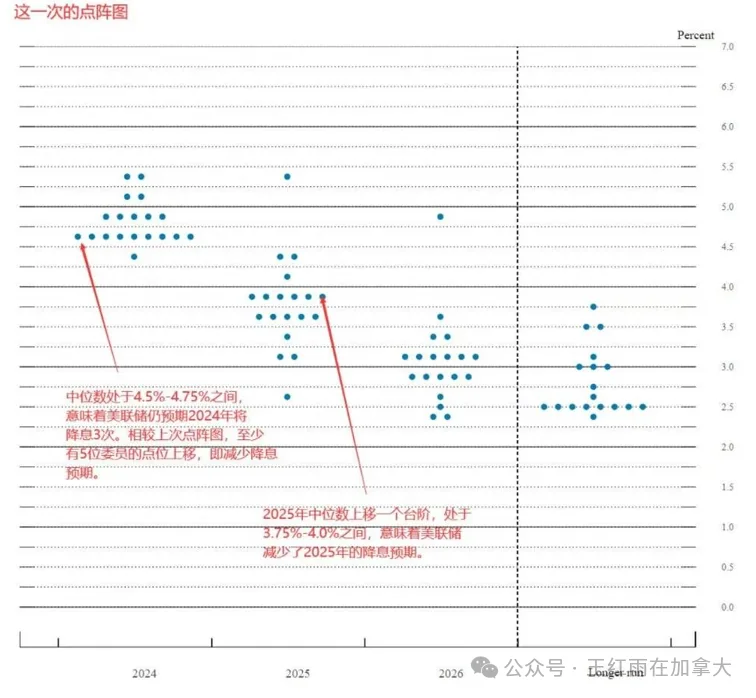
Figure 2 Fed dot plot in March 2024
01 The “conspiracy” of the Federal Reserve and the U.S. Treasury regarding interest rate trends
The last mile of interest rate hikes in June and July last year started a journey into the desert of high interest rates. The most extreme moment was the sharp increase in fixed interest rates from August 3 to November 3. During this period, households renewing their mortgages felt tremendous pressure. Almost all fixed interest rates were higher than 7%. The reason behind this was the skyrocketing U.S. bond yields. The storm suddenly stopped in early November, and the hero who debunked the high yields on U.S. Treasury bonds was a woman, U.S. Treasury Secretary Janet Yellen. Amid the global chorus of badmouthing U.S. Treasury bonds, Yellen remained calm and collected, and struck a resolute and powerful blow that struck a fatal blow: from August to November last year, the face value of U.S. Treasury bonds plummeted, and the corresponding Treasury bond yields rose sharply, causing bank mortgage loan interest rates to skyrocket. In early November, Yellen announced the repurchase of U.S. Treasury bonds. What does this mean? When a U.S. Treasury bond with a face value of 100 yuan was sold, its face value dropped to 90 yuan. When the U.S. Treasury repurchases it at this time, it is equivalent to paying off its own debt of 100 yuan with 90 yuan. Yellen's move shocked the bond market, and short sellers of U.S. Treasuries suffered heavy losses. Yellen single-handedly prevented the collapse of bond prices, paid off part of the debt for Americans at a low price, and saved the bond market.
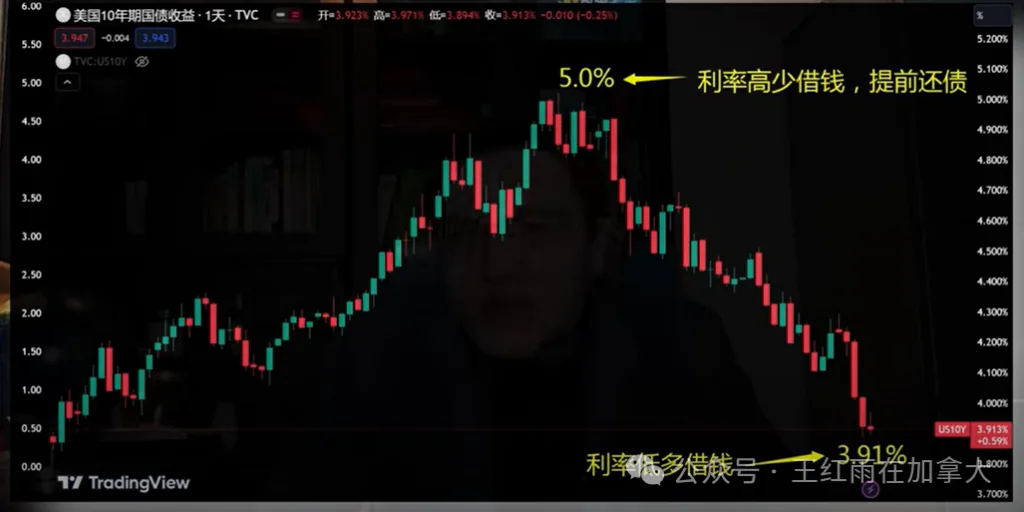
Figure 3: The Federal Reserve will repurchase U.S. Treasury bonds in November 2023
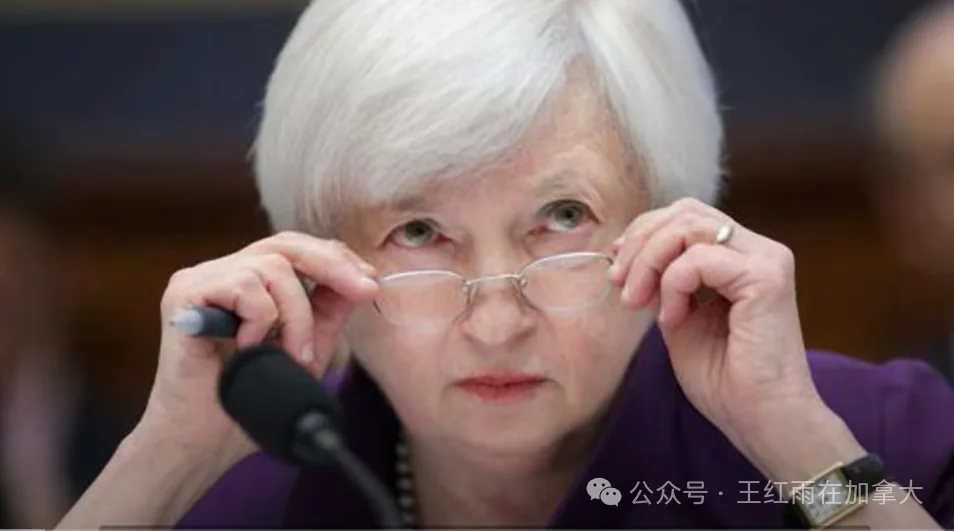
Yellen is the first female Federal Reserve Chairman and the first female Treasury Secretary in the United States. Her husband, George Akerlof, is the winner of the 2001 Nobel Prize in Economics. He is a representative figure of elite governance in the United States and the elite of American elites. The cumulative balance of U.S. national debt currently exceeds 34 trillion, and the risk cannot be eliminated by just detonating a bomb. The world is watching the live broadcast of the bomb squad composed of Yellen and Federal Reserve Chairman Powell. The biggest surprise in 2024 is how to resolve the 340,000-yuan U.S. government debt that matures this year. As we all know, Americans will not repay the national debt. When the national debt matures, new debt will be issued to repay the old debt. If a large number of old debts mature in a short period of time, new debts need to be issued intensively. Who will buy them? If it is not handled well, the yield on new debt will need to be raised to attract enough buyers, thereby increasing the United States' debt interest burden. Of the 34 trillion treasury bonds, 5 trillion will mature in the first quarter of 2024, accounting for 14.7% of the balance, which is the highest level of maturing treasury bonds in the next five years. Let’s take a look at Yellen and Powell’s bomb-disposal operation: Powell suddenly announced in December last year that he was considering cutting interest rates. At that time, the whole world was shocked and speculated on when and how much to cut interest rates. The effect of the atmosphere is to encourage people who expect interest rate cuts to quickly buy U.S. Treasury bonds when yields are high. If they buy late, the yields will gradually fall with the interest rate cut. Yellen took advantage of the fact that the IRS's first-quarter tax collections reached the highest level in the past three years to announce the scale of new bond issuance. The announced scale was far smaller than market expectations. The effect of the atmosphere was to make potential buyers feel that the U.S. government was not short of money and that national debt was a scarce resource and needed to be snapped up. This was not enough. Yellen issued a large number of short-term Treasury bonds when the old bonds matured. The issuance of Treasury bonds from 6 months to 1 year increased significantly, while reducing the issuance of long-term Treasury bonds. It is obvious that Yellen wants to issue long-term Treasury bonds when long-term bond yields are low after the Federal Reserve finally cuts interest rates, thereby reducing Americans' interest costs on Treasury bonds.It sent a strong signal to the market that it was also betting on the Federal Reserve to cut interest rates this year. When Powell testified before Congress in March, he once again emphasized that interest rates would be cut in 2024, confirming market predictions. The Federal Reserve is directly responsible to Congress. Therefore, there is no room for talk in the military, and we must do what we say. Powell's performance is not over yet. He also hinted to the market that he will acquire short-term U.S. Treasury bonds to replace long-term bonds on the Fed's balance sheet. Cooperating with Powell is another heavyweight, Waller, who is considered by the market to be the favorite to be the next chairman of the Federal Reserve. Waller made it clear that the Fed should buy short-term U.S. Treasury bonds to replace existing long-term bonds, especially long-term mortgage-backed securities. The reason is simple. The yield on short-term U.S. bonds is high and the yield on long-term mortgage-backed securities is low. The Fed also needs to make money. Yellen is selling short-term Treasury bonds like crazy, and the Federal Reserve has said, "Let's buy them." The whole drama is public. I just want to ask you whether you believe that the U.S. debt crisis has been debunked and that interest rates will be cut this year.
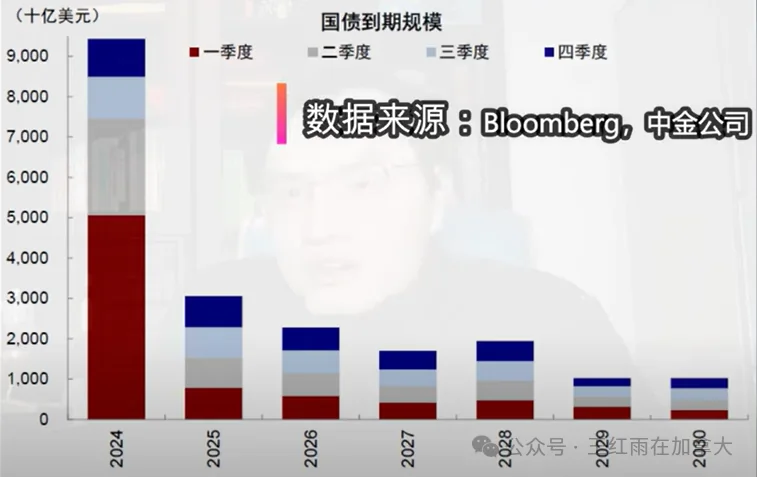
Figure 4 U.S. Treasury bond maturity scale
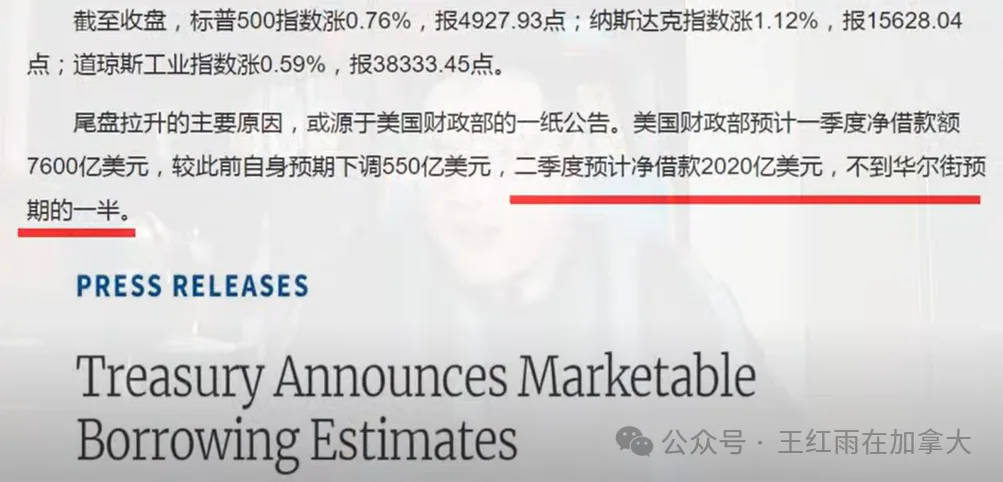
Figure 5 The Ministry of Finance reduces the issuance of new government bonds

Figure 6: Powell hints at buying short-term Treasury bonds

Figure 7: Waller hinted at buying short-term government bonds
After getting through the crisis of concentrated U.S. debt maturities in the first quarter, I don’t know whether the Fed will raise the threat of inflation again. Judging from the inflation situation, no one knows when inflation will drop to the target value of 2%, whether in the United States or Canada, but the last mile of the decline in the inflation rate must be tortuous and difficult. Therefore, the process of implementing interest rate cuts will be tortuous, cautious and difficult. After all, the risk of a resurgence of inflation still exists. This is why Powell only promised to cut interest rates this year, but never committed to the timing and extent of the rate cuts. A dot plot of Fed members shows,The 0.75% interest rate cut in 2024, with the time to be determined, is still just a weather forecast. It is still unknown when the nectar of the interest rate cut will come and how much rain will fall. Families suffering in the desert of high interest rates still need to be patient.
02 Will a black swan fly out to save all sentient beings?
In 2024, can't something bad happen to the United States and cause the Federal Reserve to suddenly cut interest rates sharply? Where have all the black swans gone? Households anxiously awaiting interest rate cuts can easily fall into this fantasy. In fact, I have been doing this daydream for a year last year. The black swans went to sleep and did not take off. In 2023, Wall Street judged six times that the Fed's monetary policy had turned, and speculated that various "emergency" events could interrupt the Fed's pace of raising interest rates. We have all seen the results, and they all failed. They were all misjudgments. The most exciting one was a year ago, last March, when three banks were taken over by the FDIC, the deposit insurance company. To this day, some people are still imagining that a "sudden" or "scaring" event will allow the Federal Reserve to cut interest rates seven times in a row. A few days ago, the stock prices of New York community banks plummeted, which made people seem to see the flickering fire again, and they are looking forward to the United States igniting a raging fire, and the Federal Reserve to open the tap to save the United States with an emergency interest rate cut. There are now more than 4,000 banks in the United States, and three of them were shut down at the same time last year. The Federal Reserve only used a few words to put out the fire. New York community banks' heavy holdings of commercial real estate credit assets have long been on the radar of regulatory authorities and are unlikely to become a black swan. If New York Community Bank really fails, it will become a specimen of a bank that was killed by rent control for future generations to admire. A large proportion of New York Community Bank loans are lent to apartment owners subject to rent control. In 2019, New York City introduced laws to strictly control the eviction of long-term ultra-low-rent tenants due to renovations. These owners have low rental income and high interest costs. It is too difficult to survive. They may choose to give up at any time and run away without paying back the loan. Issues such as the Red Sea, Ukraine, Kazakhstan and Israel have long been on the radar of the United States. They are within the range of gunboats and are unlikely to become emergencies that affect the Federal Reserve. A black swan event needs to meet two conditions: 1. It was not foreseen and there are no preventive measures; 2. It has a systemic impact and is not an isolated incident.
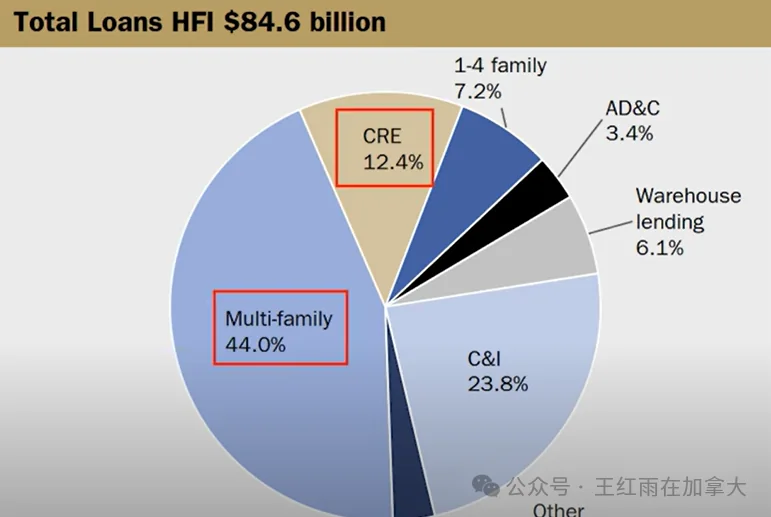
Figure 8 Asset distribution of New York community banks
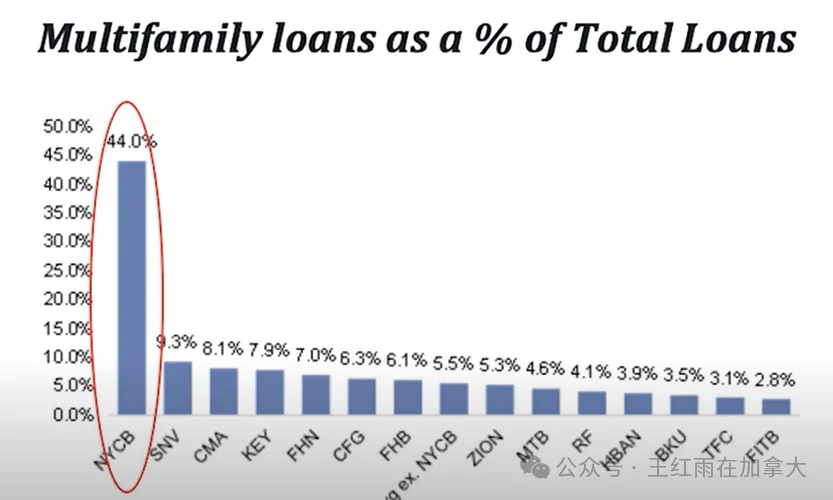
Figure 9 New York Community Bank multi-suite loan ratio
Did a white swan fly out? For example, inflation suddenly rebounds sharply. It's not very likely either. Inflation was suppressed from 9% to 3% in only 16 months, which shows that raising interest rates is a very efficient fire extinguisher. It's just that the fire extinguishing agents are not removed, making it very difficult for families with high debts. At present, inflation in the United States and Canada is not dead, so it may rekindle. When wage growth exceeds 3.5%, inflation will be supported by income growth. The US wage growth rate is now 4.5%, which is supporting inflation. In addition, rising rents and mortgage interest rates are caused by interest rate increases, which in turn support rising inflation. For example, Canada's inflation index in February this year was 2.8%, of which mortgage interest rates increased by 26.3%. It can be seen that it is not that easy to get rid of the plaster of inflation. The central bank now lacks the courage to initiate an interest rate cut policy for fear that inflation, which has been suppressed, will rise again.
There are two non-economic factors that may have an impact on monetary policy this year. One is the U.S. election. The Democratic Party urgently needs to cut interest rates to relieve its supporters. The second is artificial intelligence. OpenAI is currently breaking through the situation of general technology doing nothing, and has already emerged as the killer application of Vincent Video. If more applications are launched, the U.S. economy may not land, but directly take off again, and there will be no need to cut interest rates. These two non-economic factors have a negative impact on monetary policy, and the results are unpredictable.
03 How do ordinary people cope?
On August 15, 1978, when Nixon announced that the United States would end the fixed exchange rate between the U.S. dollar and gold, it caused global chaos. When various countries complained that the United States had plunged the world into a quagmire of floating exchange rates for its own benefit, then-Treasury Secretary John Connally responded, "The U.S. dollar is our currency, but it is your problem." Yes, this problem is still our problem today. The interest rates set by Americans are still affecting our lives today. They have been like this for the past 46 years, and they will still be like this for a long time to come. The conspiracy theory is that the United States maintains high interest rates in order to harvest so and so. After so many years of investigation, the conspiracy theory has not been solved. Therefore, I choose to believe in conspiracy. After all, the above-mentioned conspiracy unfolding before our eyes is already very brain-burning.
As an insider, the Bank of Canada is also watching the live broadcast of the conspiracy between the Federal Reserve and the U.S. Treasury Department. Because it is too confusing, the Bank of Canada has not yet made any commitment to cutting interest rates. The Governor of the Bank of Canada knew clearly that he would be scolded for asking us to bear high interest rates, but he gritted his teeth and insisted that it was still too early to cut interest rates. He searched for reasons to refuse to discuss the topic of interest rate cuts. The main reason was that he could not figure out what kind of medicine Americans were selling.Canada in January this yearThe CPI was 2.9%, and it was 2.8% in February. If the CPI continues to fall in March, it will pave the way for the central bank to cut interest rates. As for whether the Bank of Canada will "get off the slope", it is still unknown.In view of this, in my article on February 20, I suggested that households with heavy debt burdens should close the door as soon as possible and take action as soon as possible if interest rates can be lowered, instead of waiting for the big pie to hit them with seven interest rate cuts this year. Remember Connery’s famous saying that the dollar is the currency of the United States, but it is our problem. “We” include not only little people like you and me, but also big people like the Governor of the Bank of Canada. We need to solve our own problems by ourselves. It would be good if we could understand the performances of the American elites. It is difficult to compete with these people. They are not serving us.
04 How to develop your own economic thinking
British economist Maynard Keynes had a major influence on the world. He discovered that if every family was frugal and no one spent lavishly, there would be insufficient demand, and everyone's income would spiral downward or there would be mass unemployment. This situation of "good things" for individuals and "bad things" for groups, which are transmitted through the market and ultimately harm individuals, was called the "fallacy of composition" by Keynes. What he means is that the outline of a forest is not the sum of what each tree in the forest looks like. In order to deal with the fallacy of composition, he proposed a new economic idea: macroeconomics. From this we can easily see that macroeconomic policies that are beneficial to the whole may be harmful to individuals. Raising interest rates is a macroeconomic policy and a measure taken to stabilize the purchasing power of currency, but raising interest rates will hurt households with heavy debt burdens. Family is a microscopic subject. Ever since the ancient Greeks studied economic issues before BC, economists have taken families as their research object. It was not until Keynes discovered the fallacy of composition that economics bifurcated, and macroeconomics and microeconomics emerged. Before the advent of macroeconomics, the government had few ideas and means to "regulate" the economy. At that time, the people were simple and economic factors were determined through the market and interpersonal interaction. For example, American economist Irving Fisher believed 100 years ago that the level of interest rates is determined by people's "impatientness." In war-torn countries, people are very "impatient." If you want someone to postpone consumption and lend you money, you need to pay a very high interest rate. With the advent of macroeconomics, the government found that it could "regulate" the economy well by manipulating interest rates, so interest rates were not determined "impatiently" but by the central bank. It has been less than a century since the birth of macroeconomics. There is no good policy that is universally applicable, and every country is trying to cross the river by feeling its stones. Whoever touches the head will be unlucky. No, the central bank continues to raise interest rates, making families with heavy debt burdens miserable and thinking about interest rate cuts day and night. Measures that are good for the entire forest may not be good for each tree.
Technological progress is unstoppable and has an impact on both macro and micro economies. The emergence, spread, maturity and decline of technology is a spontaneous order. It is not planned and cannot be arranged in an orderly manner. Therefore, some people call the impact of technology on the economy complex economics, or mesoeconomics. The rapid progress of OpenAI technology and the emergence of killer applications will start a new Kangbo cycle expected to last 60 years. Each of us is standing at a new starting point.
The economic phenomenon seems complicated, with a lot of macro, meso and micro issues. In fact, our middle-class families in North America don’t need to worry about much. According to my own understanding, from ancient times to the present, economic issues mainly involve 30 categories and 103 topics. In agricultural society, industrial society, and the information age, while old problems recur, not many new problems emerge, but the solutions to old problems in the new environment are definitely different. For example, property rights are the foundation of the capitalist economy. From ancient Greece to today, people have been playing games around property rights, sometimes cooperating, sometimes competing. The problems have not changed, but the methods have often become new. The problem to be solved is nothing more than how to legally obtain more property rights and how to better protect their private property rights. The above-mentioned topics on interest rates involve short-term central bank interest rates and long-term bond yields, macroeconomic management departments such as the central bank and the Ministry of Finance, as well as meso-level technological progress, and micro-level household feelings and reactions. Even if you just want to see an interest rate issue clearly, you need to have solid basic knowledge of economics and the ability to filter information, use your own economic thinking to make corresponding judgments and decisions, and put them into practice. On April 6, the first Saturday in April, I will hold an offline lecture on the theme "How to Train Economic Thinking" and form an AI community on site. Once the specific registration method is determined, it will be posted in the message area of this article.
Conclusion
Don't pin your luck on black swans. Only by studying Western economics can you establish an economic way of thinking and control your own destiny.Time during the day is for studying, not daydreaming. The middle-class families of the first generation of North American immigrants are responsible for many tasks such as adapting to the environment, exploring ways to survive, and accumulating wealth. Accumulating wealth while working requires not only effort, but also direction. The last mile before the interest rate cut coincides with the promotion of AI applications in front of us. I leave you with a question for readers: After the interest rate cut, how to use AI to take yourself to the next level in wealth accumulation.