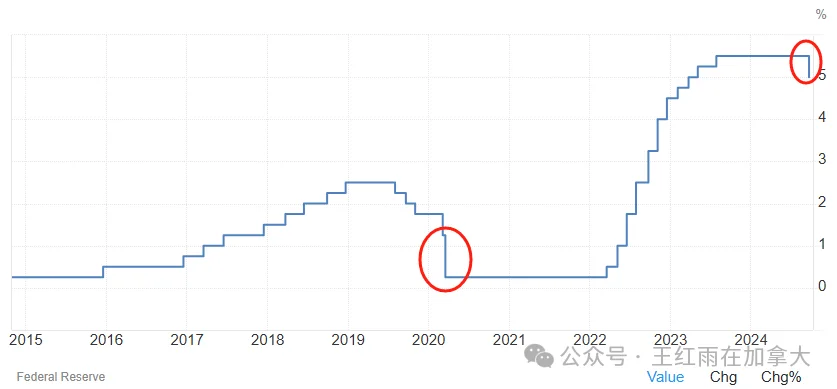
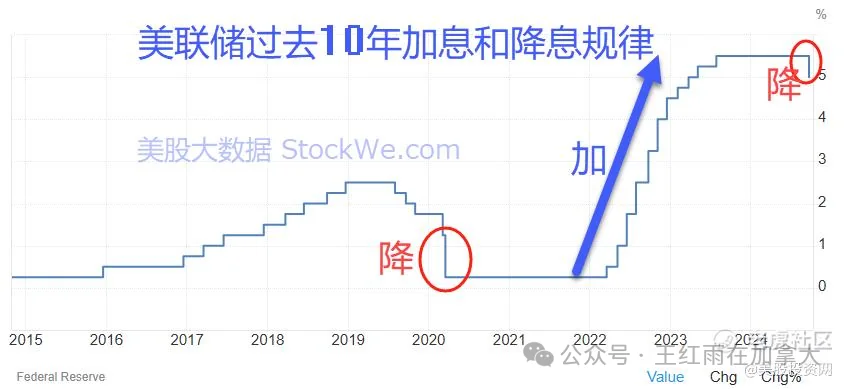
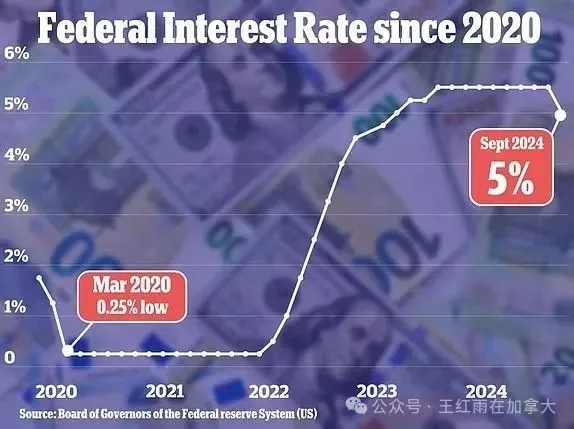
In the past two and a half years, the Federal Reserve's actions have been quite eye-catching, attracting the attention of the world. Every time it raises interest rates, people open their eyes wide and feel more and more breathless. The sudden and unexpected 0.5% interest rate cut on September 18 brought the benchmark interest rate from 5.3% to 4.8%, which made people deeply doubt whether the American Big Brother was in bad health. At the press conference, reporters frantically asked the Fed Chairman if the U.S. labor market was in trouble. Why did it cut interest rates so much? Powell gritted his teeth and never admitted that there was a problem with the economy or that the unemployment rate might be out of control.
Within a week, something unexpected happened in Canada. On September 16, the Canadian Ministry of Finance officially announced the relaxation of mortgage policies without even saying hello. In the past 16 years, there has only been news about tightening mortgage policies, but there has never been news about relaxing them. Adjustments to Canada's fiscal policy have a greater impact on those of us living in Canada.
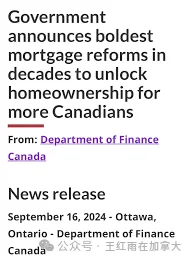
Starting from July 2012, borrowers with a down payment of less than 20% will have a maximum repayment period of 25 years, while borrowers with a down payment of no less than 20% will have a maximum repayment period of 30 years. This dual-track system, which has been implemented for 12 years, will finally be merged on December 15 this year. Currently, borrowers with a down payment of less than 20% have a maximum borrowing capacity of four times their annual income, and borrowers with a down payment of no less than 20% have a maximum borrowing capacity of five times their annual income. After the new loan policy was implemented in December, low-down-payment homebuyers have substantially increased their borrowing capacity equivalent to one year's income: borrowers with an annual income of 80,000 yuan have increased their borrowing capacity by 80,000 yuan, and borrowers with an annual income of 150,000 yuan have increased their borrowing capacity by 150,000 yuan.Relaxing and extending the mortgage repayment period is the fastest way to improve your ability to buy a house, bar none.It is unprecedented to launch such a bold policy to stimulate demand at the beginning of interest rate cuts. When the Ministry of Finance website announced the new lending policy, the title was Government announces boldest mortgage reforms in decades to unlock homeownership for more CanadiansThe boldest mortgage reform ever, to help more Canadians achieve homeownership.”
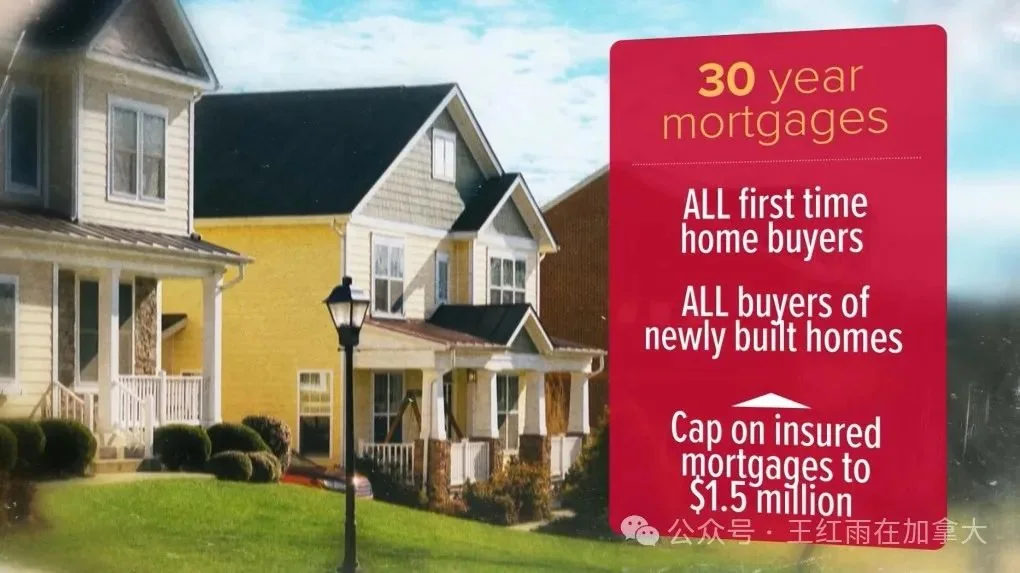
For the sake of votes, the Liberal government no longer cares about housing prices. This release of borrowing capacity is comparable to the release of currency, and is worthy of great joy. After borrowers with a down payment of less than 20% and borrowers with a down payment of more than 20% have equal borrowing capabilities, families that act quickly will buy a house earlier than families that are slow to save a 20% down payment, and they will be better off before housing prices rise rapidly. In the competition to buy a house,Families with a low down payment but high household income will have an advantage over families with a high down payment but low income.This is fair, because the higher the income, the higher the tax and the greater the contribution to society. Before December 15 this year, families with a down payment of more than 20% still had some advantages in the house-buying war. After the implementation of the New Deal, families with high income and low down payment will have an impact on the real estate market. No matter what the purpose of the Liberal Party is,Policies that can push up housing prices are good policies.Before the new policy is implemented on December 15, households that currently have a borrowing advantage need to hurry up.
01 Is the Federal Reserve cutting interest rates as a precautionary measure or turning interest rate policy?
Everyone knew that the Federal Reserve was going to cut interest rates, but the first rate cut of 0.5% was unexpected by many people. There are roughly three ways for the Federal Reserve to cut interest rates. 1. Disaster relief rate cuts, subprime mortgage crises, and epidemic outbreaks all use disaster relief rate cuts, that is, lowering interest rates to the lowest level in the blink of an eye; 2. Preventive rate cuts, to prevent economic recession and rising unemployment, and slowly cut interest rates in small steps, for example, the 2019 rate cut, cautiously lowering interest rates by 0.25% each time; 3. Interest rate shifts, from controlling inflation to promoting employment, for example, in 2001 after the bursting of the Internet bubble, known as the Fed Pivot, "Federal Reserve pivot." The third type of interest rate cut has been on people's minds over the past year. The capital market has repeatedly misjudged the Fed's policy shift, but all failed. The interest rate cut on September 18 should be a reversal of interest rates.
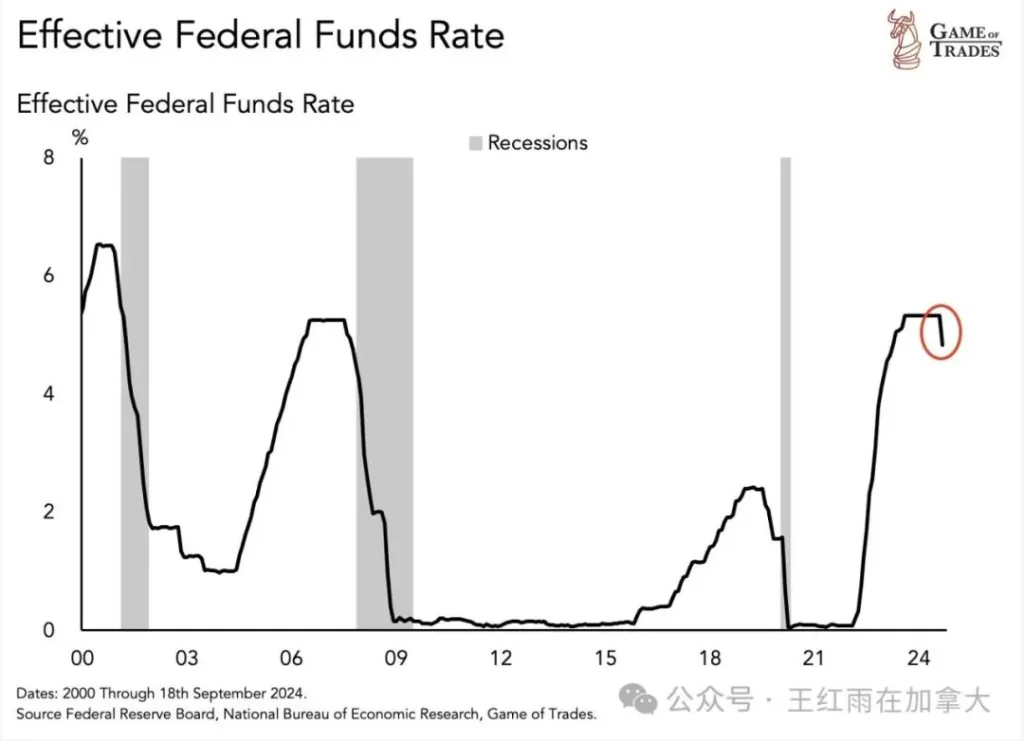
The current policy direction of the Federal Reserve is very transparent. On September 18, the dot plot of the Federal Reserve Open Market Committee was announced. The votes of the Federal Reserve members who have the right to vote on future interest rate trends show that it is expected to cut interest rates twice more in 2024, each time by 0.25%. In 2025, the interest rate is expected to be cut by 1%, and in 2026, the interest rate will be cut by 0.5%. According to the predictions of "own people" within the Federal Reserve, interest rates will be cut by 2% in the next two years, and the benchmark interest rate will return to the neutral interest rate of 2.8%. The dot plot is a method of expectation management, not a commitment of any kind, just the collective speculation of Fed members at this moment.
Every country has its own central bank, but the Fed is the central bank for all other countries' central banks because the U.S. dollar is the world's currency. The appeal of the Federal Reserve to cut interest rates is unquestionable. Most countries around the world are entering the channel of interest rate cuts, including Canada. An interest rate cut means that income-producing assets will be revalued according to the new interest rate.The lower interest rates are, the higher asset prices are. A new round of wealth effect is coming.
02 The Canadian real estate market will make waves again
"Some people cannot afford to buy a house, and it is not just a matter of income. An important reason is the shortage of housing supply. The reason is very simple. The current maximum repayment period of the bank's loan is 30 years. If it is changed to the maximum repayment period of 50 years, many people will be able to afford it immediately under the same housing price and income. Therefore, the affordability of housing prices is a false proposition in itself. No matter how you study and analyze income, it will be wrong... If the bank extends the repayment period from 30 years to 50 years, The demand for buying houses will be greater, and housing prices will rapidly rise to new heights. It is not impossible for bank regulatory authorities to allow banks to do this, because the longer the repayment period, the easier it is to afford the loan, and the lower the loan default rate will be. Any research reports, papers, and news on the affordability of houses are all based on a false proposition. "The above paragraph is excerpted from "A Collection of False Propositions in Real Estate" on August 7, 2022, "Henry Wang in Canada" public account. I wrote this article when the housing crisis was making headlines all day long. The core point is,It is difficult to solve the problem of housing supply. We need to build more houses. It is very easy to solve the problem of housing supply. We just need to extend the mortgage repayment period.It seems that there are people in the Trudeau government who understand that extending the mortgage repayment period can solve the problem of loan difficulty. Unexpectedly, demand began to be stimulated before the supply problem was solved. I was too conservative. I never expected that the government would be so determined and powerful in pushing up housing prices.
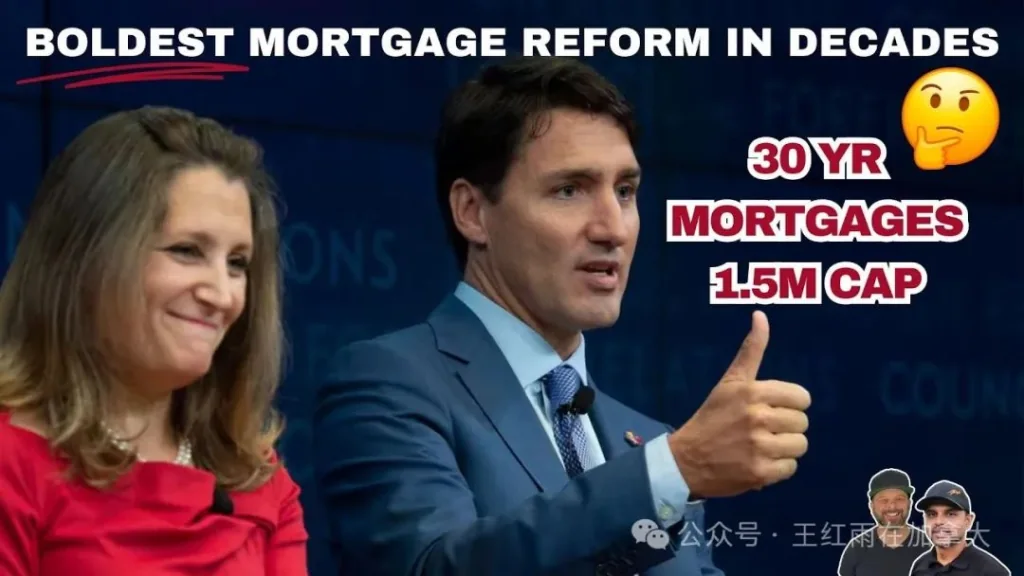
After three interest rate cuts this year, the Canadian real estate market remains stagnant. If housing prices do not rise, there will be no wealth effect and no desire to consume, which will lead to insufficient domestic demand and a deep economic recession. At this moment, it is timely to relax the mortgage loan policy to stimulate the economy. When interest rates were cut in 2008, the maximum repayment period was shortened from 40 years to 35 years, limiting borrowing capacity. After cutting interest rates in 2021, banking regulators introduced a minimum stress test rate of 5.25% to limit borrowing capacity. In the past, during periods of interest rate cuts, mortgage policies were tightened. On September 17, Canada’s consumer price index (CPI) fell to 2% for the first time in three years, paving the way for the central bank to cut interest rates. On September 18, the Federal Reserve cut interest rates by 0.5%, which will make the Bank of Canada more confident in cutting interest rates. Interest rate cuts can already stimulate demand. Coupled with the relaxation of mortgage policies, the real estate market will take off again and is just around the corner. The premise is that Trudeau will still be Prime Minister on December 15th.

The affordability of buying a home is determined by the longest mortgage repayment period.Since 2008, due to housing supply failing to keep up with demand, the maximum repayment period for mortgages with less than 20% down payment has dropped from 40 years to 25 years. As people live longer and longer, the mortgage repayment period should become longer and longer. The maximum reasonable repayment period now should be 45 years. Since 2012, borrowers with a down payment of no less than 20% have been allowed a 30-year repayment period; borrowers with a down payment of less than 20% have a maximum repayment period of only 25 years, thus limiting the purchasing power of households with low down payments. The repayment period is 25 years, and you can borrow up to 4 times your annual income; the repayment period is 30 years, and you can borrow up to 5 times your annual income. Taking a property worth 1 million as an example, the minimum down payment is 5% down payment for the first 500,000, and the minimum down payment is 10% for the remainder. Therefore, the minimum down payment is 75,000, the loan amount is 925,000, the loan default insurance rate is 4%, the insurance premium is 37,000, and the total loan amount is 962,000. According to today's policy, the borrower needs an annual income of at least 241,000. The new policy after December 15th extends the repayment period from 25 years to 30 years, and only requires an annual income of 193,000. The new policy will allow more families with low down payments to get loans to buy houses.Demand has increased, supply has remained basically unchanged, and rising housing prices are inevitable.

When first-time homebuyers face the above policy changes, they need to make some calculations and trade-offs. A family with an annual income of 200,000 yuan is buying a home for the first time and currently has a down payment of 90,000 yuan. Should it buy a house immediately after the policy changes? If you want to buy a house worth 1 million and want to make a down payment of 20%, you still need to save another 110,000 for the down payment, and there is no need to pay loan default insurance premiums. If you pay a premium of 37,000, you can buy a house immediately. Note that loan default insurance is insured by the bank to the insurance company. When the bank lends the loan, it immediately pays the insurance company a premium of 37,000. At the same time, the 37,000 is added to the loan principal and repaid in installments by the borrower. The borrower does not need to pay the premium in cash, or the premium is also borrowed. The beneficiary of loan default insurance is the bank. Once the borrower defaults, the bank will seek compensation from the insurance company. If house prices are on the rise, buying a house with a low down payment can take advantage of the situation. Families with borrowing capacity and confidence in the real estate market and their future income will choose to buy early; families with the opposite idea will continue to "wait." In any case, if the new policy of December 15 is implemented for many families who currently have insufficient loan capacity, their borrowing capacity will be greatly improved, and some families will definitely embrace this gift. The supply of new homes in Canada is about 220,000 to 250,000 units per year. The number of new immigrants has increased significantly in recent years, but the housing supply has been lower than the demand for a long time. Buying a house is like a game of musical chairs. You move slowly and have no place to sit. You have to stand all the time. More and more people are joining the game later. The number of new chairs has limited growth, and competition will become increasingly fierce.

Home loans with loan default insurance are the highest quality raw materials in the Canadian asset securitization market. Among the mortgage loans undertaken by commercial banks, the portion covered by default insurance can be easily sold to CMHC to cash out and use the funds to make more loans. CMHC sells these mortgage-backed securities (MBS mortgage backed security) to investors to help commercial banks realize mortgage loans. At present, CMHC mainly underwrites loans with repayment periods of less than 25 years. Due to the limited asset scale, the amount of securitization is also limited. After the implementation of the new policy, the scope of mortgage loans acquired by CMHC is likely to be expanded to housing loans with a repayment period of 30 years, which will greatly increase the high-quality raw materials for asset securitization. Asset securitization is the largest source of funds for housing finance. After the New Deal, banks will receive more low-price funds.
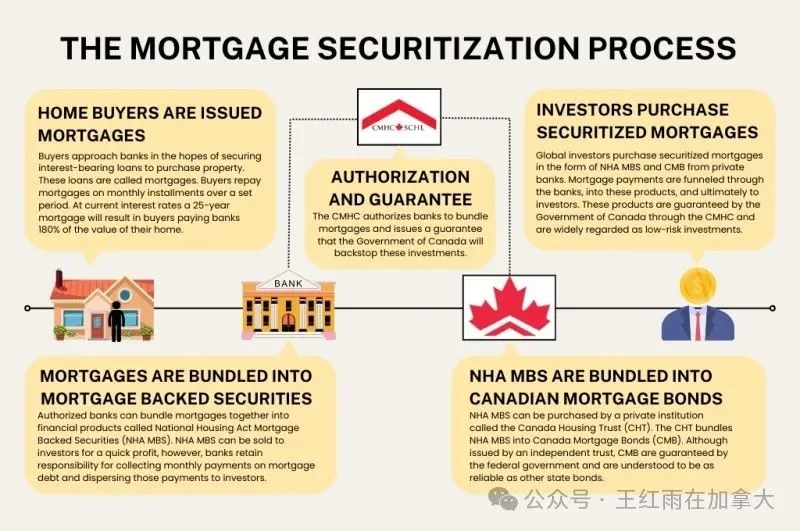
The new housing loan policy will intensify the intensity of the house grabbing game and at the same time create more funds for banks to use for issuing mortgage loans.If the Trudeau government can persist until December 15, the Canadian real estate market will set off a new wave.
03 Impact on real estate investment
Although this adjustment to the mortgage policy has increased the housing price limit for low-down payment loans from 1 million to 1.5 million, there are probably very few families with an annual income of more than 200,000 who have not yet purchased a home, so relaxing the housing price range will have little impact.
Renting a house has the attributes of a Giffen commodity. Families with higher incomes are less willing to rent. Pickles are Giffen goods. The higher your income, the less pickles you consume. Compared with buying a house, renting a house is like pickles and is a Giffen good. The income elasticity of Giffen goods is negative, as income increases, consumption decreases. Many families buy houses before their annual income reaches 200,000. The current average price of condos in the Greater Toronto Area is 675,000, the average price of townhouses is 890,000, and the average price of semi-detached houses is 1.02 million. Families that have suddenly increased their borrowing capacity should focus on purchasing the above three types of mid- to low-priced properties. Generally speaking, the target properties of first-time homebuyers are highly overlapped with those of real estate investors.
Regarding the issue of investing in second-hand CONDOs, I would like to paraphrase a passage from group friend Lao Jin in full, because he said it better than me: "People often ask me, condos don't rise, right? In fact, this question is easy to answer. Let's assume your conclusion is correct. Condos don't rise, but houses rise. So there will be a gap between the prices of houses and condos. People who buy houses are in urgent need, but the income of people who buy houses ranges from low to The high is continuous, and there will be no gap like this in a certain period of time. Buyers have no ability to push down the housing prices above the gap, so they can only raise the housing prices below the gap, which will inevitably drive the condo price to fill the price gap. If you understand this logic, it will be clear whether the condo will rise. The second one is investment housing. After-tax income is your money. The current capital gains inclusion rate is 2/3 for a house worth 1 million. Double it, earn 1 million, and double the income of 1 million with two 500,000 condos. The difference in after-tax income is even greater. The two 500,000 condos can be sold in two years, and they have enjoyed two tax discounts below 53%. Now there are two tax discounts below the 2/3 inclusion rate, and the after-tax income gap will be huge. The 2/3 capital gains inclusion rate is good for low-priced houses, but bad for high-priced houses. Now, many developers cancel projects, and condos are currently very low. Confused, there will be a supply shortage in the next few years, coupled with changes in the capital gains tax inclusion rate, this is an opportunity to buy. In addition, the income requirements for two 500,000 condos are lower than those for buying one 100, so it is easier to achieve 20% first. Pay, 5 times income, 50*0.8=40/5=80,000 income. If you buy a house, 1 million, 80,000 income requires a down payment of 600,000. For two condos of 500,000, the down payment is 10+10=200,000.The pre-tax rate of return on investment of own capital is house 100/60=1.67 and condo 100/20=5, which are also much different. The tax benefits of selling in two years are even greater. Therefore, investment cannot only be based on how much the investment has increased, but must also calculate how much is ultimately obtained and the return on investment. This is the real investment income. "Lao Jin has made it very clear about the essence of CONDO investment. I just want to remind you that he is talking about second-hand CONDO, not off-the-plan CONDO.
The New Deal will lead to the sudden appearance of many competitors, and many families with insufficient down payments were originally not eligible to participate in the home-buying competition this year. However, due to the change in the competition system, many previously unqualified contestants are now eligible to participate in the competition. Real estate investors are some of the smartest people in the crowd and know what to do now.
04 Uncertainties and risks of the New Deal
The uncertainty of the New Deal is mainly reflected in whether Trudeau can persist until December 15. The prime minister is unpopular and public discontent is growing, otherwise he would not have proposed policies that exacerbated the housing crisis. Knowing that there are more people and fewer houses, we are still stimulating demand just for the sake of votes in the hands of young people. For real estate investors, any mistake is a mistake. Policies that can make the housing crisis last longer and housing prices rise are beneficial to real estate investors. As ordinary middle class people, they have no ability to change the old policies or prevent the new policies. They can only take necessary actions in a timely manner to take advantage of the existing or upcoming new policies.
Mortgage default insurance companies may take the opportunity to raise insurance rates. Before December 15th, mortgage insurance companies may lobby the government to increase insurance rates to extract more wool from first-time homebuyers and share in the real estate feast.
Some opponents say that the new mortgage policy will increase the already heavy debt burden of Canadians and should be opposed and resisted. I asked in CHATGPT: “What is the ratio of Canadian household debt to disposable income?” Answer: 180%. Ask again, “What is the ratio of Canadians’ household net worth to disposable income?”: Answer: 850%. What does it mean? That is to sayCanadianA liability of 180 yuan is supported by an asset of 850 yuan.. Those who only look at liabilities and not assets are unfounded worries. Many people think that "cash is king", but in Canada, "debt is king". Families that can borrow mortgage loans from big banks mean that they are worthy of the bank's trust, and banks are willing to lend money to such families to hold more properties. Low-income families are depositing money, and high-income families are taking loans. The bank's job is to make losses more than enough, amplifying the Matthew Effect.
Conclusion
People who are too pessimistic about the real estate market may have forgotten that the biggest player in the market is the government. This player is also the rule maker and referee of the game. When the Prime Minister and the Minister of Finance feel that they are in danger, they will modify the rules of the game and try to continue the game, even if it is more intense, in order to compete for the referee qualifications of the next game. It is understandable that politicians pursue political correctness, not economic correctness. The public choice school represented by Buchanan believes that no politician is an angel. It is the essence of politicians to pretend that personal interests are public interests. After the Federal Reserve radically cut interest rates, the Chairman of the Federal Reserve refused to admit that there was a problem with the U.S. economy. Therefore, U.S. Chief Economist Trump suggested that the Federal Reserve was participating in a political game. Canada's political game is unabashed. Changing the mortgage policy is just to win the votes of young people.As voters and ordinary families, the only thing we can do is to be economically correct and strive to make the right economic choices every time there is a major policy change.In the past two and a half years, real estate investors have been working very hard. They have been living a hard life, trying hard to use real money to deleverage and maintain cash flow. Now they finally see hope. Real estate investors are caught up in various political games, sometimes benefiting and sometimes losing. As long as the gains outweigh the losses in the long run, it is worth continuing to play, come on!