In my article on June 24 this year, "Looking for Historical Rhythm | Analysis of the Canadian Real Estate Market after the Interest Rate Cut," I reviewed the history of the Toronto real estate market in the past 15 years. At that time, some readers commented that 15 years was too short and not representative. I humbly accept the suggestion and review a shorter history, the changes in the real estate market in the past four years since the outbreak of the epidemic.
30 years ago, Bill Gates published the book "The Road to the Future". 1995 can be said to be the node of the second industrial revolution and the first year of the third industrial revolution - the information technology revolution. In the industrial age 30 years ago, information was very slow. Not only did the real estate investment experience at that time have no reference value, but the entire employment, investment, and life experience have little reference value for today. The so-called industrial revolution is ageneral technologyThe birth of the new era has changed all production relations and production efficiency, making it difficult for past experience to adapt to the new environment.

In the first industrial revolution, the steam engine was used as a universal technology in various production fields. No matter how much we miss the handloom, we cannot stop the mechanization of the textile industry. The second industrial revolution was electricalization. Electric lights and cars entered people's lives. It was inevitable that coachmen would lose their jobs. The third industrial revolution is the computer and chip revolution. Companies can distribute the production of product parts around the world and then assemble them. An IPHONE mobile phone is jointly manufactured by 48 countries around the world, rather than being produced in one go in the United States. With the blessing of information technology, the supply chain can be dispersed around the world for the first time. The gap in production efficiency between countries has widened, resulting in the gap between the rich and the poor that can no longer be bridged. Artificial intelligence AI will lead the fourth industrial revolution. 2024 is equivalent to 1995, the first year of the information revolution, becoming the first year of artificial intelligence. It can be seen from the review of previous industrial revolutions thatAt the peak of every industrial revolution, when the most advanced technology penetrates into all aspects of work and life, society presents a highly unstable state.In the past four years, in addition to extreme social polarization in income and wealth caused by information technology, natural disasters such as the epidemic have also occurred, creating what the former Governor of the Bank of Canada called "the next era of uncertainty." The last era of uncertainty was the 1970s. In 1977, John Kenneth Galbraith published the book "The Age of Uncertainty". In my opinion, the uncertainty in the 1970s was mainly due to the withdrawal of the gold standard from the stage of history, the loss of exchange rate anchors, and the beginning of a turbulent era of floating exchange rates around the world.The uncertainty now is much more serious, mainly because interest rates have lost their anchor and become completely unpredictable.Below, combined with the Toronto real estate market that I am most familiar with, I will briefly review the unexpected and uncertain events that have occurred in the past four years, but may occur frequently in the future, and use history as a guide to help readers better grasp the future.

01 Housing prices and monetary policy
After the outbreak of the epidemic, the most unexpected thing was that without finding effective anti-epidemic measures, the Bank of Canada not only cut interest rates sharply, but also lowered interest rates to historical lows. People are confused. What is the relationship between the epidemic and interest rates? Can low interest rates cure pneumonia? On February 29, 2020, the Bank of Canada’s interest rate of 1.25% was already very low, but the central bank announced a rate cut of 0.5%. This was not enough, and on March 27, 2020, the interest rate was lowered to 0.25%, the lowest point ever. The then central bank governor announced on March 27 that he would not only cut interest rates, but also launch a quantitative easing policy to purchase various bonds without limit and inject super liquidity into the economy. The former Governor of the Bank of Canada wrote this in his memoirs: "On the afternoon of March 27, I attended the Finance Minister's press conference and answered questions from reporters. The exchange with one of the reporters was particularly memorable for me. Because we had announced that we would buy at least $5 billion in government bonds per week, the reporter asked me if there was a limit. I answered bluntly that the plan was unlimited. Then the reporter asked me if I had gone too far. My answer used another metaphor:“Firefighters are never criticized for using too much water.”"This is a historical moment. Not only does the interest rate no longer have an anchor, it neither looks at the inflation rate nor the employment rate. The central bank has the final say as to how much it should be reduced. The most exaggerated thing is that there is no anchor anymore on how much money can be printed. They can print as much as they want. People on earth have never seen this approach before, so they don't know. How to deal with it. At that time, everyone was busy looking for masks and did not care to listen to what the central bank said. They had no idea what impact this flood of money would have on our lives. On June 3, 2020, former Central Bank Governor Stephen Poloz. Poloz stepped down, and the new governor, Tiff Macklem, came on stage, opening a new chapter in the rich and colorful lives of Canadians.
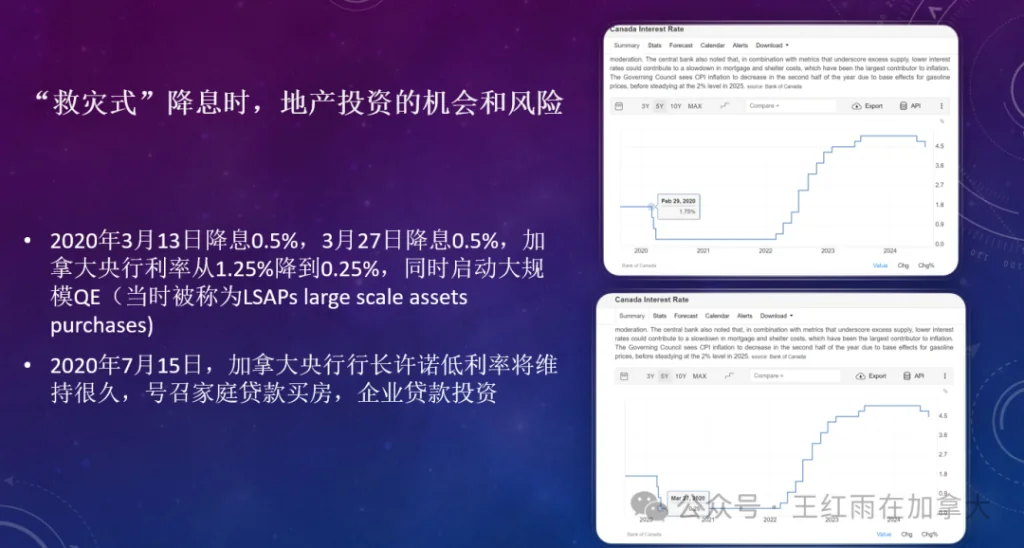
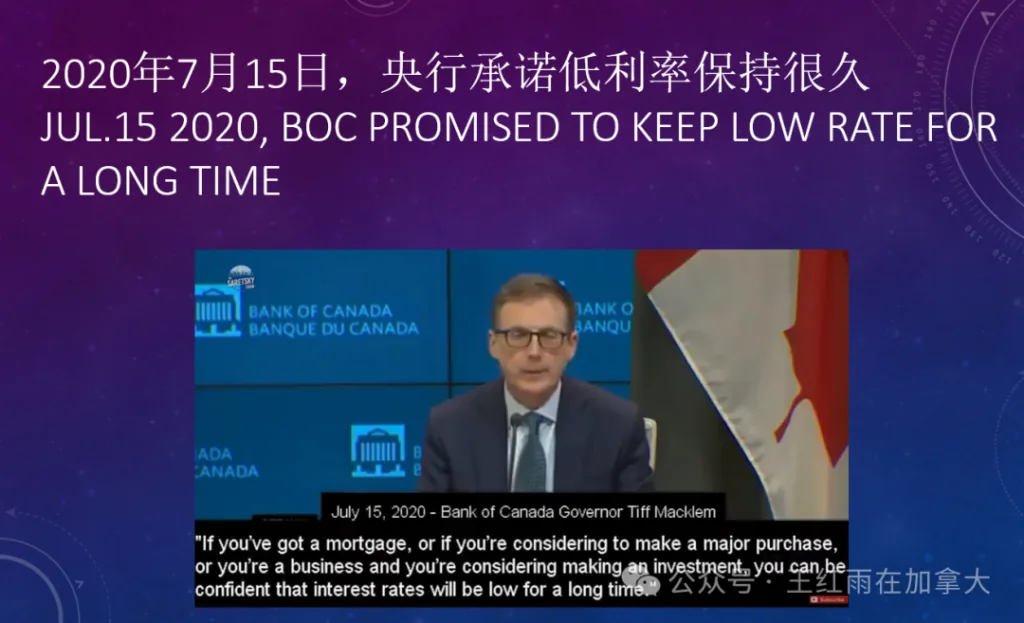
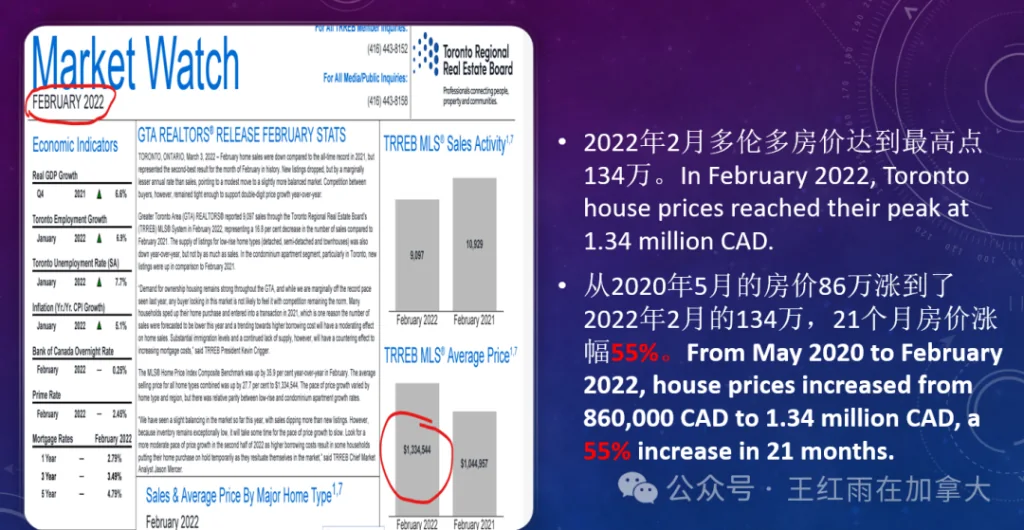
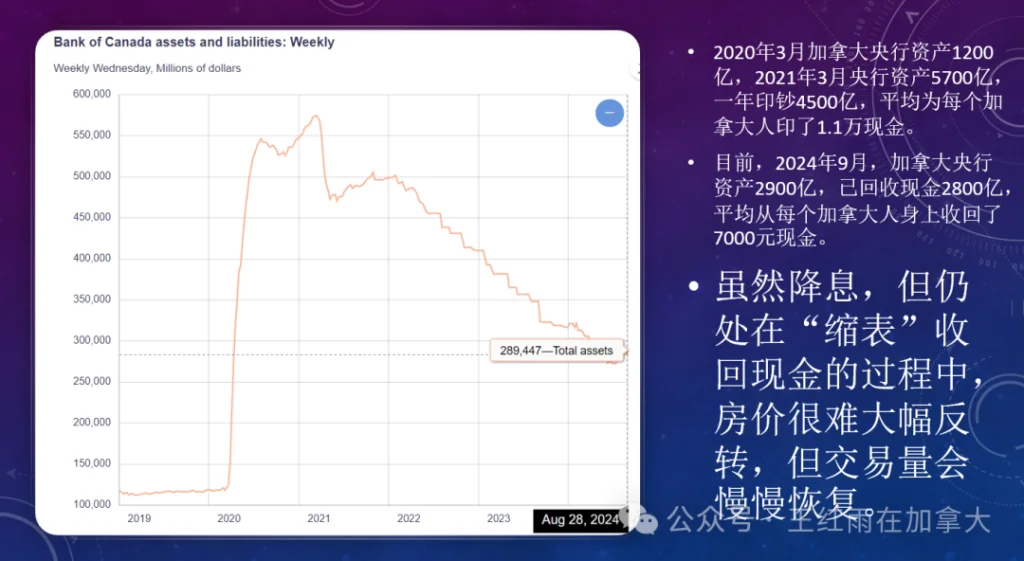
The new central bank governor is a frank and honest person. One month after taking office, he said at a press conference on July 15, 2020: If you have plans to buy a house and invest in business, go ahead and do it. I will keep interest rates low for a long time. This sentence woke up many people in their dreams. Yes, with such a low interest rate, you should get a loan to buy a house. Judging from my own business records, the V-shaped reversal of the Toronto real estate market occurred in July 2020. During the epidemic, the Bank of Canada released a total of $450 billion in water. What is this concept? The central bank gave Canadians, including babies, a banknote with a face value of $11,200. Most of this money went into the real estate market, and the rest went into the consumer market. It only took a year and a half for Toronto's housing prices to rise from over 800,000 in July 2020 to 1.28 million in February 2022. The money that really cannot go into real estate has caused massive inflation. What we see is that there is house price inflation first, and then there is price inflation.

The lessons the epidemic has taught us are:There is no anchor for interest rates, and the central bank can control it at will; there are no restrictions on money printing, and you can print as much as you want. How much wealth each family can receive depends on its own ability. In Canada, real estate has the strongest ability to attract money, not stocks, nor insurance.I think everyone knows what to do next time something like this happens.
02 When can the central bank’s words be trusted?
In the last article, I left a foreshadowing for everyone. I said that I know what the central bank governor says is trustworthy and what words cannot be trusted at all. Now here’s the answer: When central bankers, especially the current Tiff Macklem, say they’re going to keep interest rates on hold for a very long time, it’s completely untrustworthy. In July 2020, he said that low interest rates would remain low for a long time. At that time, not only me, but almost everyone believed him. When he raised interest rates for the last time in July 2023, he repeated his old tactics and said he would maintain the 5% interest rate until 2025. I didn’t believe it, and wrote an article on July 25, 2023, “The Bank of Canada said the 5% interest rate will be maintained until 2025. Do you believe it?” 》, you can Google it. My experience is,The central bank promised more thanThe predictions, promises and guarantees made in February are not credible.However, predictions and hints within 2 months can be believed. For example, at the press conference announcing the first interest rate cut on June 5, 2024, when Tiff responded to the first reporter’s question, he couldn’t wait to say: If you expect another interest rate cut on July 24, it is reasonable. I believed it on the spot, but many people, especially my colleagues, still relied on intuition and inertia to bet with me.
The lesson the epidemic has taught us is: no one can predict the future, including the central bank governor; no one can guarantee that he or she will keep his word, especially the central bank governor. If you believe wrongly, once is enough. If you believe again, you will be sacrificing yourself.

03 Is it important to choose a bank?
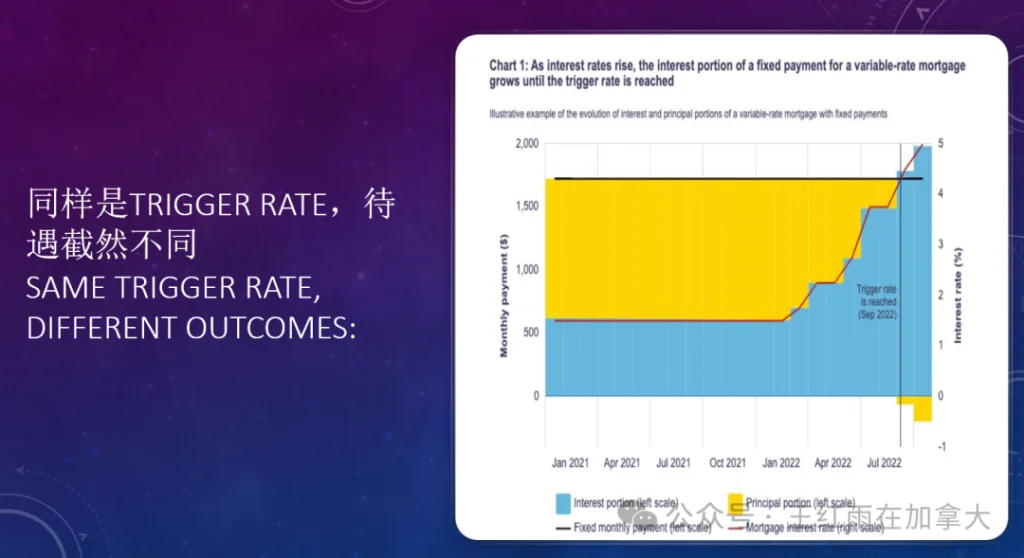
When the interest rate hike in 2022 was in full swing, a new word trigger rate suddenly appeared. Some people did not recognize this word at all and thought it was "tiger rate", which shocked themselves. What is the "trigger interest rate" is stated in the loan contract and should be explained to the borrower by a lawyer. Because each bank takes different steps when the trigger rate is reached, lawyers need to be extra careful in interpreting this phrase. I have asked several lawyers if they have noticed the different approaches of various banks on this issue. Unfortunately, very few people have noticed this issue. When borrowers choose floating interest rates, they need to pay special attention to the issue of trigger interest rates.Many people's cash outflow problems are caused by trigger interest rates. Therefore, choosing a bank is important.

There are risks in floating interest rates, but no one thought that the risks would be so great that they could affect their lives. Some people feel that they have been victimized by quackery and chose floating interest rates. No matter which bank the borrower chooses, the 5-year floating rate can be converted to a 5-year fixed rate at any time without penalty. People who feel that they have been harmed by quacks will neither read the loan contract nor take remedial measures, and just cry like a giant baby. The outcome will certainly not be ideal.
The lesson the epidemic has taught us is: the future will be more uncertain, and there are still many things we can’t think of, but adults must be responsible for their own actions. Don’t be a giant baby, don’t easily believe anyone’s advice, when you encounter problems, go to experienced professionals and do in-depth research yourself to finally find a solution.
04 Both greed and fear can cause losses
During the period of crazy rise in housing prices, some people couldn't hold themselves back anymore and entered the market with high interest rates even though they clearly had no ability to buy a house. The last batch of people who rushed into the market were all leeks who turned from fear to greed, and it was the same in the property and stock markets. Someone left a message under one of my videos in 2021: You said that you can only borrow 5 times your annual income for each house. This is seriously misleading. I can borrow more. That's probably what it means. I wonder how these arrogant people are doing now. I always watch the movie "The Big Short" over and over again, always reminding myself not to give readers overly optimistic opinions. Even if it is more conservative, it is better than being overly optimistic.
After the interest rate hike, people became too pessimistic. After the interest rate hike on March 2, 2022, Canadian households withdrew as much as 35 billion from the stock market from April to November. What is the concept? In eight months, each Canadian household withdrew $2,333 from the stock market and transferred it into time deposits. This was a typical panic that, looking back, was completely unnecessary. The S&P 500 index was at 4,000 points in November 2022. Now, it is at 5,600 points in September 2024, an increase of 40%.
The lessons the epidemic has taught us are:Greed and fear will make people lose their footing, and people who follow the crowd are unlikely to have good results in investment.In the future, the market will fluctuate with greater amplitude and frequency. Pay attention to those who are hesitant to take action. The most hesitant group of people are leeks. Once they enter the market, the market will be in danger; pay attention to the direction in which the public is running. The purpose is to become a niche, and choose to run in the opposite direction to the public, because the successful investors are in the niche.
05 Don’t buy off-the-plan properties in the bull market
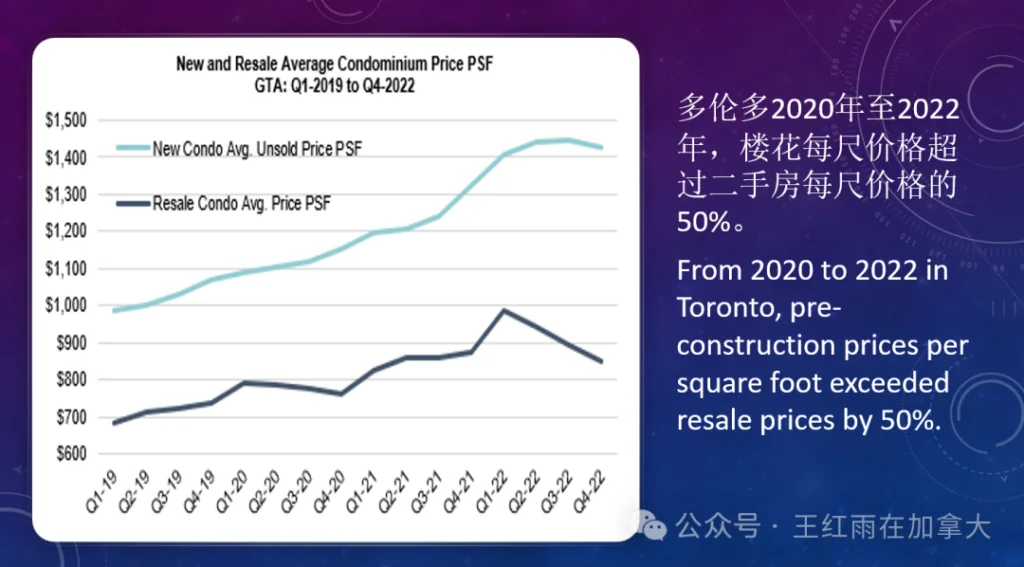
From the first day I wrote this official account, I have been advising everyone not to buy off-the-plan properties. After 6 years of code writing, it is still not as effective as the south wall. In the past two years, many people who have delivered off-the-plan properties, including some readers, are people who did not listen to advice, did not avoid risks, were blindly optimistic when the market was hot, and did not look back until they hit the wall. In the bull market, in 2021, off-the-plan property sales are booming, and many people have followed the trend and bought off-the-plan properties. Everyone has seen the difficulties faced by buyers of off-the-plan properties this year, and there is no need to say more here. For buyers who have already purchased off-the-plan properties, prepare in advance.
The lessons we learned from this are:When the real estate market is booming, don’t follow the trend. Keep a clear mind and evaluate the invisible risks through the temptations in front of you. Everyone will make mistakes in the investment process, learn lessons in time and never make the same mistakes again. Regardless of whether the market is hot or cold, real estate investors should stay away from off-the-plan properties, please generously leave this type of property to owner-occupied buyers and speculators. These buyers are not afraid of paying too high a price and can always find a way to hand it over.
06 Margin of safety in real estate investment
Every investor wants to buy a high-quality property at a low price, so they put a lot of effort into the timing and the house. Ordinary real estate investors are not prophets. The chance of buying an ideal house at the lowest price is very low. There are countless examples of missing the best opportunity to buy a house and regretting it. The best preparation in advance to resist risks is to reserve room for error. In stock investing, this margin of error is called the margin of safety. The safety margin of real estate investment is not the investment property itself, but the owner-housing debt.Households with no debt in their own homes have the strongest fault tolerance. Choosing the wrong investment property or choosing the wrong investment time can be offset by the debt-free home ownership. Families with heavy housing debt are not suitable for real estate investment.Families who have increased the mortgage on their own homes and used the money to buy investment properties should have experienced what it means to put out the fire with salary during the interest rate hikes in the past two years.
People who suggest adding a mortgage to their own home and taking out cash as a down payment for an investment home are not good doctors. The hot real estate market has aroused many people's enthusiasm for real estate investment. Some families with no experience and weak financial strength seek medical treatment indiscriminately when they are not sick, causing iatrogenic damage - they can live a few more years without seeing a doctor.Owner-housing debt is consumer debt, and investment housing debt is financial leverage. This is a matter of principle and cannot be vague.
07 Cash flow problems are the result, not the cause, of past decisions
In the past month, someone was still discussing the cash flow issue. I couldn't help but reply: When I was doing the loan, the stress test interest rate was 5.25%. Now, most of the renewal interest rate options provided by major banks are lower than 5.25%. Is the situation where the contract overturns when the contract is renewed is a bad world, a bad general environment, or is it your own problem? How did it pass the stress test?Cash flow problems are the result of past investment decisions and personal behavior, not a new problem.Negative cash flow is the installment payment of the down payment. Banks will not readily approve loans where the borrower has huge negative cash flow unless the borrower has very strong financial capabilities. I help clients apply for loans every day, and this couldn’t be clearer. It is unusual for so many families to suddenly appear with cash flow problems. Facing the problem of negative cash flow, the most common way to make mistakes is to make decisions on the rent of the house, for example, building additional properties, illegal subletting, etc. Renovation and additions require cash investment, thus reducing the leverage ratio; the legal risks of illegal subletting or renting to students by room are unbearable for investors. To solve the problem of negative cash flow, it is recommended to start with off-site income and personal consumer debt. It is more important to treat the symptoms than to treat the root cause, rather than drinking poison to quench thirst.
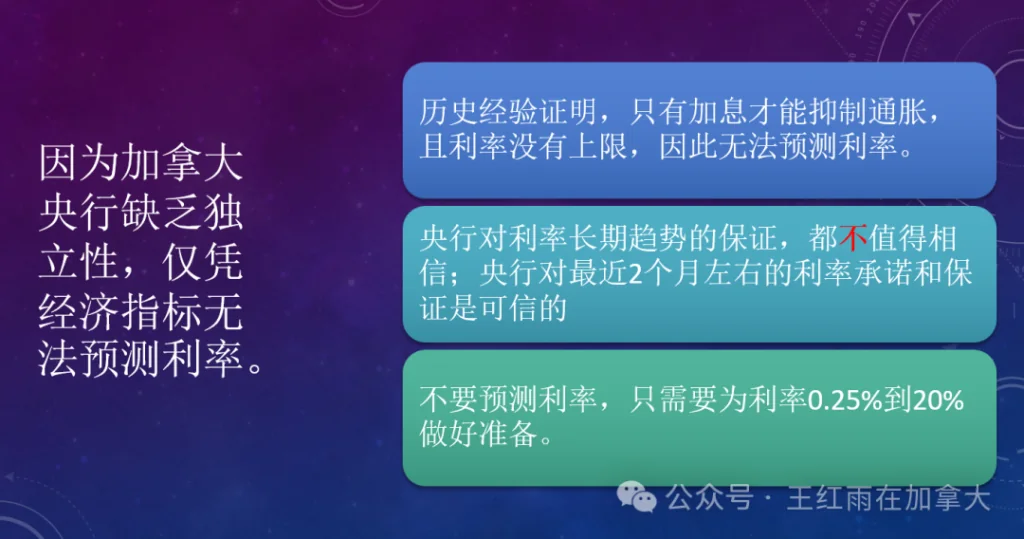
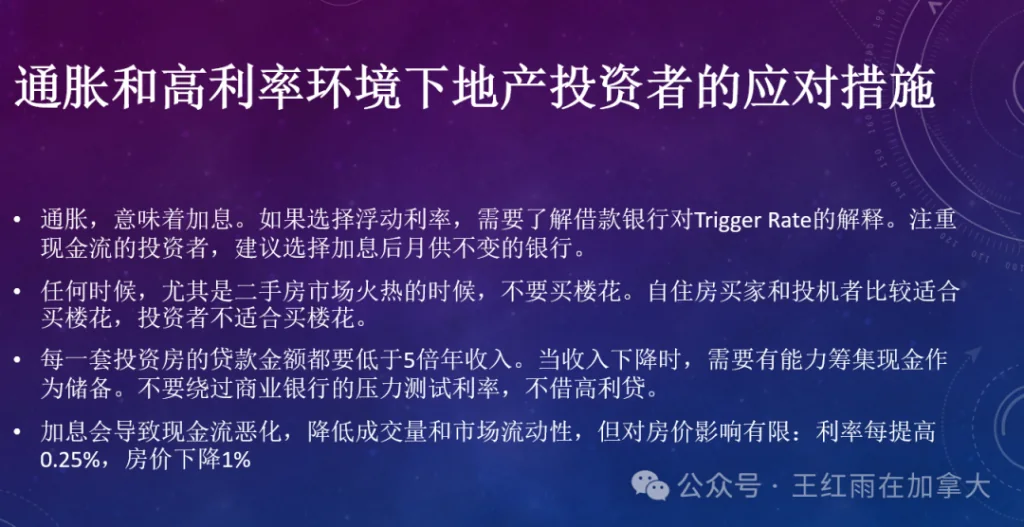
The lesson the epidemic has taught us is that real estate investment, like other investments, will not be smooth sailing.To ensure that there are no cash flow problems, four things need to be done:1. The owner-occupied housing debt must be zero or very small; 2. The maximum loan amount for each property cannot exceed 5 times the annual household income; 3. Make cash reserves for interest rates ranging from 0.25% to 20%; 4. If you choose a floating interest rate, it is recommended to choose a bank whose monthly payment remains unchanged when interest rates rise.
08 The relationship between inflation and interest rates
It is the first time for many people to experience inflation personally carrying debt, and they have neither psychological preparation nor financial arrangements. Anyone who has experienced inflation in the 1970s or has read the history of that period knows that the government at that time adopted a variety of means to control prices. The process was quite painful. To put it briefly, it was finally discovered that:Only raising interest rates can curb inflation, ten thousand other painless methods are ineffective. Anyone who knows history knows: "There is no upper limit on interest rates." If inflation cannot be controlled, the central bank will keep raising interest rates, even to 20%.
The lessons the epidemic has taught us are:As long as inflation occurs, the central bank will raise interest rates and will not stop until inflation is suppressed. Interest rates have no upper limit, so they are impossible to predict.

09 The relationship between interest rates and house prices
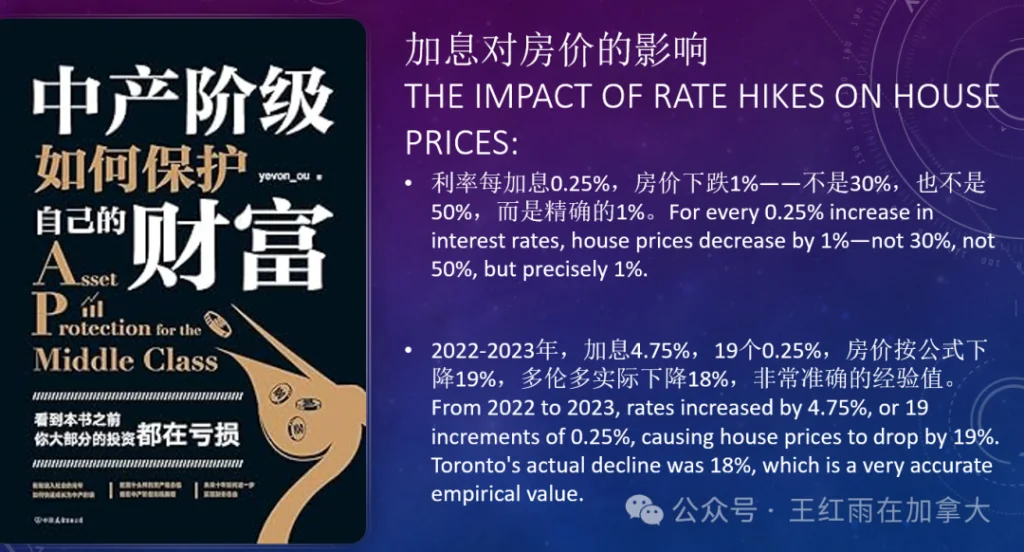
In 2017, I saw a statement in a book written by Ou Chenggong:Every time the interest rate increases0.25%, house prices fell by 1%.At that time, I didn’t believe it at all because it was completely baseless. Now, the housing prices in Toronto after Canada's interest rate hike proves this assertion of Ou Shen. The Bank of Canada increased interest rates from 0.25% to 5%, a total of 19 increases of 0.25%. We witnessed with our own eyes that housing prices in Greater Toronto came to an abrupt end after falling by 18%.
The lesson the epidemic has taught us is that there is no direct causal relationship between housing prices and interest rates. If we insist that there is a relationship, it is the above situation. Although there is no basis for it and it is purely based on naked eye observation, it can be roughly explained:There is a very weak relationship between interest rates and house prices, so weak that once other factors affect it, the impact of interest rates can be completely ignored. However, if interest rates continue to rise, it will significantly reduce volume.
10 Unemployment rate and real estate market
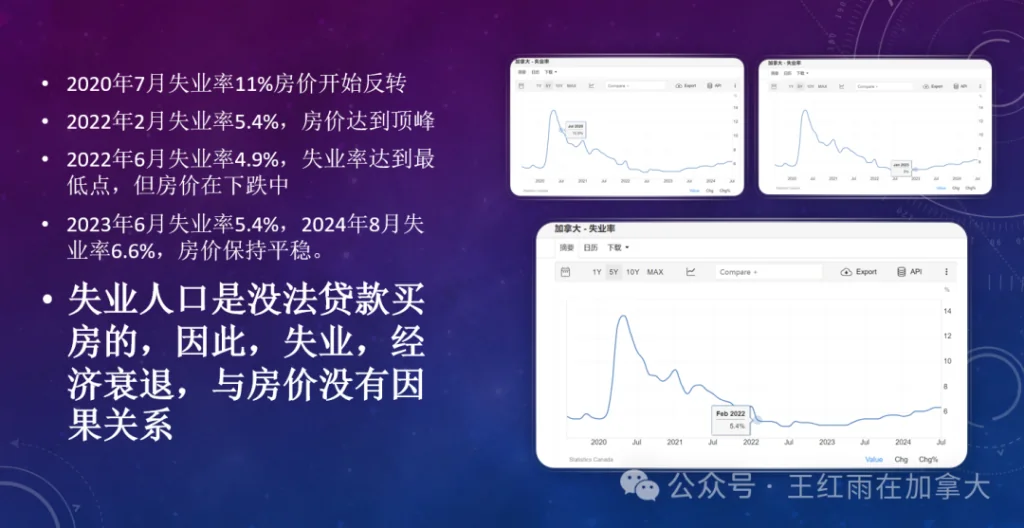
The current unemployment rate in Canada is 6.4% and is expected to rise to 7% in the second half of 2025. Many people predict that Canada will enter a recession and housing prices will fall. In the past four years, the most intuitive data has been the relationship between unemployment rate and housing prices. After the outbreak, housing prices and transaction volume began to take off in July 2020, when the unemployment rate was 10.9%. Housing prices soared all the way to March 2022, when the unemployment rate was 5.3%. During this period, housing prices in the Greater Toronto Area increased by 46%. Since then, the unemployment rate has continued to fall, from 5.3% to 5% in December 2022, and remained there for 5 months. By April 2023, Toronto housing prices fell by 18% during this period. There is no direct causal relationship between the unemployment rate and the ups and downs of the real estate market, and the correlation is not strong. The main reason is that unemployment has little to do with buying a house.
The lessons the epidemic has taught us are:The essence of an economic recession is that some people lose their jobs, not that everyone's income drops. EvenAn 11% unemployment rate will not affect housing prices, because housing prices are determined by the income of households that can afford housing, and unemployed people cannot get loans to buy houses.
Conclusion:
If this article was written in 1994, 30 years ago, the above content would be classified as science fiction. History will repeat itself, but people who don’t understand history will never realize that history is repeating itself. Since the interest rate hike, some people in my circle of friends have been complaining about the interest rate hike. They believe that the interest rate hike has nothing to do with inflation and that interest rate hikes cannot curb inflation. Therefore, it is very important to understand history and remember history. I believe that in the not too distant future, the experiences of the past four years will happen again.
The information age satisfies our desire for information, improves our quality of life, and at the same time brings more job opportunities. We are in the first year of AI. Artificial intelligence means using machine learning to replace human learning. Those who don't know how to learn or are unwilling to learn will get what they want and no longer need to study or find a job. Every industrial revolution brings benefits to everyone, but also takes away more job opportunities. Everyone who relies on work income today faces a problem:How to convert active income into passive income before being replaced by machines.In 2019, I made 6 videos titled "We are forced to invest in order to balance our lifetime income." My views have not changed since then and will not change in the future. Interest rates have lost their anchor and money can be printed at will. Today, the issue of being forced to invest has become more urgent. As a property that can be used to balance your lifetime income, buy it now and cherish it.