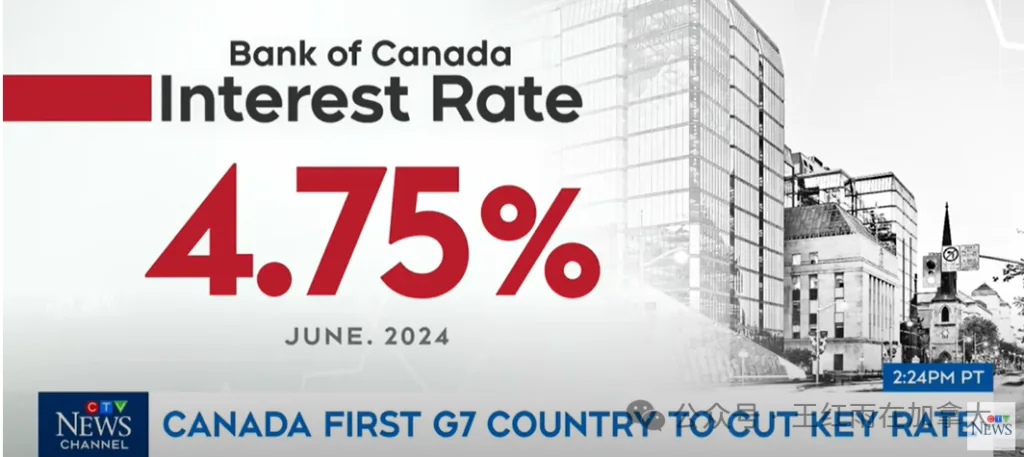
Looking forward to it, on June 5, 2024, Canadians finally ushered in the first interest rate cut since the opening of the interest rate hike channel in March 2022. Although it was only 0.25%, it also gave debtors a deep sigh of relief, as if they saw a glimmer of light in the long night. The next question is, will interest rates be cut this year? By how much, and what impact will it have on the real estate market? History does not repeat itself, but the rhymes are similar. In order to better plan for future investments, we need to review the changes in interest rates in Canada over the past 15 years, and take the real estate market in the Greater Toronto Area over the past 15 years as an example to look for historical rhymes and analyze the most likely development direction of the Canadian real estate market after interest rates are cut based on historical laws.
01 Review of Canadian interest rate changes in the past 15 years
Over the past 15 years, the Bank of Canada's interest rate adjustments can be divided into two categories: 1.policy shift, that is, substantially and continuously adjusting interest rates in one direction; 2.preventive measures, adjusting interest rates slightly.
From 2008 to 2009, interest rate policy shifted and interest rates were cut six times in response to the financial crisis caused by the subprime mortgage crisis.
In 2010, interest rates were raised three times. Precautionary interest rate increases were measures taken by Canada to prevent inflation; the Federal Reserve kept interest rates unchanged.
In 2015, interest rates were cut twice, which were precautionary cuts to prevent economic recession and rising unemployment, and more importantly, to cater for the general election that year. The Federal Reserve kept interest rates unchanged.
From 2017 to 2018, the interest rate policy changed, with five interest rate increases. The Federal Reserve's interest rate policy changed, causing Canada to passively follow suit.
In 2020, the interest rate policy changed and the epidemic broke out. Following the lead of the Federal Reserve, it printed money to provide disaster relief.
The interest rate policy will shift from 2022 to 2023, following the Federal Reserve's pace of raising interest rates, raising interest rates 10 times to curb inflation.
Throughout the past 15 years, the Bank of Canada’s interest rate policy has the following characteristics:The interest rate shift occurs when the Federal Reserve adjusts its interest rate policy. Small adjustments in interest rates are based on its own political and economic conditions; because when the policy turns and follows the Fed's interest rate policy, excessive interest rate increases or interest rate cuts are likely to occur, for example,The two interest rate hikes in May and July 2023 are considered by those in the Canadian economic industry to be an overshoot.
The central bank's interest rate affects the floating interest rate of housing loans and has no direct impact on the fixed interest rates of housing loans.The fixed interest rate on a mortgage depends on the yield on government bonds.To be more precise, the fixed interest rate on Canadian mortgages depends on the level of U.S. bond yields. I collected the data on 3-year fixed interest rates in May of each year in the past 17 years as a sample for analysis. The general situation is: the average level of 3-year fixed interest rates is 4%. That is, if we buy a house and choose a 3-year fixed interest rate from the first to the last renewal, and pay off the mortgage in 30 years, the average cost of funds will be about 4%. For a 3-year fixed interest rate, in the past 17 years, if you select the interest rate in May each year, the historical records are as follows:
There are 2 years when the interest rate exceeds 6%: 7% in 2008 and 6.3% in 2023.
One year, the interest rate was around 5%, and in 2024 it will be 5.3%.
For 6 years, the interest rate was around 4%, 4.15% in 2009, 4.6% in 2010, 4.55% in 2011; 4.3% in 2018 and 2019; 4.09% in 2022
For 8 years, the interest rate was around 3%, 3.95% in 2012, 3.55% in 2013, 3.75% in 2014, 3.39% from 2015 to 2017, 3.89% in 2020, and 3.49% in 2021.
Over the past 17 years, fixed mortgage rates, which have been between 3.3% and 4.7% for the longest time, can be considered an average of 4%.The lowest fixed interest rate period was quantitative easing/QE decides. A period of high fixed interest rates is a period when the central bank's monetary policy shifts from easing to tightening, including interest rate increases and balance sheet reduction/QT.
In the past 17 years, the central bank's highest interest rate was 5% and the lowest interest rate was 0.25%; the three-year fixed interest rate was as high as 7% and as low as 3.39%. Real estate investors can view the impact of interest rate changes on themselves in this way:When calculating return on investment, useThe interest rate of 4% is used to calculate the cost of capital, which is used to evaluate whether it is worth investing in real estate; always prepare cash reserves when renewing the contract, so as to avoid a rupture of cash flow.
02 Review of the Greater Toronto Area real estate market in the past 15 years
Analyzing changes in the real estate market mainly depends on two factors: transaction volume and housing prices.Fluctuations in the real estate market are mainly affected by people's expectations.In the modern economy, there are many factors that affect the market, and the effects of different factors at different times are also very different. Interest rate is only one of them. We cannot assume that other conditions remain unchanged and only analyze the impact of one variable on the supply and demand relationship. Therefore, we cannot find the rules for how interest rates affect the real estate market. Looking back at the market changes that have occurred around us in the past 15 years and trying to find some regular characteristics cannot be used to accurately predict the future, but only as a reference for discovering historical rhymes.
One of the characteristics of the changes in the second-hand housing market in the Greater Toronto Area is that the fluctuation range of transaction volume is much greater than the change in housing prices.Therefore, I thinkWhat affects the market is people’s expectations, and everyone’s expectations change rapidly., the sum of each person's changes is the change in total demand and total supply, which is aggregated into the market's supply and demand relationship.
Over the past 15 years, transaction volume in the Greater Toronto Area has changed as follows:
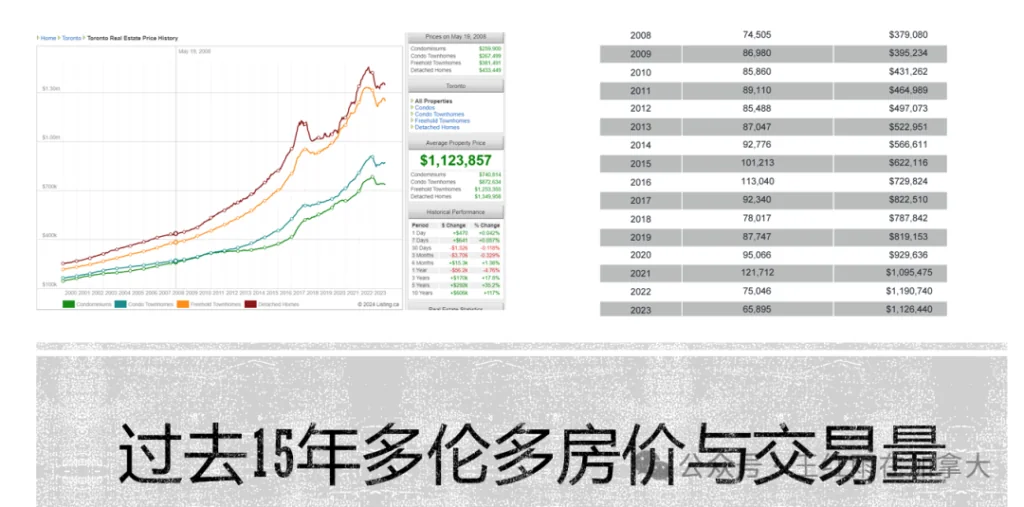
The transaction volume will be the highest in 2021, 120,000 transactions; the transaction volume will be the lowest in 2023, 66,000 transactions. Years with declining transaction volume: 2009-2010; 2011-2012; 2016-2018; 2021-2023. Years with transaction volume below 80,000: 2008, 2018, 2022, 2023. In the same area, when people expect house prices to rise, the transaction volume can be as high as 120,000 second-hand house transactions; when people expect house prices to fall, the transaction volume can be as low as 66,000 second-hand house transactions, with fluctuations as high as 45%. The magnitude of changes in transaction volume affected by people's expectations is much greater than the magnitude of housing price fluctuations.
In the past 15 years, the average home price in the Greater Toronto Area has increased from 379,000 to 1.126 million. An increase of 197% in 2015. Among them, there were two periods of decline in house prices: in 2017, house prices dropped from 822,000 to 787,000 in 2018; in 2022, house prices dropped from 1.19 million to 1.126 million in 2023. House prices rose in all other years. There are three main factors that affect housing price fluctuations, including interest rates, mortgage policies and immigration policies. Over the past 15 years, mortgage policies have continued to tighten and never relaxed. The unified mortgage approval policy B20 was launched in 2012; stress testing began in 2017; from 2017 to 2018, the income-neutral policy for new immigrants was gradually tightened until it was cancelled. The stress test threshold will be raised in May 2021. Looking at the impact of mortgage interest rates on housing prices in the past 15 years, it can be summarized as follows:House prices depend on interest rates in the short term, while the long-term upward trend in house prices has little to do with interest rates.Even if you bought a home in 2008, when interest rates were at their highest, the average house price has increased by 197%. Taking CONDO with the smallest increase as an example, the average price of a one-bedroom CONDO in 2008 was 250,000, and the average price of a one-bedroom CONDO in 2023 was 680,000, an increase of 160%. If you buy a one-bedroom CONDO unit in May 2008, the down payment is 50,000, and the three-year loan interest rate is 7%. When the contract expires in 2011, you will still choose a 3-year fixed loan contract, and the interest rate will be reduced to 4.55. %, continue to choose a 3-year fixed loan contract in 2014, and the interest rate is reduced to 3.75%; continue to choose a 3-year fixed loan contract in 2017, and the interest rate is reduced to 3.39%; continue to choose a 3-year fixed loan contract in 2020, and the interest rate rises to 3.89%; continue to choose a 3-year fixed loan contract in 2023, and the interest rate rises to 6.3%, that is, the current interest rate is 6.3%, expiring in 2026. In 2008, the rent for one bedroom was 1,372 knives, and in 2024, the rent for one bedroom was 2,495 knives. The rent increased by 81% in 15 years.The level of interest rates is not the key factor in determining the timing of buying a house. The most important factor in real estate investment is "action". Buy a property when you have the ability to borrow money, use the down payment to lock in long-term rising housing prices, and use the continuous depreciation of the currency and rising rents to obtain dividends from rising housing prices.In 2008, I made a down payment of 50,000 yuan and secured a property with a current market price of 680,000 yuan with the help of a bank loan. Based on the current rental level, the annual gross rent is 28,000 yuan, the initial investment cost is 50,000 yuan, and the annual gross rental return rate is as high as 57%.
03 The road to real estate investment is not an easy one
Real estate investment may seem like a guaranteed profit, but it is actually not easy. First, you must be able to borrow money, have enough down payment, and most importantly, you must have the ability to act; secondly, if you encounter high interest rates when the loan expires and renews, the monthly payment will increase, and the negative cash flow will increase, whether you have enough food to survive the difficulties; finally, in the face of market fluctuations, whether you can stick to the long-term goal of investment, continue to buy when you are able to borrow, and insist on not selling in the negative cash flow state. Buffett calls people who know it is a good time but dare not act "thumb suckers" who drool all over the floor and just stay put. Judging from the above example of buying investment properties in 2008 when interest rates were high, the vast majority of people were "thumb suckers" when interest rates were high. Just like the situation today, this is the rhyme of history.Without action, all learning and discussion are0, action is the most important 1.Whether to take action depends on borrowing capacity and adequacy of down payment, rather than house prices and interest rates.Borrowing ability has a shelf life and becomes void after expiration. Many families with no hope of buying a house have missed the golden period of borrowing ability. From then on, they love and hate the matter of buying a house and become a house hater, dreaming that the reverse of history will come back to pick them up one day. It's not easy to get on the bus, so don't get off easily.
Now I look back at the opportunities that have allowed me to get on a car in the past 15 years. I hope that families who still have the ability to get a car will do so and cherish it. A review of mortgage policies, immigration policies, and interest rate policies on transaction volume and housing prices in the past 15 years is as follows:
In 2008, the mortgage repayment period was shortened from 40 years to 35 years to avoid a recurrence of the overly loose US-style mortgages in Canada; Lehman Brothers collapsed on September 15, and the Federal Reserve and the Bank of Canada began to cut interest rates in October, reaching the lowest level in April 2009, and at the same time launched QE.
The latest regulations on mortgage loans in 2010 required a minimum down payment of 20% for investment properties, which was previously 10%; the Bank of Canada raised interest rates three times, while the Federal Reserve kept interest rates unchanged; Ontario's consolidated consumption tax PST+GST=HST resulted in a decline in transaction volume from 2009 to 2010.
In 2011, the loan repayment period was shortened from 35 years to 30 years.
In 2012, the repayment period for borrowers with less than 20% down payment was reduced from 30 years to 25 years; the banking regulatory authorities issued B20. This resulted in a decline in trading volume from 2011 to 2012.
The federal investment immigration program was stopped in 2014.
In October 2015, Trudeau was elected; the Bank of Canada cut interest rates twice.
In January 2016, the Federal Reserve raised interest rates; in August British Columbia introduced a non-resident real estate speculation tax; in September, the bank's policy of requiring new immigrants to make a 35% down payment regardless of income was exposed by the media, and banks urgently tightened their mortgage policies for new immigrants; from the end of 2016 to the beginning of 2017, the last batch of investment immigrants landed in Canada, and the detached house market was booming, pushing up the price of housing.
Stress test rules were introduced in 2017, with the contract interest rate + 2% to calculate solvency, or the V80691335 interest rate, whichever is higher; Ontario’s 420 policy introduced the foreign real estate speculation tax NRST; the central bank began to raise interest rates in July until early 2019. Both transaction volume and house prices fell in 2016-2017.
In 2018, interest rates were raised throughout the year, stress test interest rates were rising, and borrowing capacity was decreasing month by month; the housing bubble burst; all banks tightened policies on new immigrants regardless of income; transaction volume fell below 80,000 units for the first time in 10 years; house prices and transaction volume fell for two consecutive years.
The Federal Reserve cut interest rates three times in 2019; the Bank of Canada kept interest rates unchanged.
When the epidemic broke out in 2020, the Federal Reserve and the Bank of Canada lowered interest rates to the lowest level and restarted the QE quantitative easing policy.
In 2021, the transaction volume soared to 120,000 units; the average house price exceeded 1 million for the first time; on May 10, OSFI modified the stress test rules, and the contract interest rate + 2% was used to calculate solvency, or 5.25%, whichever is higher.
Interest rates will be raised eight times throughout the year starting in March 2022; transaction volume has dropped by 40%; house prices have dropped by 18% from the highest point in 2022;
Interest rates were raised twice in May and July 2023; the bank regulatory authority OSFI planned to tighten mortgage policies, but was unable to implement them due to resistance; transaction volume and housing prices continued to fall.
Mortgage policies are tightening year by year, which is visible to the naked eye and does not require any technical analysis. This trend is caused by more new immigrants and fewer new houses. The current situation continues to worsen. Therefore, if you can get on a car, get on one. The more you can get, the better. Especially in the first cities. The cities with the worst housing affordability are usually the first cities in a country with the most concentrated capital and population, and the proportion of the population living in rented houses is much higher than that in other second-tier cities.The choice of location for real estate investment is the most difficult place to buy a house. For investors living in the first city, buying, buying, buying is the most important investment strategy.The best time to buy a house in the first city is when interest rates are low and house prices are also low. For example, when the subprime mortgage crisis broke out, the time window was about 3 months; when the epidemic broke out, the time window was about 6 months, that is, every time the city was closed. This kind of optimal opportunity is not prepared for novices. Only a lonely warrior who has experienced hundreds of battles can seize such an opportunity. All other times are opportunities for ordinary people, regardless of interest rates, housing prices, or transaction volume."Buy early" is the best time。
04 How to face the future
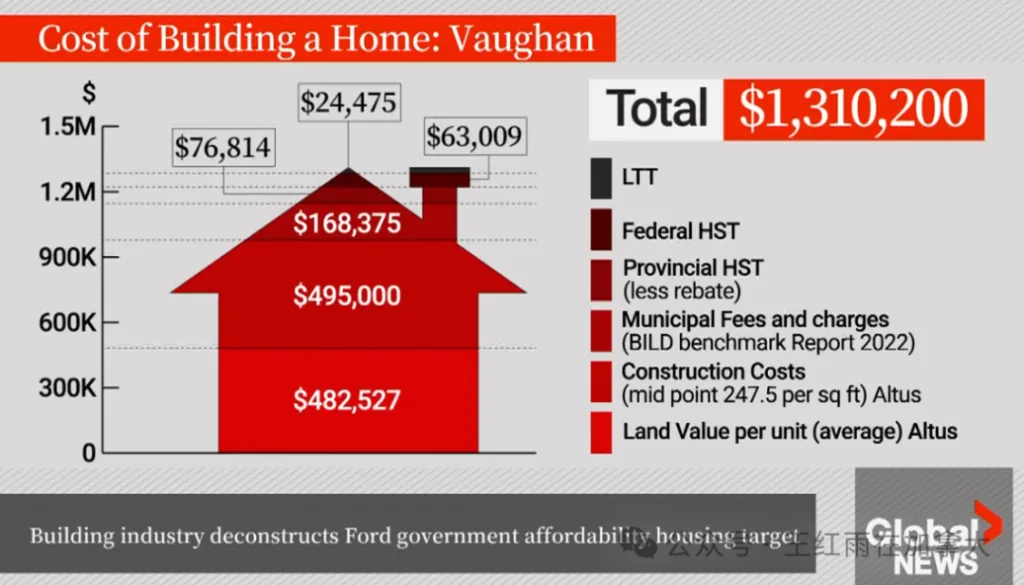
In the long term, the contradiction between housing supply and demand in the Greater Toronto Area will take 20 to 30 years to resolve. The premise is that there must be the right policies and the right people to lead. Families with current borrowing capacity can make full use of this protracted housing crisis and use down payments and borrowing capacity to lock in today's housing prices.
In the short term, interest rate factors will play a positive role. Whether interest rate policy is a preventive interest rate cut or a shift to loose interest rate policy, it will trigger a shift in expectations, that is, buyers will shift from pessimism to optimism, including buyers of owner-occupied homes and investment properties. The two rate hikes last year were technically excessive. The main reason was that the federal budget in April last year promoted inflation and seriously conflicted with the central bank's monetary tightening policy. Therefore, the central bank decided to excessively raise interest rates twice to offset the impact of the Canadian government's excessive spending on inflation. The federal budget in April this year adopted tax increase measures in response to the central bank’s excessive operations last year. Therefore, in an interview on May 10, I confidently predicted that interest rates would be cut on June 5. For the same reason, the Bank of Canada’s decision on July 24 will most likely cut interest rates by 0.25% in response to the federal government’s policy concessions. Interest rate policy adjustments are affected by data, but data is not decisive and other factors are more important.
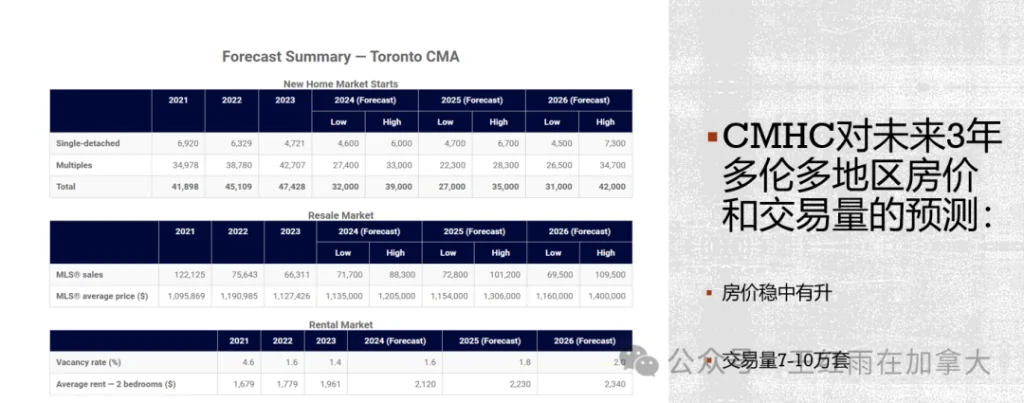
From the perspective of interest rate trajectory,The current situation andThe diachronic rhymes of 2015 are the most similar.Precautionary interest rate cuts, 2-3 times, buyers' expectations have turned. In 2015, the transaction volume increased by 9% compared with 2014, and house prices increased by 9.7%. The president of Royal Real Estate predicts that between now and the first quarter of next year, house prices across Canada will rise by 5.5%. CMHC predicts that house prices in the Greater Toronto Area will increase by between 1% and 6.8% in 2024 compared with 2023, and transaction volume will increase by 8.1% and 33%.
Soros’s views on the market are worth learning from: “Market prices always distort the fundamentals behind them. It is not supply and demand that determines market trends, but market trends that manipulate supply and demand."The current housing prices obviously do not reflect the extent of the contradiction between supply and demand. Canada builds about 250,000 new homes every year, regardless of the number of new immigrants, that is, the supply curve is rigid; the number of new immigrants in the past two years has been as high as 1 million, twice the scale before the epidemic. The housing demand curve has shifted significantly to the right. The intersection of aggregate demand and aggregate supply should reflect a sharp rise in housing prices, but it has not happened now. This is what Soros said, "Market prices always distort the fundamentals behind them." Interest rates are in a downward channel, not an upward channel. Sellers have rushed to the streets, while buyers are still waiting and watching. Supply and demand have not influenced the market. As Soros said, people are waiting for the market to manipulate supply and demand. There is a lot of potential demand, but insufficient effective demand. At this time, the role of the market is to reverse the psychological expectations of buyers. No one knows when the market will ignite this fire, but smart investors need to buy insurance before it catches fire and use down payments and borrowing capacity to keep house prices in check.
How to face the future? There is only one way: get involved. Talking on paper is useless. Teacher Li Xiaolai said: "I'm tired of those people who pretend to study and say they like my articles all day long. They never listen to my suggestions. Regarding how to study, I only have one piece of advice: if you practice it, you will be invincible. If you practice it, you will be invincible."
Conclusion:
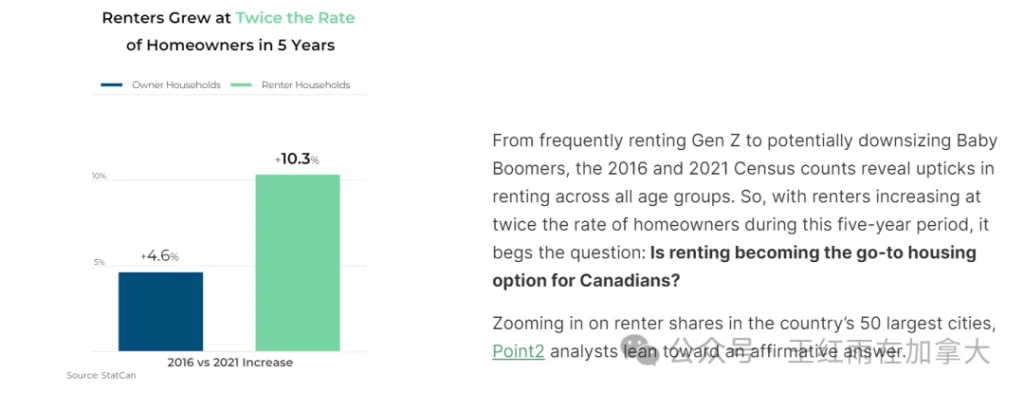
I have summarized the past 15 years. I suggest you collect this article and compare and reflect from time to time on what opportunities you have seized and what you have missed. The next 15 years will begin with the current high interest rates. The golden 15 years of Canadian real estate investment are over, and an even more brilliant platinum era has begun. Population growth and declining labor productivity mean affordability is unlikely to improve, if not continue to worsen.The home ownership rate will become lower and lower, and the proportion of renting households will increase year by year. Especially in the first cities, the demand of renting households corresponds to the supply of investment housing.Comparing the two most recent Canadian census data, in the five years from 2016 to 2021, the number of Canadian households that own property increased by 4.6%, and the number of households that rented housing increased by 10.3%. This trend will continue as the housing crisis deepens. Banks will not relax their mortgage policies. If they are relaxed, housing prices will rise faster.
If you think it’s getting harder to invest in real estate, you’re right, it’s even harder for first-time home buyers.If buying a house is not difficult, the house is not worth investing in.Interest rates are not a determining factor in the timing of buying a home, because everyone needs to pay off the loan over 30 years, no matter what the interest rate is at the starting point. There is only one time to buy a house and invest in the first city: buy early. The strategy for buying a house is to buy, buy, buy, and not sell until you retire. In another 15 years, people who bought investment properties when interest rates were at their peak in 2008 will have paid off their mortgages, freeing up all that positive cash flow.The long-term goal of "buying a house for retirement" is to subsidize investment in housing when your working income is high, and enjoy passive income after retirement.Teacher Xue Zhaofeng said that the clearer the goal ahead, the straighter the path. If you plan to live in a house for retirement, don’t be fooled by the illusion that market transactions do not reflect the relationship between supply and demand. The further you look, the clearer the direction will be, so you can avoid going in circles and walk in a straight line.