Historical article note: This article was originally published on 2018-07-16. Rates, policies, home prices, statistics, product names and qualification standards reflect the environment at that time and may have changed. This archive is for historical record and general education only. It is not mortgage approval, investment, legal or tax advice.
"Look at population in the long term, land in the medium term, and finance in the short term." People have observed and analyzed the trends in housing prices and the development of the real estate market for many years, and concluded that most of the rules are related to population growth, land supply, interest rates and loan policies. Usually, in the same country, the same population policy as well as interest rate and loan policies are implemented. The difference is that the elasticity of land supply in each city is very different, and the urbanization process is also different. Judging from the situation in China and Canada, housing prices in different cities vary greatly. The reason is that urbanization has different impacts on different cities. Some cities have large-scale population inflows, while others have population outflows. The elasticity of land supply in various cities also varies greatly. In cities with low elasticity, even if the population increases and housing prices rise, the land supply is still very limited, and housing prices will become increasingly unaffordable. For real estate investors, identifying the intrinsic value of a property is a real skill. The intrinsic value investment theory is about identifying the true value of the asset and taking advantage of market fluctuations to buy when the price is lower than the value. People who cannot identify the intrinsic value of real estate rely solely on luck to buy it at the right price. The most critical aspect of identifying a property's value is identifying the property's land value.
CMHC released a report in February 2018, Examining Escalating House Prices in Large Canadian Metropolitan Centres, in which Chapter 6 analyzes the land supply situation in major Canadian cities. Make the following translation, analysis and interpretation of the situation in the City of Toronto.
For "price elasticity", give a simple explanation. When the demand for a commodity increases and its price rises, the degree to which supply will change is called price elasticity. A good whose price rises, demand remains unchanged, and supply does not change much is said to be inelastic. Take the three cities in Canada as an example, Vancouver, Toronto, and Montreal. Vancouver has the least elasticity of land supply. When housing prices remain high, land supply is still very small; followed by Toronto; and Montreal is the most elastic. When housing prices rise, land supply will increase. For real estate investors, choosing to buy a house in a city that lacks elasticity in land supply will have greater possibilities and potential for house price appreciation.
Housing prices are composed of two parts, land price and surface property price. Land is a capital commodity, and its economic attributes are capital goods, which are greatly affected by the degree of shortage, interest rates and return on investment. Ground objects are industrial products and are related to manufacturing costs. The CMHC report concluded that it found no evidence of rising labor costs or significant increases in construction costs in Canada's major cities. The main evidence is that the number of employees in the construction industry increased only slightly from 2010 to 2016, and the wage levels of workers in the construction industry and other industries are not significantly different. Statistics Canada data shows that the average profit in the construction industry over the past 10 years was 6%, with no major fluctuations. It can be seen that the rise in housing prices in Canada's big cities is driven by rising land prices.
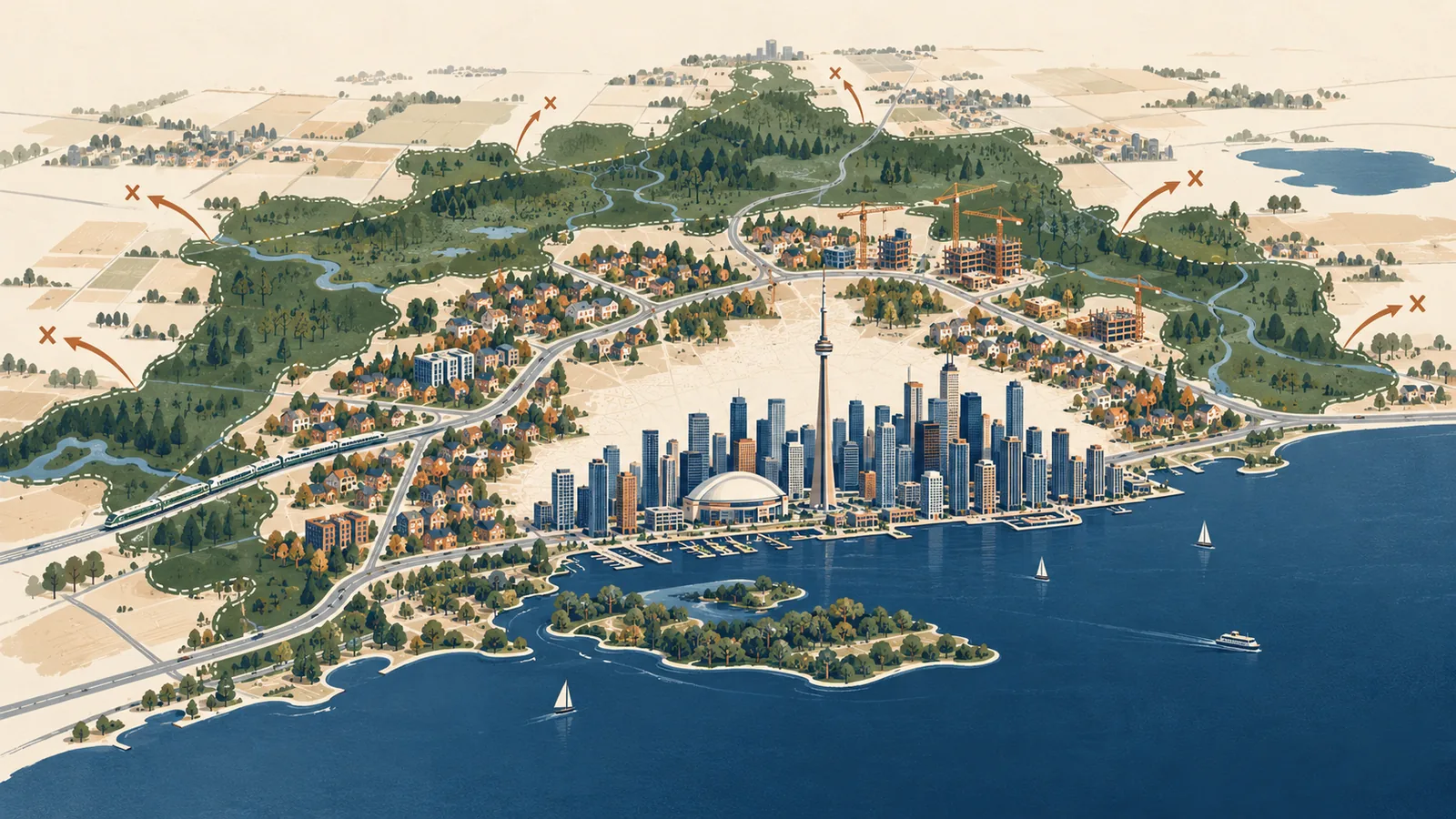
An important reason for the rise in housing prices is the rise in land prices. The rise in land prices is due to insufficient supply, and the main reasons for the lack of supply are legal and geographical restrictions. Taking Toronto as an example, there is a lake to the south and a green belt on the back. One is geographically restricted, and the other is restricted by laws and regulations. The Public Policy Institute of Canada and the Fraser Institute conducted an assessment of urban land use regulations in 48 Canadian cities. The conclusion is that Toronto has the most and most stringent urban land use regulations, and the cost of land use approval, including time and fees, is the highest in the country. This is the most important reason for the poor elasticity of land supply in Toronto.
The high price of land in urban centers reflects the capital nature of land. Companies and businesses are willing to pay more to be adjacent to each other. Real estate prices in Silicon Valley and New York reflect this. Due to the lack of relevant data in Canada, the CMHC report cited the research results of American researchers to illustrate the problem: excluding inflation factors, housing prices in major American cities increased by 400% from 1970 to 2007, while construction costs increased by only 33%. Rising housing prices and high land prices have led to the construction of high-density residential and office buildings such as skyscrapers in large cities. In Canada, the government has strict zoning for the construction of low-density, high-density, and commercial properties. The CMHC report concluded that Toronto and Vancouver are still not efficient enough in building high-density housing and that the cities should be more crowded.
We have finished talking about the elasticity of land supply, legal and regulatory restrictions, and the characteristics of urban land supply. So in the past 10 years, what proportion of land has accounted for in housing prices in Toronto, Vancouver and Montreal, and what are the future trends? Data obtained from the housing price appraisal department MPAC shows that housing prices in Vancouver and Toronto are largely determined by land prices. Nearly 70% of housing prices are land prices, and land prices are rising rapidly and are still on an upward trend.
The CMHC report concluded as follows: Insufficient land supply will lead to rising house prices and fluctuations in house prices. Cities that lack land supply elasticity will have higher house prices and higher land prices. Since land belongs to capital, price changes are greatly affected by the capital market and have little to do with construction costs. In cities where land prices are high and account for a large proportion of housing prices, housing prices are greatly affected by changes in population, interest rates, and tax policies. On the contrary, housing prices in cities where land accounts for a low proportion of housing prices, land prices are low, and land prices are highly elastic are more affected by industrial reasons (such as construction costs and labor costs). Due to limited Canadian data, CMHC still cited the research results of American scholars in the conclusion, but this part is very important. American scholars divide large cities in the United States into three categories: "Cyclical", "Steady", and "Recent boomers". "Cycling City" refers to super cities, such as New York City, San Francisco, Boston and Los Angeles. The housing prices in these cities rise and fall. Ultimately, due to the scarcity of land and the continuous influx of population, housing prices always rise in a cycle. “Smooth cities” refer to cities where housing prices fluctuate less due to changes in interest rates and construction costs, such as Atlanta, Chicago, Denver, and Detroit. "Upstart cities" refer to housing prices that suddenly rise significantly due to some reasons that deviate from basic factors such as population, land supply, and interest rate changes, such as Las Vegas, Phoenix, parts of Florida, and Southern California. "Upstart City" is where bubbles grow. The bizarre rise in housing prices will attract investors from surrounding cities to join the fire. Every 10% increase in buyers from other cities will lead to a 6% increase in housing prices. Buyers in "upstart cities" took on debt when housing prices were high, and then housing prices fell as land supply increased, ultimately resulting in a situation of high debt and low housing prices.
Seeing this, I can't help but think of the current real estate market in Montreal. Housing prices have benefited from the 15-20% surcharge imposed on non-residents in Toronto and Vancouver. Transaction volume and transaction prices have been increasing. The population has not increased. The land supply is elastic. The increase in housing prices depends entirely on belief. Montreal in 2018 is Canada’s “upstart city”.
Specific to Toronto, the conclusions of the CMHC report are very clear and clear. Everyone should remember these conclusions: The increase in land prices in Toronto has driven up the rise in housing prices, and surrounding cities have also been affected. However, the degree of impact is not directly proportional to the distance. The cities most affected by Toronto’s housing prices are not the cities closest to Toronto, but Peterborough, St. Catharine’s-Niagara, and London. Affected by the water wave effect, the order of cities from near to far is: Oshawa, London, Hamilton, Kingston, Windsor, Sudbury, Ottawa, Thunder Bay.
As in previous relevant reports, CMHC has always believed that the correct way to solve the high housing prices in big cities is to increase the supply of high-density properties, that is, to build more high-rise apartments. Judging from Toronto's long-term situation of small land and large population, this view is not only practical but also feasible.
Looking at this report from my work practice, I believe that land prices in some areas of Toronto are close to 80-90% of housing prices, such as properties in the C14 area. In the house valuation report made by the bank, the appraiser is required to provide the proportion of the land price to the house price. Judging from the results of the evaluation report, the closer the area is to the city center, the greater the proportion of land and the stronger the housing prices. Apartment prices are not included in the CMHC report because it is impossible to estimate the proportion of land occupied by each household. In the apartment unit price assessment done by the bank, the land price ratio is not included. The price of apartments, as high-rise high-density buildings, should mostly be related to construction costs and supply and demand.
The value investing proposed by Graham and his disciple Buffett is also applicable to real estate investment, that is, identifying the true value of assets and taking advantage of Mr. Market's irrationality to buy when the price is lower than the value. In recent years of real estate investment in Toronto, most people have done the opposite: they can't figure out the intrinsic value of the house and buy it when the house price is high. Fortunately, the interest rate is very low. If you are reckless, you may get lucky, but the condition is that you must buy real estate in cities with inelastic land. If you can't even identify the value of the land, you are not so lucky. Torontonians rushed to Oshawa to buy new houses. After they were built, the bank appraisal price could barely reach 80% of the purchase price two years ago. This is a living example of the negative side of value investing - misjudging the intrinsic value and buying when the price is higher than the value.
When the tide goes out and we look at the naked swimmers, it’s easy to draw some lessons for real estate investing. When deciding whether to invest in real estate, you need to consider: 1. Should the funds be put into real estate or the financial market? If the interest rate is very low, of course put it into real estate. Now that interest rates are rising, real estate investment may not be the first choice; 2. Since 2009, 50% of people in the world have lived in cities, that is to say The acceleration phase of the urbanization process has been completed. The second half of the urbanization process is the megacities of large cities, and the population of small cities is likely to outflow. Therefore, real estate investment can only invest in megacities and their surrounding satellite cities. There are not many such "cyclical cities" in the world, and Toronto is one of them. It is the opposite for people from Toronto to invest in Montreal. 3. Buying a house in a city means buying stocks in that city. If you don’t buy a house, you won’t get the dividends of city development. Which city you choose is much more important than which neighborhood you choose. 4. There are actually only two cities in Canada suitable for real estate investment, as well as satellite cities of these two cities.
Real estate investing is a very complex issue, and I'm not trying to simplify it, but the basic principles of real estate investing are exactly the same as stock investing, that is, value investing. First understand the intrinsic value of the property, and then find a buying point where the price is lower than the value. The basis of the intrinsic value of the property is the land price.