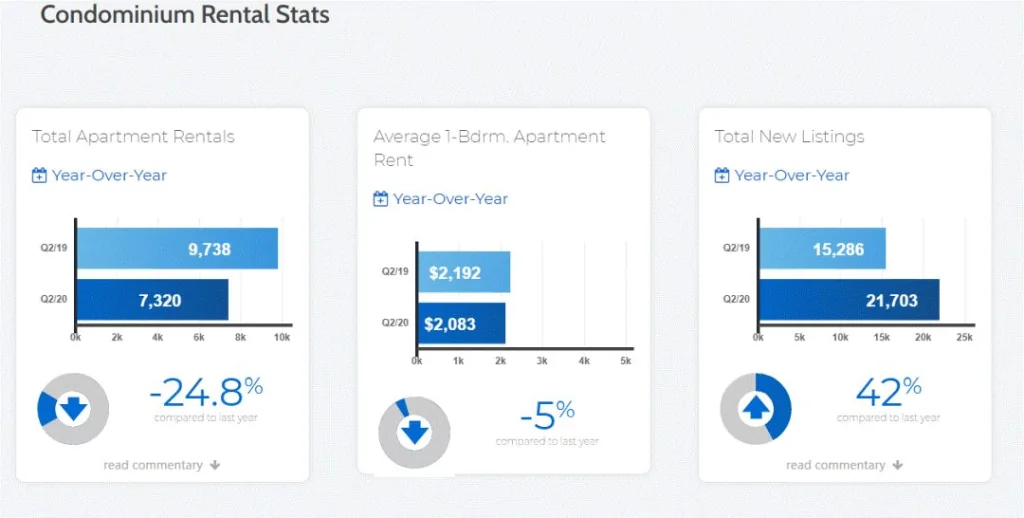
The immediate problem is most easily magnified, and fast variables can easily be mistaken for slow variables, because we all live in the present and cannot escape the real situation. The current data on the Toronto CONDO market makes people feel that there is a big problem, and some numbers are particularly eye-catching: In September 2020, the number of CONDOs listed for sale was 215% of the same period last year, and the proportion of sold was as low as 24%. It is completely a buyer's market; rents have dropped by 14% compared with the same period last year, and the number of rentals is 80% higher than the same period. These figures are enough for pessimists to conclude that the CONDO market in downtown Toronto is about to collapse.
There has been a popular saying since the outbreak of the new coronavirus: We are all victims, but the victimized parts are different. For the real estate market in Toronto, and indeed across Canada, the condominium market in downtown Toronto has suffered the most. Should we sell the condos in the city center as soon as possible, or should we go against the trend and hunt for bargains? I put the conclusions of my own observations and thinking here for your reference. Readers who are impatient can only read this conclusion without reading the entire text.
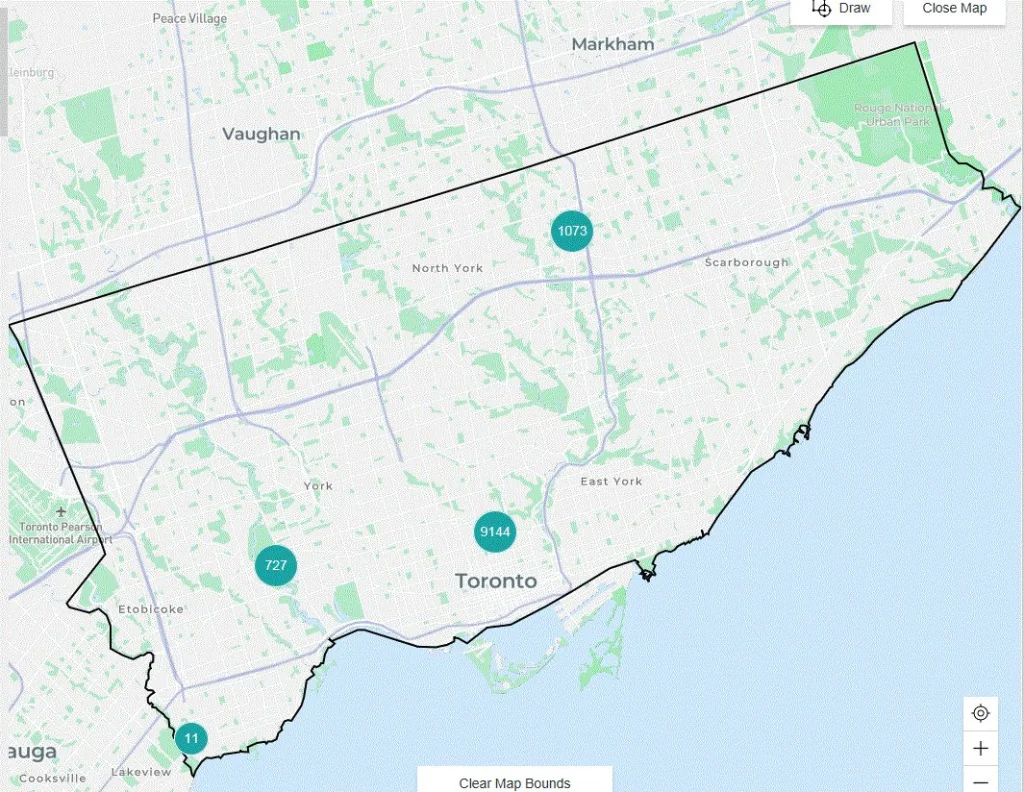
In a competitive market environment, when buyers compete with buyers, prices will rise; when sellers compete with sellers, prices will fall. Downtown Toronto CONDO The current situation is: landlords compete with landlords, and sellers compete with sellers. Therefore, rents and house prices will fall. Rents will continue to fall, but will 10 month 20 After the announcement, when international students were allowed to return to Canada, the decline slowed. The forecast is based on the fact that Ontario needs 4 Thousands of apartments will be used to accommodate the influx of new immigrants and non-residents, while only 10,000 new houses are available for rent. 2 Thousands, every year 2 The shortage of 10,000 housing units has been alleviated by the epidemic. After the epidemic is brought under control, this problem will reappear. For detailed analysis, please see the previous article "How to Solve the Difficulty of Renting in Toronto". toronto CONDO Home prices are just showing signs of falling, but are sure to fall further as sellers compete with sellers, compared to this time last year CONDO Prices have not fallen, but they have fallen in the third quarter of this year compared to the second quarter 0.3% . How much can the price drop? This question is very important to many people and determines whether to sell or hold CONDO . My prediction is that if the number of listings for sale doesn't decrease between now and next year 6 month, each month will be lower than the same period last year 5% , the decline in home prices narrowed as sellers gradually took back properties they were selling. If the spread of the epidemic increases exponentially and the city is closed again, prices may fall by as much as10%。The prediction is based on the endowment effect and the three-dimensional attributes of housing prices. See the previous article on the official account "Why housing prices rise quickly and fall slowly".
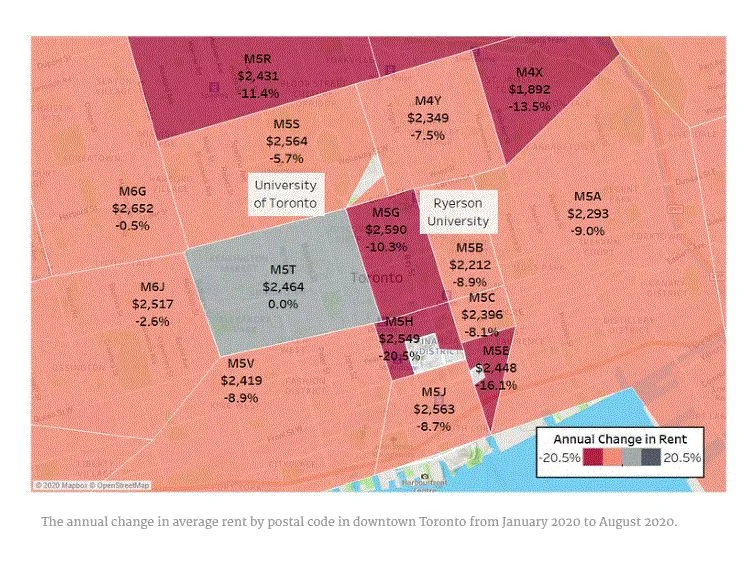
01 Renting is a real need, and the drop in rents is a supply problem.
People need a safe and comfortable place to live. Buying a house is never a necessity, because renting a house can meet basic living needs. The decline in rents does not mean that there has been a change in demand, but that there has been a change in the number of houses available for rent. I have focused on analyzing the upcoming changes in the Toronto CONDO market in 2020 in the "2020 Toronto Real Estate Outlook". The epidemic was not expected when I wrote the article in January this year. However, the changes in the management of AIRBNB short-term rental housing in Toronto and the relatively concentrated completion of new CONDOs will lead to a situation where supply exceeds demand in the rental market. This is a fact that was already known in January.
There is a CONDO named ICE. When AIRBNB management was lax, it was very tolerant of short-term rentals. Under the epidemic, the short-term rental business was unsustainable. At the same time, the city of Toronto implemented strict regulations on short-term rentals, causing the rent and sales price of this building to plummet. The BLOGTO website conducted a detailed analysis of the impact of short-term rental properties returning to the long-term rental market. From a glance at a CONDO, we can know that when a new investment model or investment product appears, don’t rush to participate. At least observe two economic cycles. It is indeed a good project that can be invested in the long term before it is too late to intervene. When we define "making quick money" as investment, it is easy to be attracted by the investment model of AIRBNB. When we define "to balance a lifetime of income" as investment, we will not rush in, resulting in an embarrassing situation where it is easy to get in but difficult to get out. Short-term rental, this tricky investment method, has not stood the test. Even after the epidemic, readers are not recommended to regard short-term rental as an investment method.
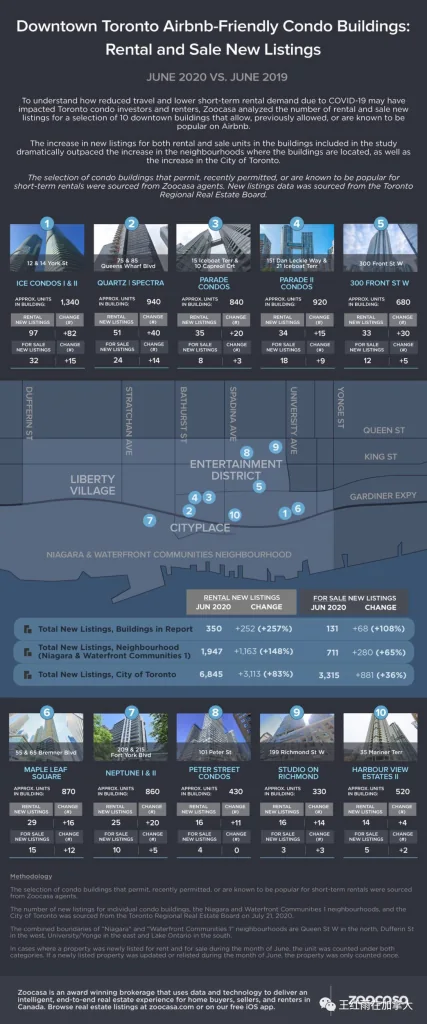
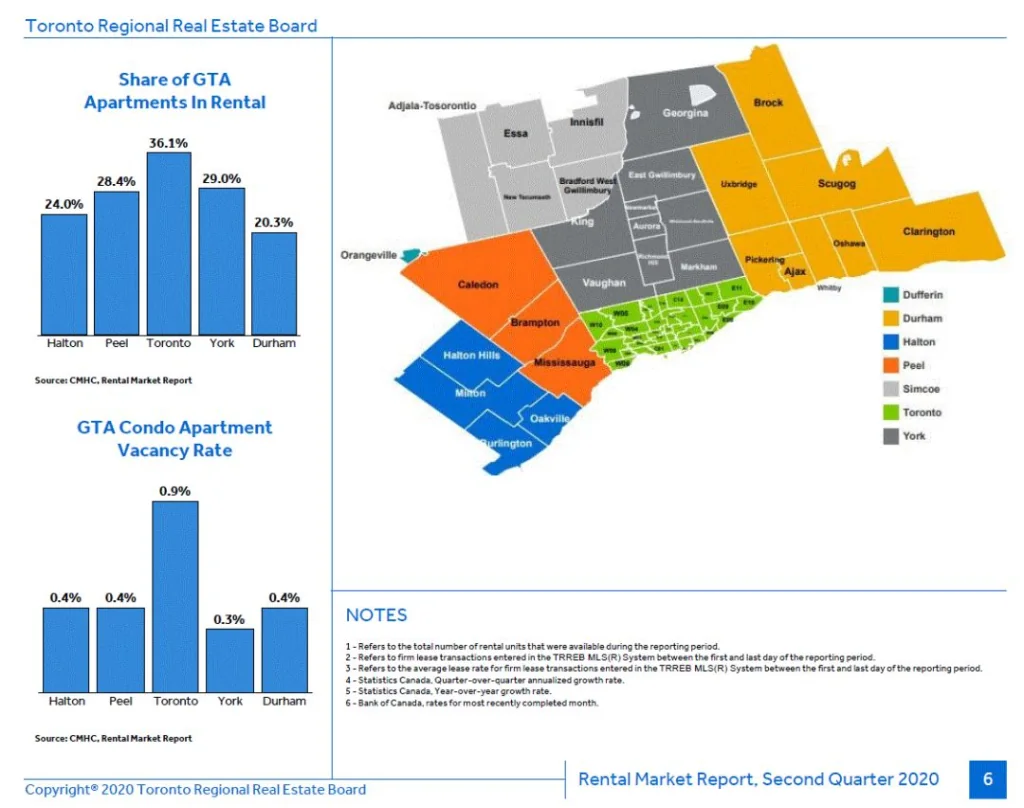
Many people have a special liking for buying pre-construction properties and fall into the illusion of beautification in front of the gorgeous advertisements for pre-construction properties. In Toronto, 34% of CONDOs are purchased by investors, that is, about 1/3 of the units in each building are for rental. When a 350-unit CONDO is delivered, 117 units will be rented out at the same time. The competition between landlords and landlords can be imagined. If there was no epidemic, and tenants preferred to live in new houses, they might be able to digest it in 2 or 3 months. But with the epidemic and the return of short-term rental properties to the market, investors who have completed the delivery of new pre-construction properties this year are facing the difficulty of renting a house. During the epidemic, the desire of builders to survive was particularly strong. The previously unhurried projects under construction have stepped up construction. There are still many pre-sold properties on the road that have not yet been delivered, and they are rushing to deliver them for use during the epidemic. The exit for builders to escape must be provided by buyers of pre-construction properties. Where do pre-construction property buyers flee? Landlords compete with landlords. If the inflow of non-residents and new immigrants cannot keep up with the speed of newly completed CONDOs, it will be difficult for the rental market to improve for a while.
New homes built after November 2018 are not subject to rent control in Ontario. This regulation has stimulated the interest of big capital in entering the rental market. Next to my office, a new CONDO under construction by yonge/sheppard is specially built for rental, not for sale. After the builder builds and rents out the apartments, he will sell the project to real estate trust funds REITs to cash out. If there is rent control, the apartments cannot be sold at a good price. After the rent control is abolished, big capital has another option besides selling the apartments to end buyers. That is, after the construction is completed, they will be rented out, and then the entire building will be sold to REITs. Since Ontario implemented the rent control policy in 1975, big capital has begun to withdraw from the rental market, leaving the rental market to small investors. This is why 1/3 of Toronto's CONDOs are currently for rent. Since the cancellation of new housing rent controls at the end of 2018, big capital has regained interest in the rental market and has begun to return to the market. The specific impact is still unknown, but the epidemic has dealt a blow to these big capitals. It is not easy to rent out hundreds of units at the same time.
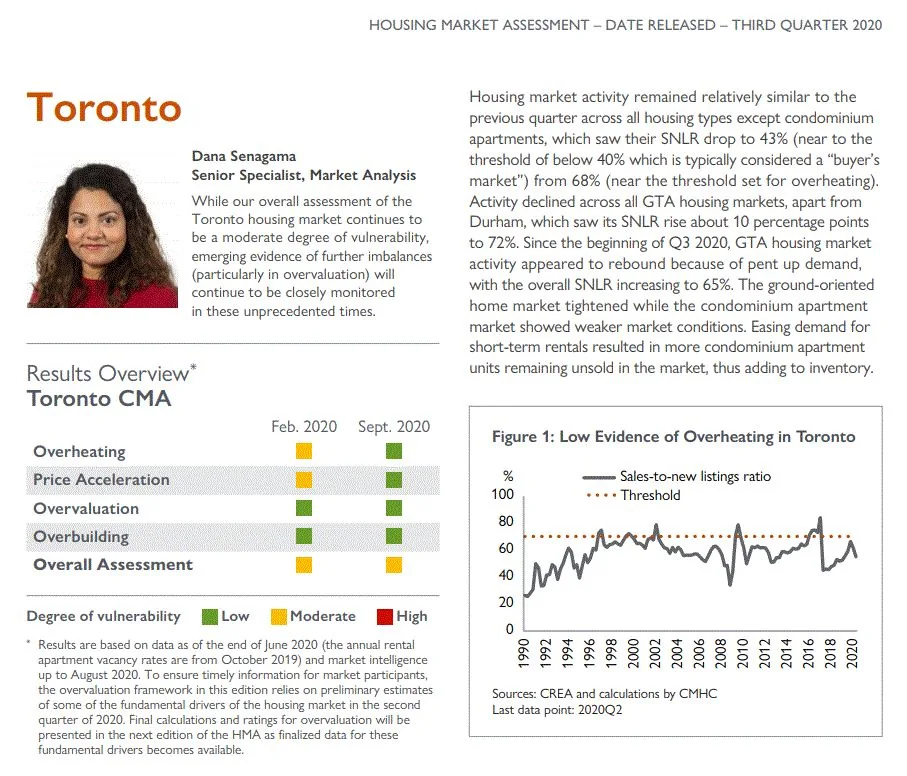
02 Suburbanization is determined by financial ability
Urban sociologist Lewis Mumford, described cities as “ cultural container"It contains the achievements of human civilization. No matter which area of the city you choose to live in, the trend of pursuing big city life and sharing human civilization and progress will not change. The place where culture and ideas are most concentrated is also the place with the highest population density, but the epidemic requires people to maintain social distance. Even being forced to work from home, the agglomeration effect of the city has encountered the challenge of the new crown. After the lockdown was lifted, many people immediately chose to move out of the city center and to the suburbs. In fact, they did not escape the cultural container of the city, but just stayed away from the most densely populated places. Thoreau, the author of "Walden Pond" said, " A city is a place where millions of people live together in solitude. ” City life is millions of people being lonesome together. That's right. In the past, we gathered together not to rely on and help each other, but to make it easier to meet and make transportation more convenient. Since the epidemic is not a big deal, there is no need to meet or go to the office. Moving farther away and living in a larger space has naturally become an option for people. City life has long been a lonely way of life. It doesn't matter if we move further away from each other, we will feel a little more lonely. The two most important cornerstones of urban life are: economic activity and social activity , when a person is excluded from economic activities or social activities, he will feel uncomfortable, as if he has lost his soul, and has nothing to love in life. Therefore, no matter where you live, the desire to participate in urban economic and social activities belongs to the desire to survive in the city and is the spiritual and material sustenance of city people. Don’t worry, people who are accustomed to living in the city cannot run far even if they move. They will still live alone in the container of the city. It is just that the spatial selection preference has temporarily decentralized.
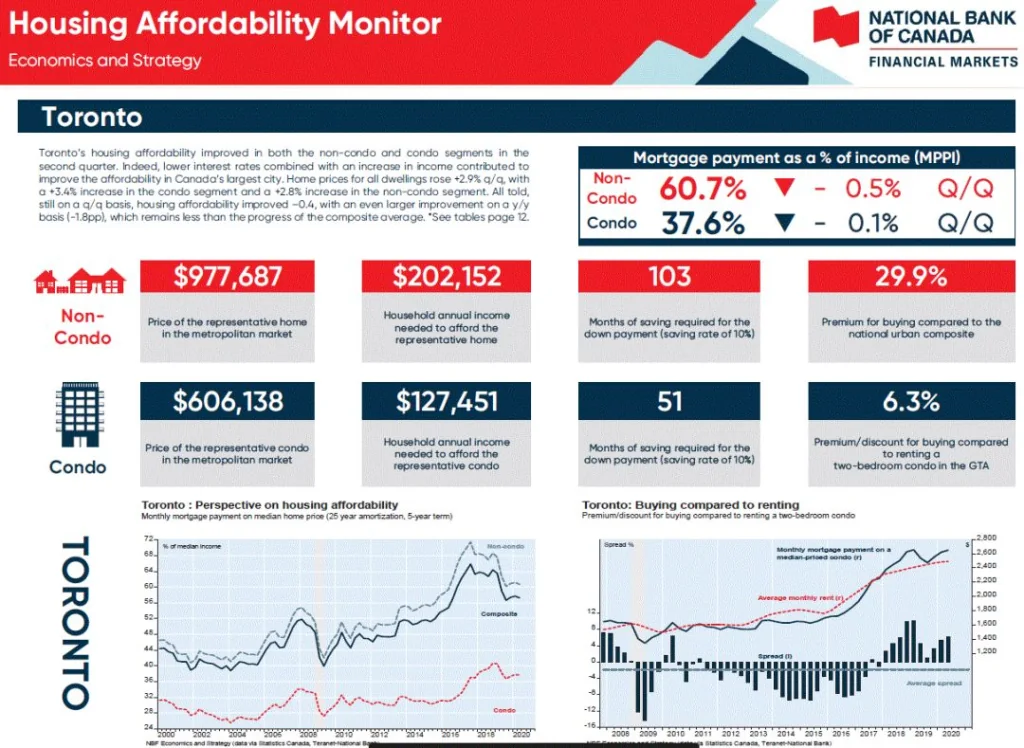
Most of my clients, families with successful careers and stable lives, live in the suburbs but work in the city center. Newly formed families, or those who have just started to work in the city, more often choose to live in the city center. Spurred by the epidemic, many families living in the city center have brought forward their long-term suburbanization plans. But suburbanization requires ability. According to the National Bank mortgage affordability report, the housing affordability of metropolitan residents is divided into two levels: CONDO affordability and non-CONDO affordability. Taking Toronto as an example, if you buy a CONDO as your main place of residence, your monthly housing expenses will be 37.6% of your income, while if you live in a non-CONDO, this ratio will be as high as 60.7%, that is, more than half of your monthly income will be used to pay for housing expenses. It can be seen from this that the kite of suburbanization is held by a kite string, which is income and mortgage affordability. In the past two months, housing prices in suburban areas have increased significantly, indicating that families who are currently able to move to suburbs cannot wait any longer and must expand their living area as soon as possible and move from their original gathering places to places away from crowds. This fierce momentum of suburbanization will weaken after the snow, and will be taken over by new immigrants who are eager to land next year. New immigrants can afford to buy houses in the suburbs directly without passing through the city center.
The ideal of suburbanization is very rich, but the ability of suburbanization is still very skinny for many families. Affordability has to be built up slowly. In fact, everyone is eager to escape the city center, so those who stay in the city center are actually not in a hurry to move out, because the population density has been reduced.
03 How to predict the real estate market in the post-epidemic era
Forecasting is a thankless job. If your prediction is right, no one will give you a reward. If your prediction is wrong, of course no one will come to settle the score with you. You just feel like a slap in the face. In April, I predicted a V-shaped reversal in the real estate market, and there were video materials and my articles to prove it. So what? Aren’t everyone hiding and not daring to buy a house? Many people want to see what other people predict. In fact, they just want to satisfy their curiosity and will not use anyone's predictions as economic decisions. But for those who dare to make predictions, prediction is a self-test question to see how much you know about history and your ability to reason logically. I will make a few predictions, including the one at the beginning of the article. Just treat it as entertainment gossip.
The principle of prediction is this: first find similar events that have happened in history, and then make logical deductions based on the current situation. For example, someone asked me what do you think of the prospects of the New Silk Road? The historical event I can find is that when the Japanese bought Rockefeller Center, the yen appreciated strongly and overseas purchases exploded. The Japanese mentality also changed from the wary post-war to arrogant, and they could afford to buy everything. The result? You cannot move overseas things, especially real estate. You bought them at a high price and sold them to locals at a low price. Historical events and logical reasoning can be used to predict the investment results of overseas real estate. What will happen when COVID-19 is under control? There is no need to predict this. If you look at WeChat Moments, you will know that China’s current prosperity is what will happen in Canada’s post-epidemic era. North America is a free society, and ordinary people are free-roaming chickens that cannot be contained. To control the epidemic, we cannot control people from roaming around, which is difficult. We can only rely on herd immunity or vaccines. "Fighting the epidemic" is actually divided into two parts. One is to control the viral spread of the virus, that is, the number of infections increases exponentially every day; the other is to control the fatality rate of the virus. Efforts to control the virus's lethality are ongoing. There are already ways to control the viral spread of the virus, wash your hands frequently and wear a mask. The most serious plague in human history is called the Black Death, which occurred 680 years ago. Now people think it was caused by the plague, but the "scientists" at the time concluded that it was caused by four planets aligned in a line. I don’t know whether today’s scientists and doctors will come to similar conclusions to those of the scientists back then, but I do know that 680 years ago, humankind relied on the group’s interest-free approach to prevent extinction, not the reasons and methods discovered by scientists at that time. Human beings are always too confident in science. In fact, many mysteries of the universe cannot be understood by modern technology. I will make a bold prediction that the epidemic will definitely pass and Canada will be able to sing and dance again.
The real estate market in the post-epidemic era will be like before the epidemic, with buyers and sellers, some pessimistic, some optimistic, some waiting and watching, some daring, government intervention, and passionate speculation. As if the epidemic has never happened, purchasing power determines whether to buy a CONDO or a non-CONDO, and whether to rent or buy a house. If the epidemic does not kill us, it will make us stronger.
Let’s predict a few more things: Developers will reduce the development of CONDOs in the city center and instead develop non-CONDO housing in the suburbs; people who have bought pre-construction properties will have a clear understanding of off-the-plan investment, and the target customers of sales staff are people who have never experienced buying pre-construction properties; big capital will build more CONDOs specifically for rental, pushing up supply and CONDO rents The increase will slow down; suburbanization will be long-term, instead of flocking to the suburbs in the short term, the increase in suburban property prices will shrink; new immigrants and non-residents, especially international students, will love Canada more, because other English-speaking countries will become more and more unfriendly and will pounce on Canada whenever possible; people who have applied for immigration but have not come to live for a long time will make up their minds to settle in Canada;
04 Be prepared to own your property for the long term
We have never seen the price of an asset only rise but not fall, nor have we seen any investment target in the market whose price change curve is not a curve but a straight line. It is impossible to create any miracles in the price changes of condos in Toronto. There are no mixed fluctuations, only a straight line rising into the clouds. The risk of investment is not the size of price fluctuations, but the possibility of permanent loss of principal. The best opportunity to cause permanent loss of principal is panic selling, and this opportunity is firmly grasped by many investment losers. Observe others, especially those anonymous forums, and you will be able to find out whether "others" are greedy or fearful. If others are fearful, you can be greedy; if you find that others are greedy, just like when Joseph Kennedy found that the clerk who shined his shoes was also talking about stocks, be afraid quickly.
Some people regard investment as a way to make money and have obsessive-compulsive disorder, but I regard investment as a way to balance my lifetime income, so I will not sell any property easily. If you need cash reserves to fight the epidemic, go to a bank to provide additional mortgages. Recently, I helped a client make a mortgage on an investment house, taking out 150,000 dollars in cash from the house, and extending the loan repayment period back to 30 years. Because of the current low interest rates, although the customer's loan balance increased by 150,000 dollars after the mortgage, the monthly payment was only less than 100 dollars more than the original. We will also have a cash reward for transferring to the bank before October 31, and the borrower also received certain compensation for the fines caused by the original loan not expiration. These are still small favors. The borrower has this 150,000 dollars in cash. Even if the tenant does not pay rent for five years, it is enough to maintain the normal repayment of the mortgage and will not cause a situation of being forced to sell the house. It is fully prepared for long-term investment.
Conclusion:
Human beings are economic animals, making trade-offs and trade-offs all the time in order to achieve the best possible survival. When deciding to immigrate, you have to make trade-offs. You have to weigh whether you want to live in a basement or rent an apartment. You have to compare whether you want to move out of an apartment or continue to rent a larger apartment. You have to calculate the distance between your job and your children's school. Each family has different financial capabilities and has its own priorities on the to-do list, so it is not possible for everyone to choose to move to the city center, or conversely, to escape from the city center at the same time. As a container of culture, the city center is the place where culture and wealth are most concentrated. It is impossible for the real estate in the city center to completely collapse because of an epidemic. "Life is a besieged city, and marriage is also a besieged city. People who are besieged in the city want to escape, and people outside the city want to rush in. Whether it is marriage or career, most of the wishes in life are like this." Isn't it?
There is no doubt that Canada’s post-epidemic era will be the scene where China is now singing and dancing. Sellers compete with sellers, landlords compete with landlords, and there is only one result - price reduction. Only when some people are pessimistic and others optimistic can there be buying and selling, and the market will be active. Canada's real estate market is an existing market, because there are not many new properties. As long as transactions are active in the existing market, there will be partial oversupply and partial insufficient supply. This is what we often see, with prices of different property types rising in turn. If you invest with the goal of balancing lifetime income, you will not panic sell your assets and sell them in a hurry. If you make money, you will have to pay capital gains tax. If you lose money, it will be a permanent loss of principal. What are you anxious about? Mortgage is the best helper for holding real estate for a long time. You must learn to use it skillfully.