How to extend the trigger rate. Make a lump sum payment and increase the monthly payment now? What should I do if the interest rate really rises to above 8% and I can no longer afford the mortgage? If the interest rate is raised to 8%, if many people cut off their mortgage payments, banks auction their houses, and tenants have no place to live, it will probably cause greater chaos than inflation. Will the government do this?
There is no trigger rate for floating-rate loans that wait for principal repayment. As long as the interest rate increases, the monthly payment will rise next month. For example, BNS, NBC. For example, when P is 2.25%, the monthly payment for a 500,000 loan is 1,700, and now it has increased to 2,700.
Only floating-rate loans with equal repayments have a trigger rate. Trigger rate varies from person to person. The calculation formula is = monthly payment/principal X12. The lower the principal, the higher the monthly payment, the higher the trigger rate, and the harder it is to reach.
Exceeding the trigger rate means that the monthly payment cannot cover the interest expense. The monthly repayment is all interest. If the actual interest exceeds the monthly payment, the additional amount will be added back to the principal. When the principal accumulation exceeds 105% of the initial principal, the bank will require an increase in monthly payments. Using the most exaggerated interest calculation method, it will take 6-7 years before you may be required to increase the monthly payment or repay the lump sum in advance.
You can increase the trigger rate by increasing the monthly payment or by speeding up the principal repayment with lump sum.
If the interest rate is raised to 8%, many investors will sell their houses, house prices will plummet, rents will skyrocket, and there will be social problems. Government decisions are based on votes, with tenants often being the loudest and landlords largely silent.
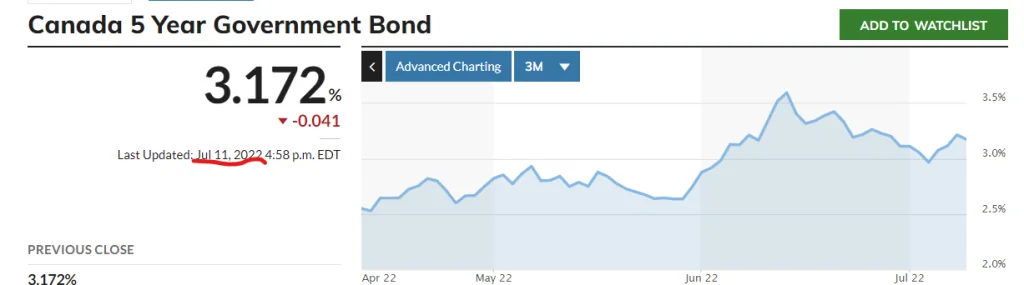
If the floating interest rate rises to 8%, floating rate borrowers are not fools. They will find that the fixed interest rate is lower, for example, 5.5%. Therefore, when the floating interest rate rises to the same high as the 5-year fixed interest rate, someone will convert the floating interest rate to a fixed interest rate to prevent the floating interest rate from continuing to rise. The pricing basis of fixed interest rates is the Treasury bond yield plus 2%. On June 14, the Canadian Treasury bond yield rose to 3.59%, and has since begun to fall. Currently, in mid-July, the bond yield is 3.15%.
When the floating interest rate is lower than the fixed interest rate, do not convert from floating to fixed. For example, the current floating interest rate is 4.1%, the fixed five-year fixed interest rate is 5.5%, and the monthly payment of the floating interest rate is 1,700. If it is changed to a five-year fixed interest rate, the interest will be calculated immediately at 5.5%, and the monthly payment will be greatly increased. If the borrower has the ability to increase the monthly payment, use this money to accelerate repayment rather than converting to a fixed interest rate. If the floating interest rate rises to 5.5% one day, it will be converted to a fixed interest rate at that time. Because the pricing of fixed interest rates follows changes in Treasury bond yields, as long as there is no more selling of bonds in the market, bond yields will stabilize.
A $1M house at the beginning of the year requires a loan of 800,000. One year later, the market price is 850,000. Taking into account transaction costs, the bank can get back 800,000. However, because of the triggering rate, the borrowing has actually returned to 800,000, and is rising every month. How does the bank control the risk? If there is a recession next spring, the unemployment rate will rise significantly. Will the bank's sharp interest rate cuts stimulate significant growth in the housing market as it did in 2020?
Once the trigger rate is reached, when the monthly payment is lower than the actual interest, the excess is added back to the principal. When the principal accumulates to 840,000, the bank requires the borrower to increase the monthly payment or reduce the balance to less than 840,000. Interest rates are completely controlled by the central bank and cannot be predicted whether they will rise or fall, let alone the timing.
When the trigger rate arrives, the bank will calculate my monthly payment based on the trigger rate (for example, 4.2%). If the interest rate continues to increase to 5%, will BMO increase my monthly payment by 5% or will I still stay at the 4.2% trigger point until the next trigger rate occurs and will it change my monthly payment?
Banks calculate loan interest based on the actual interest rate. The trigger rate is just a symbol, which means that negative amortization is possible, that is, if the monthly payment remains unchanged, the loan will be repaid more.
With interest rates rising like this, what impact will it have on investors with multiple properties? Is it "bleeding", is it "fatal"?
The monthly payment is low and the monthly payment remains unchanged. When interest rates rise, interest expenses increase, and the cost of real estate investment increases. The cost can offset the rental income, and the actual after-tax income decreases. Therefore, tax benefits will be obtained, that is, the tax bureau will subsidize the landlord. The landlord bleeds, but the amount of blood loss is limited. If the investor's contract happens to expire and the monthly payment increases, he may not be able to afford the monthly payment, which may also be fatal.
The central bank stepped up its stance and ignored it. Are they really ignoring it? How can we let them "manage" and "take care of"?
Among the central bank's policy goals, the most important is the unemployment rate. If the unemployment rate rises and is accompanied by inflation, that is, stagflation, the central bank will have some scruples. The central bank will not care about mortgage borrowers. Central banks are unelected authorities with no checks and, in most cases, no scruples.
Has the interest rate increased so much, has it changed the basic judgment (or belief) that "real estate investment is a good investment"?
The reason why interest rates rise is that inflation is too high. High inflation means that money cannot be recovered in a short period of time. As long as more money is printed than is withdrawn, money will flow to assets, and real estate will absorb the money. Real estate is still the best investment. The more money there is, the more valuable the real estate is because the central bank cannot print houses. I don't see the possibility of getting back more money than is printed, and real estate investment is still the best investment.
Want to know how much stress test to choose? Also, if interest rates are raised in September, do you have any good advice for lenders and people who want to increase their mortgage? Should I still choose a floating interest rate? With fewer people lending money, will banks introduce some preferential policies?
The current stress test interest rate is about 6.1% to 6.2%, which is about 1% higher than the 5.25% before July 13. Borrowing capacity is between 4.5 and 5 times annual income. After July 13, every time interest rates were raised, the stress test rate increased accordingly. , wait until September, more people will be priced out. At present, loan capacity is the biggest issue. If you can get a loan, you can negotiate the interest rate. Therefore, you can only choose the loan with the lowest interest rate, such as floating interest rate and 1-year fixed interest rate. Banks are not obligated to provide preferential treatment. Banks will select borrowers by raising stress test interest rates. Mortgage applications follow merit policies, similar to the college entrance examination.
Please share the difference between the most recent loan valuation and the actual closing price.
Throughout the epidemic, and now, Chinese people have been very cautious when buying houses. Very few people blindly bid high prices. In 99% of cases, the appraisal price is the same as the purchase price.
If there is a supply cutoff, will banks or the government come to the rescue?
Judging from the experience of the United States, there will be no bailout. However, commercial banks will launch rescue plans to suspend repayments. Must be used with caution. With the six-month moratorium on repayments in 2020, many people suffered huge losses. During the 6 months of payment, the bank will charge all the money as interest. Many people's principal increased throughout 2020.
Which types of Toronto property prices are least affected by rising interest rates?
Empirically, CONDO prices have the lowest interest rate sensitivity. Interest rates were raised throughout 2018, and CONDO rose throughout the year.
Are the days of low interest rates over?
Low interest rates are goodbye to us for now. Unless unemployment rises, or there is an economic crisis or recession. The inflation rate should hover around 3% for a while, and everyone needs to get used to mortgage interest rates of 4% to 5%.
There are two sources of money: money printing and credit. Now that the central bank is desperately raising interest rates, the stock and bond markets are both declining, and there may be a wave of supply cuts in the coming months. If banks are afraid of lending due to a disaster and there is one less source of currency in circulation, in order to prevent the Great Depression, is it not far from the government to send money?
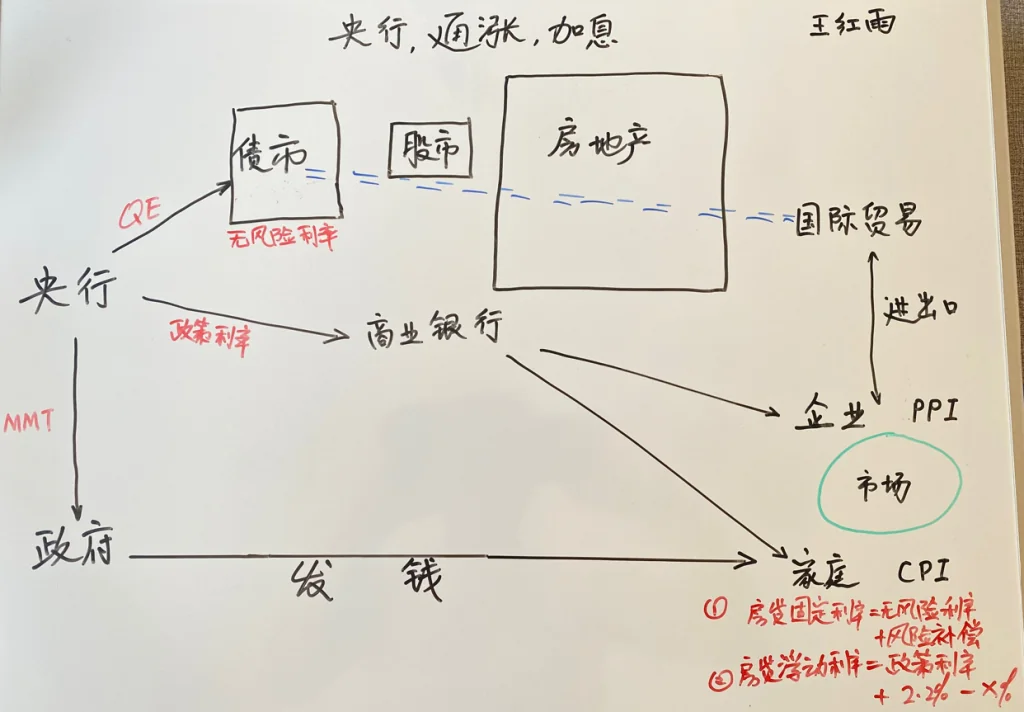
The quality of bank loans is very good, with a bad debt rate of 1.7% per thousand. There is no reason for banks to tighten mortgage policies because they are already tight enough. The quasi-principal rate of deposits is 2.5%, which is very low, and banks have the incentive to actively lend. The government will do anything for votes, and it has been spreading money without stopping. This is why housing prices cannot come down, and most of the money printed is used to support housing prices.
What is the impact of interest rate hikes on the government? and what will the government do?
The government will continue MMT and continue to borrow money from the central bank. It has no plans to shrink the budget or balance the budget. Raising interest rates has nothing to do with government spending. When the national debt matures, new debt is issued to repay the old debt, but the interest rate on the new debt is over 3%. The current government only cares about spending money, not about the flood after death.
The Fed is scheduled to begin shrinking its balance sheet in June. Has it reduced its holdings of Treasury bonds and MBS as planned so far? Is there any news that it is increasing instead of decreasing? What about Canada’s balance sheet reduction? Will this have any impact on future monetary and fiscal lending policies? Can you foresee a recession?
The scale of balance sheet reduction is not large, and the principle of balance sheet reduction is not to sell bonds but to wait for bonds to mature, so the progress is very slow. Part of MBS was sold off, but the amount was not large. The more the selling, the greater the losses, so there was no incentive to sell on a large scale. Balance sheet reduction has an impact on asset prices and has little to do with GDP. Exact balance sheet reduction data for the U.S. and Canada are not available. After the subprime mortgage crisis, QE increased the Federal Reserve's assets by 3.6 trillion, reduced its balance sheet by 0.7% trillion, and recovered 20% of the additional currency issuance.
In the era of high interest rates, will Toronto housing prices fall back to 2018?
If the population and currency circulation return to 2018, housing prices can return.
Will interest be added for the next three times? Will it be stable next year and then decrease later?
The progress of interest rate hikes cannot be predicted. How many times the interest rate will be increased is not something we can guess. The trend of this round of interest rate hikes is to step on the accelerator first and then make fine adjustments.
Buy now or wait until interest rates rise in September?
Whenever interest rates are raised, the stress test rate increases. One more time, if it is 50BPS, the borrowing capacity will drop by 15% compared to July 13th. Unless housing prices also drop by 15% from now to September, only a house that can be afforded before July 13th will be purchased.
Judging from the current situation, the central bank raises interest rates to curb inflation, but the government is the largest liability party. Will it eventually return to low interest rates to cope with the government's debt pressure? Or does the government simply not care about debt?
The government owes the central bank a large amount of money through MMT, and it can repay part of it with taxes. If a large amount of debt matures, the government will issue new treasury bonds to pay the old debt, and will also use the newly issued treasury bonds to redeem the IOUs held by the central bank. When bonds are issued at this time, the interest rate is 3%, so it is easy to issue. This usury will be left to future governments and to future generations. It is also possible that when the next crisis occurs, the central bank will buy it, suppressing bond yields again and cutting interest rates again. A rate cut is possible, but we don't know when.