The real estate transaction data of various provinces in January 2022 have been disclosed one after another. The increase in house prices in GTA is not only double digits but also starting with 2. Although the national data has not yet been compiled, the momentum of continuous skyrocketing in house prices is obviously still there. Since the general election in September last year, the measures to suppress housing prices that people are worried about and long for have still not been introduced. Some people are eager to see it through, while others are frightened and don't know when the promised boots will fall.
The government has many departments, including the federal government, provincial governments, central banks, bank regulatory authorities, etc. Where does the boot fall? Can this boot put out the fire of housing prices? Let's go through each one one by one and analyze why the boots haven't fallen yet.
01 Please, the federal government, stop implementing the election promises. Taxpayers can’t stand it.
During last September’s federal election, the political parties scrambled to make promises about the housing crisis and what they would do if they came to power. All the policies and promises of the Liberal Party are off target. Even if the election promises are fulfilled, they will not have any effect on the blazing real estate. Among the various proposals put forward at that time, only one proposal from the Conservative Party hit the bull's-eye.
After the election, the federal government established the "Department of Housing". Yes, there is another civil servant who eats taxpayers. Currently, the Ministry of Housing’s only initiative is to announce that it will use taxpayers’ money to build 74 sets of affordable housing. Most of these welfare houses will be allocated to Aboriginal people. This means that these achievements will not be circulated in the market and will not help solve the housing crisis. Similar measures to implement election promises should really not be implemented again. This is not watering the market, but pouring oil. Millions of taxpayers' money has been used to build more than 70 welfare houses. How can the people who are eagerly looking forward to suppress housing prices be embarrassed?
Before the election last year, the Conservative Party proposed a plan to defer capital gains taxes for real estate investors, which was immediately labeled by Trudeau as "seeking benefits for the rich." But it is the only proposal of all parties' campaign promises that would solve the housing crisis. There is a tax provision in the United States, Section 1031 of the tax code, that is, if a real estate investor sells an investment property and buys another investment property, the capital gains tax on the sale of the property can be deferred. The Conservative proposal is similar to Section 1031, which means that if an investor sells a townhouse and buys a condo, the capital gains tax on the sale of the townhouse can be deferred. In this way, the current scarcity of housing supply can be alleviated, because the current liquidity in the second-hand housing market has dried up. If investors are not encouraged to sell houses, it will be difficult to release liquidity and housing supply. Some people have put forward an idea contrary to the Conservative Party, which is to impose double capital gains tax on real estate investors selling houses. This is a relief, but will investors still sell their houses? The increased tax will only be passed on to the buyer, and the only person who benefits is the tax bureau. Those who resort to harm only want to rob the rich, but we all know that the principle of robbing the rich and helping the poor has killed all the capitalists. Who will the workers work for? Will tenants be able to afford a house if they drive out landlords?
The Liberal Party’s campaign promises are more deceptive if they are implemented than if they are not implemented. When the promises were made, it was about votes. Now that he has been re-elected, no one can expect or urge the implementation of these promises. The election promises that have been implemented show that they will only increase the burden on taxpayers and will not alleviate the housing crisis.

02 Provincial government, do you still dare to take political risks?
In 2017, Ontario was governed by the Liberal Party. Facing the provincial election, the Ontario government decided to follow the example of British Columbia in taking measures to suppress housing prices. Of course, it was for the sake of its own votes. Suppressing housing prices, in the name of curbing non-resident real estate speculation, achieved fruitful results with an 18% drop. However, the calculation of the votes was wrong, and the Liberal Party was completely defeated in the provincial election. The British Columbia Province made the right decision. It first targeted non-residents in 2016 and continued to raise the height of the tiger bench in the following years. The price of condos in Vancouver has not returned to the high point in 2018. The political party representing the interests of tenants and unions has been in power ever since. In contrast, Quebec has been much calmer and has not taken any action against non-residents. From 2018 to 2019, off-the-plan properties were in full bloom, attracting a large influx of non-residents and speculators. The real estate market remains stable to this day. The housing price intervention policies introduced by the provincial government are obviously more effective than the federal government, but political parties need to risk losing votes. Judging from the situation in the above three provinces in the past six years, the probability of being driven out of office if you interfere in the free market is 50%. For politicians, it is safest to do nothing.
Judging from the current situation in Ontario, intervention in the real estate market is in the right direction, that is, to increase supply. This direction is also politically correct. The short-term problem of insufficient housing supply does require long-term efforts to solve. Now that apple prices have soared by 30% due to too many buyers, the government's policy direction of diversifying apple trees is definitely right. Although the policy cannot solve the current anxious state of the market, it is politically correct. The most important thing is not to let this unsolved problem affect the votes in this year's provincial election.
Solving the housing supply problem is very difficult. If the zoning control is too strict, housing construction will be too slow. If it is too loose, it will be like Texas, where housing can be built anywhere and housing prices will never rise again, leading to a shrinking of residents' wealth. Ontario plans to build 1.5 million new houses in the next 10 years, which is probably an election promise made for this provincial election. To implement it, two problems need to be overcome: 1. Can the urban density be like that of Manhattan without reducing the quality of life? I personally think that the current infrastructure does not meet this condition at all; 2. NIMBYism is actually a kind of neighbor's power. Can you add your house from one floor to four floors without your neighbor's consent? I think even if you have the backing of the government to approve your building permit, it would be difficult for your neighbors to agree. In terms of increasing supply, we don’t see any good way to achieve immediate results, so the problem of insufficient supply will continue to exist for a long time.

03 The central bank is a kind-hearted double-dealer
The Bank of Canada has reminded the public more than once in 2021 to pay attention to the debt burden and the housing bubble. Some Chinese self-media editors took advantage of the situation and speculated that the central bank would intervene in the real estate market. Throughout history, no country's central bank has ever suppressed the second-hand housing market, at all times and in all countries. The Chinese editor has no common sense at all.
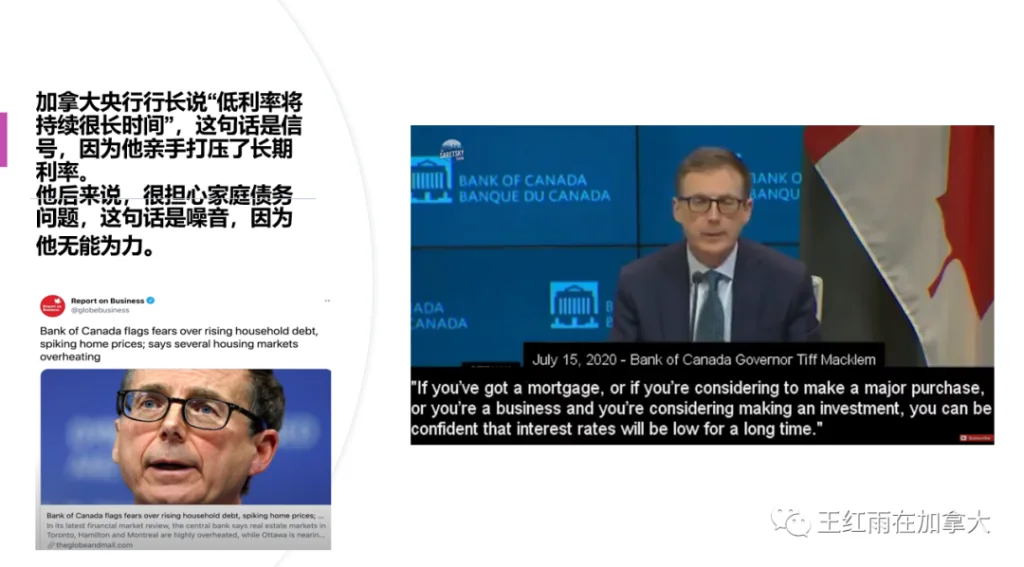
As early as May 2020, the governor of the central bank personally gave a speech, advising Canadian households and businesses to boldly borrow money, because he said that Canadian interest rates will remain at a very low level for a long time to come. In July 2021, it came out to warn Canadian borrowers that the debt was too high. What does the central bank’s double-dealing mean?
After the outbreak of the epidemic in March 2020, the Canadian banking regulatory authority OSFI lowered the reserve ratio of commercial banks from 2.25% to 1% overnight, injecting 300 billion in cash into commercial banks in one night. The central bank has not shown weakness, and has purchased 4 billion bonds every week since March 2020, that is, it has invested 4 billion in cash every week. The reason for releasing liquidity on such a large scale is because banks are unwilling to lend, which will lead to economic paralysis. If bank regulators and central banks pile cash on banks and the banks don't lend, the cash released means nothing, a situation that has occurred in Japan and is known in economics as a "liquidity trap," or central bank pushing the rope. In May 2020, the Governor of the Bank of Canada called on Canadians to go out, enjoy low interest rates, and borrow money quickly because he did not want to see Canada fall into a liquidity trap. This speech sent out a very valuable signal. Those who understood it bravely picked up the lever weapon. More than a year later, in July 2021, Canadian real estate is booming, commercial banks are actively lending, and the central bank's worries about liquidity traps have been lifted, so it comes out to persuade everyone, okay, okay, just borrow this much. At the same time, the central bank is still printing money non-stop, and the government is still giving out benefits without reason. People who understand the economy regard the warnings issued by the central bank after July 2021 as a kind of noise and actively block them. People who do not understand people understand that the central bank is going to suppress real estate.
The thing is that simple. Because of its responsibilities, the central bank must be a kind-hearted two-faced man, no matter what mountain he climbs, he will sing no matter what song he sings. Which song is the signal and which song is the noise? Only those who know how to listen will know.

04 Will banks increase down payments on real estate investor loans?
“Where does the money that causes housing inflation in Canada come from?” This is the topic of a working group initiated by Pierre, a Conservative member of Parliament. The panel held multiple hearings in January, inviting real estate agents, university professors, debtors from CMHC and banking regulator OSFI to testify. The current investigation has no results. Judging from the few words from CBC News, the current conclusion is that the rise in housing prices has nothing to do with inflation. The Conservative Party believes that the soaring housing prices are caused by the Liberal Party's uncontrolled welfare payments and expansion of government spending.
From my personal observation, in the past two years when there was no inflow of hot money from new immigrants and non-residents, there are two crucial factors for the soaring housing prices. One is that the Liberal government overdrafted the future and printed money in the name of fighting the epidemic, which led to an increase in people's deposits and abundant down payments. The other factor is that Canadian commercial banks did not hesitate to lend and lent their cash to middle-class families who worked hard during the epidemic in accordance with B20 standards. Everyone knows that down payment plus loan equals house price, so Congress doesn’t have to bother to track it down. The money comes from the Treasury and commercial banks. After attending the hearing, Peter, the director of OSFI, was interviewed. The interview lasted for an hour. Although the media pricked up their ears to hear whether there was any information about suppressing housing prices and increasing the down payment ratio of investment housing loans, the results were disappointing. However, the content of this interview was unsurprisingly taken out of context by the media. The headline of the Financial Post reads: Banking regulators warn that house prices may fall by 20% as speculation recedes. Banking Watchdog Warnshousing prices could plunge 20% when “speculative fever” break. I listened to this interview, and the context is this. When Peter was asked about the reasons for the rise in housing prices, he said: The first reason is that people with home equity are equivalent to savings; the second reason is that the bad debt rate of commercial bank mortgages is very low, 1.7 per thousand, so banks issue loans according to normal procedures, and qualified borrowers can easily obtain loans; the third reason is that the interest rate is too low, so the return on real estate investment is large, attracting many speculators. As interest rates rise, investment income will decrease, so the speculation trend will gradually subside as interest rates rise. In the process, house prices in some areas may fall.However, commercial banks are very stable. Even if house prices fall by 10-20% like in 2017-2018, commercial banks can handle it calmly. Obviously, the content of the news reports is seriously inconsistent with the content of Peter's conversation.
Peter’s last sentence in this interview is very important. He said, “I know that as a banking regulator, any policy changes we make will involve thousands of households in Canada, especially those involving housing. We will listen to the voices of Canadians before making changes.” It is very clear that the rumored proposal to let banks change their lending policies to solve the current real estate crisis has been clearly and unequivocally rejected by the regulatory authorities with the power to change B20 policies.
05 closed loop of happiness
Peter’s interview is very rich in content, and the current status and problems of Canadian real estate revealed are also very profound. A question asked by the host during the interview impressed me deeply, and Peter's answer was also very candid, which confirmed a long-term observation of mine. The host said that the wealth reservoir of Canadians is house property rights. People with property rights can continue to take out property rights as down payments to buy more properties, and more property rights are grown in more properties..., forming a closed loop. People without property rights are excluded from this closed loop. Even some families who consider themselves middle-class are afraid to consider themselves middle-class because they cannot afford a house. How can this situation be broken? Peter answered very frankly that it could not be solved in the short term, because if housing prices were to drop to a level where every newly formed family could afford a house, Canada's entire financial and economic system would collapse.
What I saw is highly consistent with Peter’s conclusion. Families with an annual income of more than 140,000 yuan and a home loan balance of less than 300,000 yuan are the beneficiaries of this closed loop. They have the ability to continuously accumulate home equity in this closed loop. As we all know, in Canada, houses make money faster than people make money. Five or six houses make money for the owner around the clock, which makes me happy just thinking about it. In "David Copperfield", there is a definition of happiness and unhappiness, "An annual income of 20 pounds and an annual expenditure of 19 pounds and 6 pence will produce happiness. However, an annual income of 20 pounds and an annual expenditure of 20 pounds and 6 pence will cause misfortune." This was the definition of happiness 150 years ago. In the past, carriages and horses were slow and letters were far away, and 6 pence could distinguish happiness and misfortune. Today, people no longer worry about food and clothing. The green color usually comes from comparing with others. People in the closed loop are happy, while people outside the closed loop seek medical advice everywhere, thinking about entering this closed loop day and night.

The closed loop of happiness seems simple, but it is like a strong castle that shuts out many people. Breaking into the closed loop of happiness is a big challenge for the first-generation Chinese immigrants, because Canada is a developed country, and if you want to get rich, you have to get a share of the existing wealth. I wanted to make a sketch of what I saw about the Chinese families that rushed into the closed loop, hoping to inspire more people.
First of all, you must have a job that you love;
Secondly, you must buy a house early;
Third, prioritize wealth accumulation before tax saving;
Fourth, it must comply with public order and good customs, and do not evade taxes; official business must be done, and children and parents must also charge rent if they live in their own investment houses;
Fifth, the self-owned house is enough to live in, and there is no need to live in it for others. The basement of the self-owned house is not rented out;
Sixth, owner-occupied housing loans have not been reduced to the annual household income.2.5Do not hide money in the tax shield until the amount is below 100%, and the savings will be used first to accelerate the repayment of the home loan;
Seventh, income is lower than14Ten thousand years ago, I continued to accumulate real estate by moving;
Eighth, do not partner with anyone other than husband and wife to purchase a house on loan;
Ninth, do not illegally sublet the property;
Tenth, the maximum amount of each investment housing loan shall not exceed the annual income5times.
The above ten points, even if they are not used as iron rules for real estate investment, as self-discipline principles, will make every family live happily in Canada.
I have been doing mortgage loans for 13 years and have summarized two formulas for calculating mortgage capacity. See the picture at the end of the article. Those who hope that each loan amount will reach 6 or 7 times their annual income simply cannot enter this happy closed loop. People who have no job and do not pay taxes regularly are the most difficult to enter this closed loop of happiness. Even if they are lucky enough to borrow money from a Class B financial institution to become a landlord and get into a car in a hurry, they will not feel happy. it by exception will not be happy.To enter and stay in a happy closed loop, the maximum borrowing amount is 50 times the family's annual income and it is entirely possible to hold 10 rental houses at the same time. Nearly 1% of my clients reach full positions every year, and one family holds 10 investment properties. People who get on the bus at all costs and stay away from the above ten self-discipline principles will find it difficult to achieve this goal.