Historical article note: This article was originally published on 2018-02-12. Rates, policies, home prices, statistics, product names and qualification standards reflect the environment at that time and may have changed. This archive is for historical record and general education only. It is not mortgage approval, investment, legal or tax advice.
There is an important type of mortgage product in Canada and the United States: a revolving line of credit collateralized by home equity, Home Equity of Credit, abbreviated as HELOC. As the name suggests, it is a mortgage product that can be used repeatedly, just like a credit card. When used, the approved limit is occupied. After the balance is repaid, the available line of credit will be restored. One feature of Canadian HELOCs is that as long as the mortgage is not released, the credit line is always valid, while the corresponding products in the United States have life limits and will automatically expire if not used within a certain period of time. Due to this longevity feature, the cumulative amount of HELOC in Canada is getting larger and larger, now reaching 11% of GDP, while the United States only has 3%. China has had similar products, such as China Merchants Bank's revolving loan, but because regulatory authorities require borrowers to prove that the funds they withdraw have not flowed into the stock market, artificial obstacles have made the product difficult to operate, and this type of loan product has been basically abandoned.
What are the benefits of a product that is so popular in Canada? 1. It is convenient to borrow and repay at will, similar to a credit card; 2. Because there is real estate as collateral, the interest rate is lower than other recyclable financial products; 3. The minimum monthly payment is only interest and no principal, which is lighter than a mortgage loan, and you can even only repay the "minimum payment amount"; 4. If the withdrawal amount is large and the loan is occupied for a long time, it can be converted into a mortgage loan and enjoy the mortgage loan interest rate.
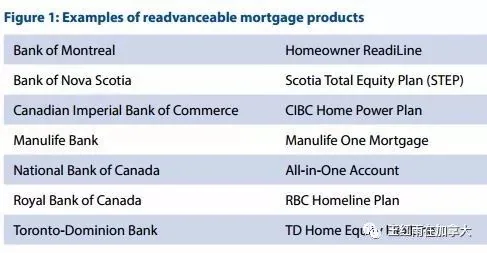
HELOC is roughly divided into two categories: 1. HELOC mixed with mortgage, that is, mortgage loan + HELOC, which we call readvanceable mortgage; 2. Stand-alone HELOC. The first type is a mortgage + HELOC hybrid product, which is given different names by different banks. The roster is as follows: Bank of Montreal: Homeowner Readiline/HRLC; Bank of Nova Scotia: Scotia Total Equity Plan (STEP); CIBC: CIBC Home Power Plan; ManulifeBank: Manulife One Mortgage; NationalBank of Canada: All-in-One Account; RoyalBank of Canada: RBC Homeline Plan; Toronto-DominionBank: TD Home Equity FlexLine.
The names are different, but the nature is basically the same: as the mortgage balance decreases, the available line of credit increases, and withdrawals from the available line can be converted into mortgage loans for installment payments. Second, the available amount of the bare HELOC is fixed and has nothing to do with the decrease in the principal of the mortgage loan, and withdrawals cannot be converted into mortgage loans. Taking BMO Bank as an example, the name of one type of HELOC is HRLC, and the name of the second type of HELOC is HOLC. According to the B20 regulations in 2012, the recyclable amount cannot exceed 65% of the house price. In the case of mortgage loan + HELOC, the mortgage loan part cannot exceed 80% of the house price. Taking a 400,000 house as an example, the mortgage loan amount is 320,000, the HELOC part is 260,000, and the down payment is 80,000. As the principal repaid gradually increases, the available line of credit gradually increases. When the available line of credit increases to 260,000, the mortgage loan continues to be repaid, and there is no longer an increase in the available line of credit. If the interest rate is 4% and the repayment period is 25 years, the specific changes in the available amount are shown in the figure below.
Canada's HELOCs grew rapidly between 2000 and 2011, almost simultaneously with the debt service ratio, which is very scary. Regulators announced in 2011 that they would no longer securitize all mortgages with HELOCs. As we all know, Canada's non-bank financial institutions rely on continuous securitization of mortgage assets and cash out to maintain the source of mortgage funds. As soon as this order came out, the vast majority of financial institutions that relied on the securitization of mortgage loan assets stopped issuing HELOCs. Therefore, consumers found that only big banks are still issuing such financial products, while most non-bank financial institutions have withdrawn from this business. Since 2011, the development of HELOC business has been much slower. The concerns of the regulatory authorities are not unreasonable. Many people will not use HELOC products, especially those who do not know how to manage their debts, and borrowers who do not understand the language and take it for granted.
Let me tell you a heartbreaking case. After the borrower obtained a mortgage loan of NT$500,000, he applied for a HELOC of NT$200,000. It was the second smooth HELOC with an interest rate of P+1%. He then withdrew NT$190,000 from the NT$200,000 limit and left Canada. The murder occurred because the borrower chose the "minimum payment" repayment option when setting up this HELOC without having any idea what this repayment method meant. The HELOC withdrawal of 190,000 is interest-based at P+1%, and compound interest is calculated daily. At the end of the month, the bank will notify the borrower what the interest is this month and what the "minimum repayment amount" is. The monthly interest is calculated based on the interest rate. For example, if the current P=3.45%, the borrower's interest rate is P+1%=4.45%, and the "minimum payment amount" is calculated using 2%. Because the borrower chose to repay the calculated "minimum payment amount" of only 2% per month, the difference between the monthly interest payable and the "minimum payment amount" was added back to the principal of the withdrawal of 190,000. Since the borrower had not lived in Canada for a long time, the bank issued a collection notice when the total compound interest withdrawal exceeded the limit of 200,000. The borrower still did not reply. He sent a lawyer's letter but still did not reply. The terrible result finally happened. When the borrower returned to Canada, he found that the door lock had been changed by the bank.
The disadvantages of HELOC are: 1. Floating interest rate, high risk; 2. Daily compound interest calculation, high cost; 3. Unable to transfer to bank/switch/transer, only refinance/additional mortgage, and the cost of switching to bank is high; 4. Only paying the "minimum repayment amount" debt accumulates rapidly, which is very dangerous. It is recommended that HELOC borrowers set a repayment plan for themselves. They should not just pay the "minimum payment", but at least pay off the current month's interest every month, and it is best to repay some principal every month. Debt is a double-edged sword, if you use it incorrectly, it will kill you.
Previous public account articles introduced the PHRESE investment method: Purchase, hold, refinance, continue to hold, continue to reinvest, and finally sell. Regarding this investment methodology, I suggest friends who invest in real estate to pay off their home in one go, and then make a HELOC as a backup. For investment properties, it is actually not necessary to take out a mortgage loan + HELOC when you buy it, and then add the mortgage at the last time, that is, you can do it again when you no longer want to increase the mortgage. For example, the purchase price of an off-the-plan property purchased in 2013 was RMB 400,000. When the property was delivered in 2018, the market price was already RMB 480,000. However, the bank still made a loan based on the purchase price of RMB 400,000. The investor could borrow a maximum of RMB 320,000, which is only 66.7% of the market price. The leverage is too short, so after two years, an additional mortgage must be made based on the market price. It does not make much sense to make a HELOC of 400,000 and 65% when the off-the-plan property is delivered. In addition, compared with applying for a smooth mortgage loan, the loan amount approved for the HELOC will be smaller. The reason is that according to the new B20, when a borrower applies for a HELOC, the actual interest rate is P+0.5% plus 2% as the interest rate for calculating the borrowing ability, that is, 3.45%+0.5%+2%=5.95%; if you only apply for a smooth mortgage loan, the interest rate for calculating the borrowing ability can be as low as 5.14%. For investors, the lower the down payment, the more efficient the use of funds. Therefore, I do not recommend that investors should have a HELOC for every mortgage loan. It should vary from person to person and according to local conditions.