This is the record of an interview with Hayek by Thomas Hazlitt, a contributing editor of Reason magazine, in 1977 when he first started studying for a graduate degree in economics at the University of California, Los Angeles. The original text comes from Reason Magazine, 1992. This article is selected from "Why Intellectuals Oppose the Market", edited by Qiu Feng, Jilin People's Publishing House. The text is reproduced from the public account translator Qin Chuanan.
When I was about to interview Hayek in Los Angeles in May 1977, he seemed to have sensed the changing direction. In the 1930s and 1940s, Hayek was once the second most famous economist on the planet. He was famous for his sharp criticism of Keynes's theory. The debate between Professor Hayek of the London School of Economics and Professor Keynes of the University of Cambridge centered on the fundamental issues of economic policy. This was the first confrontation between classical economics and the "macroeconomics" published by Keynes in his 1936 book "Introduction" (reprinted by the author's note: "The General Theory of Employment, Interest and Money").
The debate ended with Keynesian victory. In fact, after Keynes died in 1945, Hayek (and his classical business cycle theory) quickly faded from the public eye. In 1950, he came to the University of Chicago to chair the Committee on Social Thought, and later spent his academic career at the University of Freiburg (1962-1968) and the University of Salzburg (1968-1977). He made important contributions in new fields such as psychology ("Order of Senses", 1952), political theory ("Freedom Charter", 1960) and law ("Law, Legislation and Freedom", Volumes 1 to 3, 1973-1979).
From the 1920s to the 1940s, Hayek, together with his Austrian compatriot Mises, insisted that planned economy, as an economic system, was destined to fail. Because only a free market, driven by individuals and pursuing their own interests, can generate the information necessary to coordinate social behavior intelligently. In other words, freedom is a necessary condition for economic prosperity.
He wisely avoided economics. For his dispute with Keynes was not the only defeat he suffered in a purely theoretical argument. The famous socialist computing debate was sparked by Austrian economists' criticism of centrally planned economies. From the 1920s through the 1940s, Hayek and his compatriot Mises maintained that planned economy was bound to fail as an economic system because only free markets—individuals pursuing their own interests—could generate the information necessary to coordinate social behavior intelligently. In other words, freedom is a necessary condition for economic prosperity. But while Hayek's famous paper demonstrating that market prices were the necessary signal for a rational economy made an original contribution and won plaudits when it was published in the American Economic Review in 1945, astute planning theorists also proved themselves victors, saying that centrally planned economies could be improved upon by using the nascent mainframe computers to solve the information problems identified by Hayek.
Being defeated in one or two academic debates is nothing for a brilliant person. Hayek was not defeated. Over the next few years, he continued to publish his wise writings. However, in the economics circle, everyone seemed to have a tacit understanding: Hayek was just an outcast, a loser, and a marginalized person. All reasonable people who were active in scientific journals at that time simply ignored his ideas and views.
But then something strange happened. The second half of the 20th century was destined to provide facts to prove that this scholar, regarded by the academic community as a failed scholar, was correct. The postwar prosperity of those countries that believed in Keynesianism (mainly the United States and the United Kingdom) turned into worsening inflation in the 1960s and 1970s. People have to admit the cruel fact: in many cases, full employment cannot be maintained using Keynes's ready-made Rubik's Cube. The traditional prescription—stimulating consumption while limiting savings and injecting funds with beneficial government deficit spending—has been tested in the real world, and the results have not been pretty. The macro models of Cambridge, Harvard, Berkeley and MIT were abandoned, and by the 1980s Keynes himself had been abandoned as the solutions he proposed were seen as the source of the troubles of our time. Suddenly everyone was shouting, The economic policy goals of good government should be the classic prescriptions: savings, investment, balanced budgets, competition, and increased productivity. Even politicians who had become accustomed to seeing government only as a panacea for economic downturns openly abandoned Keynesianism.
In a planned society, is it possible to rationally formulate economic plans? Yes, we have had too many experiences. Third world countries tried it, and the incomes of their people quickly fell to newer world levels. The Second World (Soviet Union and Eastern Europe) also tried this, which ultimately resulted in the emergence and collapse of large-scale police states.
In 1974, when Hayek—who had been outside the economics profession for more than three decades—unexpectedly won the Nobel Prize in Economics, the West was just beginning to abandon Keynesianism and the rest of the world was moving away from socialism. In the blink of an eye, Hayek went from being a silly weirdo to a respected mentor. At the end of the 1970s, the Labor Party, the Democratic Party and the Social Democratic Party (ah, you remember them, think about it, think about it) were still in power in London, Washington, and Bonn, and Hayek had the foresight to see the opportunities for global political changes. In this interview (which has never been published before), Hayek already anticipated the slow policy shifts that were taking place around the world in the 1980s. He seems to have sensed that it won't be long before he, the greatest philosopher of capitalism since Adam Smith, will no longer be underestimated.
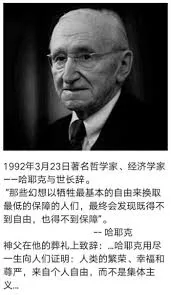
sometimes, Only by living a long life can you prove that you are right . Hayek, who was born in 1899, died in Freiburg, Germany on March 23, 1992. He lived longer than both Keynes and Marx. This is a good thing for mankind, and it is also a good thing for his ideas.
Hazlitt: Regarding your book "The Road to Serfdom", Keynes once said: "In my opinion, this is a very important book...In fact, I find that both morally and philosophically, I can be said to accept the arguments of this book completely: not only agree with it, but deeply agree with it." Why did Keynes say so about a book that is deeply critical of Keynesian views?
Hayek: Because he believed that, in essence, he was still an orthodox British liberal, without realizing how far away from this tradition he had become. His fundamental idea remains the concept of individual freedom. He does not systematically explore the conflict between the two. In a sense, he was corrupted by political needs. His (Keynes) famous mantra was "In the long run we all die" , which can well explain how he is subject to current political needs. He no longer thinks about what is desirable in the long run. So I thought,History will prove that he (Keynes) is not the creator of ideas that can maintain long-term vitality. His ideas are just a fashion. Fortunately, this fashion has now passed.
Hazlitt: There is a common legend that Keynes woke up in his later years?
Hayek: This is a sharp turn. However, he was always swaying from side to side. He always stands in the middle, wondering what ideas are popular at the moment. At the last meeting I attended with him (this was in 1945, just three weeks before his death), I asked him if he had been alerted to how his disciples would treat his ideas. He said, "Oh, they were just idiots, and these ideas were very important in the 1930s. Believe me, I will change public opinion again, just like this time." I'm sure if he had survived the war, he would have become a crusader against inflation.
Hazlitt: Keynes argued that when unemployment is high, Is it always true at some point that government spending can stimulate aggregate demand?
Hayek: No, not right at all . But of course, that's not all I see. I believe that if the government did not intervene in the monetary system, we would not have industrial fluctuations and we would not have periods of recession.
Hazlitt: So the business cycle is caused entirely by government monetary authorities?
Hayek: Cause and effect are not so direct. As you point out, it is the result of consciously wrong policies on the part of the government. The mistake is the fact that the government controls the quasi-monopoly of the monetary base, with all commercial banks issuing only the intermediate currency ( second ary money), which can be repurchased with base currency. This is a system that no one can really control. Therefore, the government's monopoly on currency issuance does bear the final responsibility. In such a monopoly position, no one would act rationally.
Hazlitt: You once wrote that the period from about 1950 to 1975 will go down in history as the Great Boom. If Keynes' theory was incorrect, why was the economy so prosperous? In 1922, although Germany experienced sharp inflation, it did not experience such a boom. Why?
Hayek: Because in Germany, inflation is not aimed at achieving prosperity, but entirely to cope with financial difficulties. If you inflate to maintain prosperity, you always end up well beyond moderation.The boom did last longer than I expected. I had been predicting an economic collapse, and I thought it would come soon. I base my expectations on the timing of the collapse of the inflation-driven boom in the last business cycle. But the last collapse was due to the gold standard, which hit the brakes after several years of credit expansion. In any monetary order framework, beneficial credit expansion cannot continue indefinitely. As soon as we see that we cannot continue to prosper by accelerating inflation, credit expansion is over.
Hazlitt: How does inflation lead to unemployment?
Hayek: Inflation moves people into jobs that can exist only when the relative demand for something is temporarily increased, and that become unsustainable once the increase in the quantity of money ceases.
Hazlitt: Your prescription for controlling inflation is: The goal pursued by monetary policy should be to maintain the stability of currency value. Is it necessary for politicians to manage the money supply? Couldn't market forces gradually adjust to correct gradual deflation?
Hayek : Yes, market forces can occasionally do that. The problem is that the gold standard would take away the jobs of politicians. Even if we only implement a nominal gold standard now, it won't work because people are no longer willing to play by those rules of the game. The rule of the game required by the gold standard is that if your trade balance is bad, you can only contract your currency. Now, no one wants to do that - so they stay away from the gold standard. I do believe that if we restore the gold standard now, within half a year, some countries will abandon it, and within three years, the gold standard will disappear from the entire world again.
Fundamentally speaking, the gold standard is based on some irrational superstition. The gold standard can only function if people believe that there is no savior, only the gold standard. People have completely lost this illusion or superstition. Now, we can no longer successfully implement a gold standard. I hope we can do this. Because of this, I had to think of other options.
Hazlitt: You have repeatedly proposed the establishment of a commodity-reserve monetary system and advocated competition in the money supply. Is this a viable reform option for a government-controlled central banking system?
Hayek: Yes. I am sure that the idea of a commodity preparation system is a good one, but in practice it is unworkable. Trying to continuously accumulate large inventories of goods as currency reserves is too complex and simply unfeasible. No one can do it.
So I came to the conclusion: Unless you impose some sort of constraint on the government that issues the currency, it has no interest in keeping the currency it issues stable. , Therefore, we need to have some real commodities that can be exchanged when the currency is unstable. But if you give the right to issue money to businesses, and the success or failure of their business depends on whether they maintain the stability of the currency they issue, then the situation is completely different. In this case, we do not necessarily rely on them to pay our debts with commodities: this depends on the fact that they must control the issuance of their currency so that the public will accept their currency because it is relatively stable. This is better than any other method.
Hazlitt: Keynesian economic prescriptions have brought the various political forces of the modern welfare state into an almost perfect symbiotic relationship. Where can we start to break this alliance of interests? How to defeat Keynesianism politically?
Hayek: I think we should start with Keynes himself. In the 1920s, Keynes gave up hope of making wages flexible again and concluded that we must accept wages as they are and adjust monetary policy to suit the established wage structure. Of course, that would force him to say, "I don't want to limit the use of monetary policy because I have to adapt it to a situation that is already there."
However, he fails to note that whenever union organizations know that they must bear the government's obligation to correct the consequences of union policies, then we will be trapped in a vicious cycle from which it is difficult to extricate ourselves. Unions push up wages, and the government is forced to print money to maintain employment at those wages, and we get into an inflationary spiral. And all of this was originally just Keynes's short-term expediency consideration - we can't touch wage rigidity.
In fact, in the 1920s, Britain came close to successfully solving the problem of wage rigidity. The painful and unhelpful process of deflation came close to overcoming wage rigidity by the end of the 1920s. At this time, they were worried about long-term unemployment. I think if they had stuck with it for another year or two, they could have been successful.
Hazlitt: Gurniai Myrdal, who won the 1974 Nobel Prize with you, recently published an article advocating the cancellation of the Nobel Prize in Economics, obviously to vent his dissatisfaction with you and Friedman for winning. His most famous assertion was that he referred to your lack of social concern, specifically that you "have never thought seriously about epistemological issues."
This view is really surprising, because you have written extensively on epistemological issues (in economics and other fields), and your Nobel Prize lecture focused on epistemological issues in economics, and Myrdal was present at that time. Is Myrdal's absurd statement born of ignorance or resentment? Is this a typical reflection of the academic environment across Europe?
Hayek: No, this is obviously just an extreme example. Even in economic circles, this kind of intellectual arrogance is rare. Myrdal formulated those views before Keynes himself became famous. His writings on monetary theory, value, etc. date back to the 1920s, and he has a unique perspective on the subject, which I believe is wrong. His work is never in print now, and I don't think he is a good economist at all.
Hazlitt: Myrdal, then, was not a type? Isn't the European intellectual and academic environment, in general, more hostile to your ideas?
Hayek: Ah, more hostile to Myrdal, of course. Of course, the younger generation has become much kinder to me. I would say that in some sense the biggest problem is methodological, not Myrdal's ideas. I believe, Economics and generally the sciences that study complex phenomena, including biology, psychology and other disciplines, cannot build models in the same way as natural sciences such as physics that deal with simple phenomena.
Don't be surprised when I call physics simple phenomena. What I mean is that when you explain physical phenomena, you use a theory that contains only a few variables. You only need to look at the equations in the appendix of any physics textbook to understand this. You will find that no matter which equation represents the theorem of physics, there are no more than two or three variables.
You cannot explain any social life phenomenon with a theory containing only two or three variables. The result is, We'll never get a theory that effectively predicts specific phenomena because you have to plug so many variables into the equation that you have no way of knowing. In this sense, our possibilities for explaining and predicting social phenomena are much more limited than in physics.
However, the ambitious young man was not satisfied with this. They wanted to create a science whose predictions of social phenomena were as precise and as controllable as those in physics. Even after they knew they couldn't do it, they would say, "We have to try harder and eventually we will find this equation." When we do this kind of research, We want to achieve complete control over social events, just as we want complete control over physical phenomena in physics. If they did create a society guided by the collective will of the group, then the progress of knowledge would have come to an end. Because then it would be impossible to make use of the widely dispersed knowledge on which our society is built, which exists only in some complex process that you simply cannot grasp intellectually.
Hazlitt: In 1947, you founded the Mount Pilgrim Society, an international organization of free-market scholars. Are you pleased with its progress?
Hayek: Ah, yes. I mean, its main purpose has been achieved by and large. I noticed more and more strongly that we all felt that there was less and less room for true freedom, and that people everywhere were accepting the fashionable theories of the day. So I brought people together with different interests. At any given moment, if one of us said, "Ah, yes—but we need government regulation when it comes to cartels," another one of us would say, "No, no, I've studied that." And we developed a coherent theory of thought and became a sort of international community.
Hazlitt: Last year, U.S. News & World Report ran a specially curated cover story in which eight prominent social scientists from around the world, including you, asked the question: "Is democracy dead?" What I found most interesting was that several thinkers seemed to quote passages from "The Road to Serfdom" to argue that the current crisis is the result of the welfare state's excessive interference in problems that were once the private domain. Do you feel this argument has gained academic support? Might we say that more intellectuals are now beginning to understand the fundamental conflict between freedom and bureaucracy?
Hayek: Without a doubt, yes. There is no doubt that this idea is spreading. But I'm not sure how many intellectuals were exposed to this idea. Compare it with 25 years ago, when we were fighting alone in a few countries. Today, in the countries I have visited, there are ten or twenty people spreading liberalism. Still, there are very few liberals among opinion figures, and I'm sometimes very disappointed in that. Two weeks ago I went to Brentano's bookstore in New York for an afternoon, and I was so disappointed when I saw the vast majority of the books that people were reading. It seemed hopeless, like you have no hope left.
Hazlitt: You have recently carried the torch of Austrian economics, a great tradition that stretches from Menger to Böhm-Bawerk to Mises to yourself. So, what is the biggest difference between Austrian economics and Friedman and the Chicago School?
Hayek: Basically, the Chicago School mainly considers "macroeconomic" issues. They try to use the concepts of aggregates and averages to analyze problems, such as monetary aggregates, aggregate price levels, and aggregate employment. I think all these statistics are very useful and can even give people a deep impression. Let’s talk about Friedman’s “Quantity Theory of Money.” Forty years ago, I wrote an article strongly opposing quantity theory because this method was too crude and missed many important things. I can only pray to God that the public will never believe those theories. Because it's such a catchy, simple equation that's easy to understand. I regret that a man of Friedman's brilliance could see it as everything instead of just using it as a primary tool. So, ultimately, our differences are primarily methodological.
Friedman was a positivist who believed that anything can only enter the scope of scientific research if it is empirically verifiable. My view is that our understanding of economics is detailed enough. Our task is to bring order to our knowledge. We don’t need much new information anymore, our biggest problem is digesting what we already know. Statistics don’t make us smarter , unless it can tell us something about a specific situation at a specific moment, which, theoretically, I believe statistical research cannot do.
Hazlitt: You once pointed out that the main reason why people accepted the Keynesian explanation of unemployment and abandoned the classical theoretical explanation was that the former could be statistically verified and the latter could not.
Hayek: From this point of view, Friedman’s monetaristism has more in common with Keynesianism than I have with them.
Hazlitt: You met Solzhenitsyn at the Nobel Prize ceremony in Stockholm. What do you think of him as a person? Is there any truth to his claims about the collapse of the West?
Hayek: I think he paid too much attention to some superficial phenomena of Western politics. If he believes—and he probably does—that what our politicians are doing is the inevitable result of commonly held ideas in the West, then he may indeed be able to conclude that. Fortunately, I think, what politicians are doing does not reflect the deep beliefs of the wiser people in the West, and I hope Solzhenitsyn soon discovers that, Some people have a much longer-term perspective than Western policies suggest.
Hayek: I have always doubted whether planned economy is intellectually defensible. They can refine their argument all they want, but as long as you understand that price is a communication and command tool that contains far more information than we can directly grasp ourselves, then the whole idea that you can use simple instructions to create the same order based on the division of labor must not hold water. Likewise, the idea that you can allocate income based on criteria such as merit or need is untenable. If you need prices, including labor prices, to direct the movement of people to where they are needed, then, Apart from market principles, there can be no other distribution principles. In my opinion, from an intellectual point of view, planned economy is not worth refuting at all.

Hazlitt: If there is no technology, no innovation, and no price information, and they can borrow from Western capitalism and the domestic black market, can a planned economy exist in this case?
Hayek: I think this can only create some kind of medieval system. They could only exist like this, with periodic mass famines to clear out the excess population. Why can't such an economy continue to exist? Of course, all of Russia's economic progress has been achieved using technology developed in the West. I believe that the Russians will probably not deny this.
Hazlitt: A very interesting part of your social philosophy is that value and contribution are, and should be, two different things. In other words, individuals should not be rewarded according to any concept of justice, whether Puritan ethics or egalitarianism. Do you find that many free market advocates feel that in a "truly ethical society" value and contribution should be equal? So why doesn’t something like social justice exist?
Hayek: Because justice refers to rules for individual behavior. And any individual behavioral rules cannot have such a result: The good things in life should be distributed in a certain way. There is no question of justice or injustice in the state resulting from the rules of individual conduct: it is only a question of justice or injustice if we assume that someone has a duty to bestow it on people.
Now, when one family suffers tragedy one after another, while the children of another family grow up healthy, we complain that God is unfair. But we know that we cannot pursue this issue seriously. We don't know who is doing the injustice.
Likewise, In a market that operates spontaneously, prices guide people's actions. We have no way of saying what people need and what they should get, because what the market causes is not a distribution result designed by anyone, but something that cannot be designed. It is such a state that we cannot say whether it is fair or unfair. The idea that certain distributions should be designed in a certain way ultimately means that we have to abandon the market and go back to a planned economy in which someone decides how much everyone should get, which of course also means that we have to pay the price of a complete loss of personal freedom in order to get these things.
Hazlitt: Is Britain on the road to slavery?
Hayek: No, it’s not the point of no return, that’s a misunderstanding. The Road to Serfdom is simply a warning: "You must reverse your course, or you will go to hell." You can always correct your course.
Hazlitt: What policy measures can be taken to reverse the current trend in the UK?
Hayek: As long as you give an organized group of interests, that is, a labor union, special powers to use violence to gain a larger share of the market, then the market cannot function properly. This approach has also been supported by the public. They have always believed that the living standards of the poor have been improved because of the many struggles of labor unions in the past, so we should be kinder to them. I believe that as long as this view persists, there is no hope for Britain. But you can lead change. We must now place our hopes on a change of perspective.
I fear that many of my British friends still believe, as Keynes did, that traditional British moral beliefs can protect them from such a fate. This is nonsense. The character of a nation is largely shaped by institutions, and institutions are determined by the character of the nation. The current British system is changing the British character in every aspect. You can't count on traditional "Britishness" to save the British from bad luck. Instead, you must create institutions that revive ancient ideas that are rapidly disappearing under the current system.
Hazlitt: So until public mentality changes, the government is helpless?
Hayek: You can distinguish between positive and negative changes. The government should certainly try not to do as much as it does now. From this perspective, we first need the government to not do certain things, and then developments that you cannot direct or regulate can occur. It is now common to complain that British entrepreneurs are inefficient, lazy, etc. These are just the results of the system. If you encourage more competition, you can eliminate inefficient entrepreneurs. If they work for their own benefit, you'll soon find that they can work just as diligently. It is the system now in place that has created a new mentality that is not conducive to economic prosperity.
Hazlitt: If big government is indeed to blame, why do many welfare states in Sweden and Scandinavia seem to be quite prosperous?
Hayek: Well, these special cases have no general significance. Sweden and Switzerland, two countries that had not suffered the devastation of two world wars, became havens for large amounts of European capital. In Switzerland, there is also a traditional instinct to resist government intervention. Switzerland is an unusual example of a country where, while politicians have become progressives, the people hold a referendum and quickly say, "No!"
Hazlitt: But Sweden was quite successful...
Hayek: Yes. But social discontent is perhaps greater in Sweden than in almost any country I've seen. There are many people in Sweden who have a strong feeling that life has no meaning at all. Although they may not be able to imagine anything better than what they themselves are accustomed to, I think their suspicion of their own past theories is quite strong.
Hazlitt: From 1948 to about ten years ago, West Germany worked hard to maintain free market policies, thus creating a very dynamic economic recovery process, known as the "German Miracle." Yet the Social Democrats' firm hold on power today has been suggested by some American analysts as a sign of flaws in the philosophy or strategies of the group of free-market economists who led the "German Miracle", the so-called Freiburg School. What mistakes did they make that we can learn from God?
Hayek: First of all, the idea that the Germans are now governed by a Socialist government is completely wrong. The German chancellor now admits—perhaps not in public but in private conversations—that he is no socialist. Second, until recently, the leadership of Germany's trade unions was in the hands of those who actually understood what high inflation meant. And until recently, when German union members made excessive wage demands, you just told them, "This will lead to inflation," and they would collect.
Germany's prosperity owes much to the sanity of German union leaders, which in turn is related to their experience with inflation.
Hazlitt: Your Austrian fellow, Schumpeter wrote "Capitalism, Socialism and Democracy" in his later years, published in 1942. In this book, Schumpeter predicted that the collapse of capitalism would not be due to its weakness (as predicted by Marx), but due to its strength. The great economic abundance produced by the flowering of the seeds of capitalism will usher capitalism into an era dominated by bureaucrats and managers, who will most likely replace innovators and entrepreneurs, and this will destroy the social foundation on which capitalism operates: widespread recognition and respect for private property. Are Schumpeter's propositions about the inherent political instability of capitalism consistent with your own theory of the road to serfdom?
Hayek: As far as the nature of prophecy is concerned, there are some similarities. However, Schumpeter was caught in a paradox. He wanted to call attention to his favorite paradox by saying that capitalism was indeed far superior, but that it could not sustain itself, and that socialism, bad as it was, was bound to come.
Underlying this paradox was the idea that certain trends in public opinion - as he correctly noted - were irreversible and unstoppable. Although he also appealed to the opposition, in the final analysis, he did not have confidence in the power of the argument. The status quo forces people to always think a certain way, and he takes it for granted.
This is completely wrong. People must believe something under certain conditions , the relationship is not that simple. The evolution of concepts has its own laws and depends to a large extent on developments and changes that we cannot foresee. I mean, I can try to change public opinion in a certain direction, but I'm not sure it will actually change in that direction. I hope that I can change the public mentality to some extent, but Schumpeter's attitude is one of utter despair and disillusionment with reason.
Hazlitt: Are you optimistic about the prospects of freedom?
Hayek: Yes, a certain qualified optimism. I feel that there is going to be some kind of reversal of thought soon, and that we will have a chance to turn back in time before the movement of thought that is antithetical to freedom becomes irreversible. I am more optimistic than I was when I was 20 years old, when almost all the opinion leaders were on the socialist side. The changes are particularly significant among the younger generation. Therefore, if we change in time, there is hope.