At the beginning of the new year, I wish everyone a happy new year and good health. After summarizing the investment gains and losses in 2022, let’s look forward to this year’s real estate investment prospects.
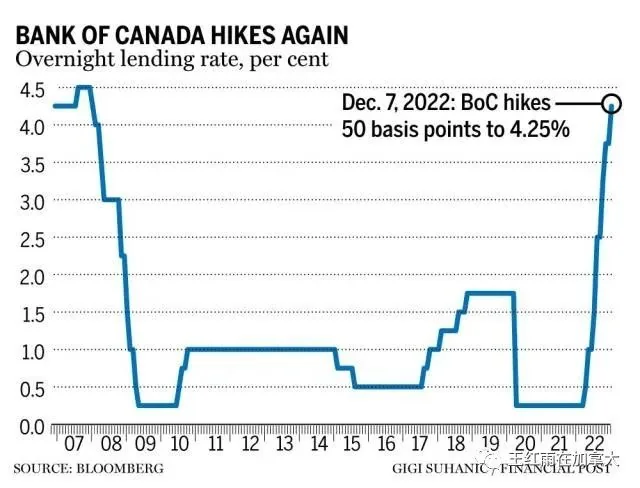
Real estate depends on finance in the short term, land in the medium term, and population in the long term. Although the short-term financial environment will still be troubled by high interest rates in 2023, it is impossible to raise interest rates by 400 points a year like last year. The certainty of the financial environment is more conducive to real estate investors making long-term plans . There are no breakthrough improvements in land or new home construction in the medium term, and real estate supply is still growing at a slow pace. Even though both Ontario and British Columbia have made some positive efforts to ease the tension in the rental market, the results have yet to be tested. Canada's immigration policy has not changed. In the long run, Canada's population is still in a period of rapid growth. From a mid- to long-term perspective, there is a great contradiction between population growth and housing construction. The profit window created by the housing crisis for real estate investment is still huge.
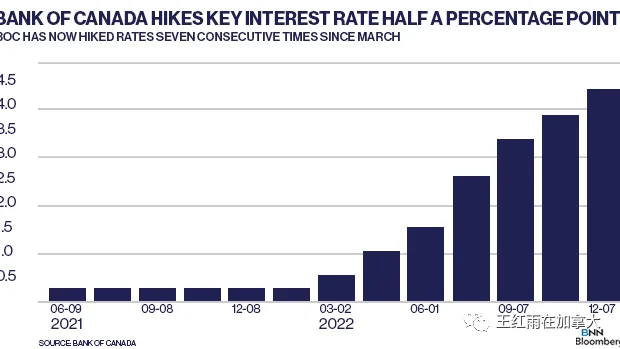
The interest rate hike in 2022 has entered deep waters, and many families need to stand on tiptoes to keep breathing. If the central bank continues to raise interest rates sharply, some people will drown. I believe the central bank can see this from the data. Borrowers whose mortgages currently have floating interest rates, as well as households whose loans need to be renewed in 2023, are facing interest rates higher than 5.25%, which is the highest interest rate in the stress test in the past 10 months. In other words, when the contract interest rate exceeds 5.25%, the debt burden has exceeded the affordability of these borrowers when they applied for a loan. At present, many people have entered the state of "carrying" and "supporting". If the central bank raises interest rates by 0.25% in 2023, people's consumption behavior will change significantly; if the interest rate is raised by 0.5%, consumer demand will be severely suppressed and may enter a chronic recession; if the interest rate is raised by 0.75%, the economy is expected to enter a state of shock or coma. Don’t forget that household debt is not a common problem. Those households that borrow from shadow banks have the most difficult time. Households that take the risk of applying for high-interest loans to buy a house will be hammered. In 2023, they will face a renewal interest rate of as high as 7% to 8%. Judging from the current situation, the central bank, which controls the economic thermometer, is optimistic that it can lower the inflation rate and achieve a soft landing for the economy this year, so it will be very cautious in raising interest rates. In the medium to long term, the certainty of real estate investment returns is still high, because there is still no fundamental solution to the housing crisis, and it is difficult to match the new immigration policy and housing policy. In 2022, most real estate investors have regrets. Fear has tied people's hands and feet. They see their borrowing capacity declining rapidly but do not take any action. 2023 is a year to make up for the situation.
Investment is future-oriented, and the future is characterized by uncertainty. If you wait until everything is confirmed before investing, the opportunity will be lost. In 2022, most investors are waiting, and as a result, the whole year of 2022 has changed from the future to the past. Finally, we have waited for 2023, and the new year is still full of uncertainties. In this article, I will share with you some of the certainties I see in 2023 and the signals these certainties bring to us. At the same time, I will discuss how to deal with these signals.
As you can see, there is greater certainty in the following aspects in 2023:
1. The interest rate environment is relatively stable, and interest rate hikes have entered the danger zone. The central bank will be more cautious in raising interest rates. At the same time, inflation is very sticky, making it difficult to significantly cut interest rates for the time being. Many people expect the Federal Reserve to still raise interest rates this year, and therefore have doubts about whether the Bank of Canada will follow suit. The extent to which each country raises interest rates depends on its specific affordability. The ratio of household debt to GDP in the United States is 80%, and the ratio of household debt to GDP in Canada is 106%. Therefore, Canadians are more sensitive to interest rate increases of the same magnitude. At the same time, U.S. mortgages mainly have fixed interest rates of 15 years and 30 years. 95% of Canadian mortgage contracts are within 5 years, and they will be immediately hit by high interest rates when renewing the contract. The general meaning of interest rate sensitivity is that when Canada raises interest rates to 4.5%, household consumption responds to interest rates in the same way as when the United States raises interest rates to 5.5%. We say Canadians are more interest-rate sensitive. Judging from the amount and structure of Canadian household debt, the Bank of Canada's interest rate hike to 4.25% has had a significant impact on Canadians' consumption behavior. The Bank of Canada's basic goal has been achieved. It is not ruled out that the Bank of Canada may overcorrect and continue to raise interest rates, but the economic data after continuing to raise interest rates will be very ugly.
2. In a high interest rate environment, the affordability of first-time homebuyers has deteriorated sharply, and they will be forced to accept low-priced entry-level properties as move-in properties;
3. The banking regulatory authorities decided that the stress test requirements will remain unchanged and the mortgage policy will still follow the merit principle. The stress test interest rate remains high, resulting in transaction volume remaining sluggish, but it will be higher than in 2022, because the speed and intensity of interest rate increases will be significantly weakened, and panic will be alleviated; households with strong loan capacity will have more opportunities, and the wealth gap between households who can borrow to buy a house and those who cannot get a loan will continue to widen;
4. New policies to increase the supply of housing are mostly focused on solving the current problem of sharply rising rents. There is no solution to the difficulty of new immigrants and young families buying houses. The supply of real estate is still tight. The situation of more people and fewer houses will cause the market that has reached equilibrium to tilt towards the housing market again.
The above certainty sends a signal to real estate investors:
1. The transaction volume of low-priced housing will increase;
2. Families who plan to upgrade their own homes face the problem of reduced borrowing capacity. After selling their original homes, they may not be able to borrow the same amount as the original mortgages for their new homes, so the supply and demand for high-priced homes will be weak;
3. Housing prices have stabilized in September 2022. The stable and high housing prices provide a platform for families who plan to increase their mortgage on real estate, creating opportunities for them to increase their mortgage on existing properties and purchase more properties;
4. In a high interest rate environment, people who are worried about unemployment and economic recession will remain complacent, and market competition will not be too fierce.
01 Proactive and in-depth debt management
It is dangerous to think about retreat first without thinking about advancement. It is dangerous to rush forward before finding a way out. In the hottest period of real estate in 2021, many people have increased their mortgage on their homes and cashed out their homes to buy investment properties. Homeowner debt approaching or exceeding five times a household's annual income is dangerous, regardless of whether the housing market is good or bad. If you don’t plan to change your home, and you increase your mortgage on your home, you are cutting off your own path, because when the debt balance of your home is close to 5 times your annual income, you lose the ability to increase your mortgage on your investment home, and your debt exposure is fully exposed to the risks of unemployment, disability, serious illness, and interest rate increases. The liquidity of real estate depends on the ability to remortgage. When market transactions are light and the owner-occupied housing debt is high and cannot be remortgaged or sold, real estate investment becomes a high-risk investment. Families who have trouble repaying their loans will not share their plight in their circle of friends, but I will receive help inquiries from such families. The best solution, of course, is to never increase the mortgage on your home unless you want to change your home; secondly, it is best to leave enough available credit on your home. Some people suggest not to apply for a HELOC line of credit. This suggestion is only for the convenience of applying for loans from some banks and is not conducive to long-term planning for multi-home investment; finally, if the debt of your home is already full, then don’t think about anything, stop paying RRSP, TFSA, and reduce your home debt as soon as possible. The core idea of self-housing debt management is only one: if you come out to mess around, you will have to pay it back sooner or later.
By adding a mortgage on one or more investment properties, you can pay off your mortgage in one go. There are many details about this violent surgical procedure, so I won’t repeat it. You can check the article “Returning the House Slave to Sing” on the official account. Before the epidemic, a couple came to my office and asked to perform this surgery. I told them that if they remortgage to invest in a house, the loan interest on the new money will not be tax deductible because it will be used directly to repay the mortgage and not be used for investment. They said without hesitation that we will file tax returns truthfully. After we have no loans for our main house, we can borrow up to 5 times of our annual income for each investment house. The interest on the loan for the new investment house will be tax deductible, so it is worth it. After completing this surgical loan, the family has purchased three more investment houses so far. After the entire process is completed, the non-tax-deductible loan amount is 400,000, and the tax-deductible loan amount is 2.1 million. Families with a strong desire to retire early need to be far-sighted in their tax avoidance arrangements. From this example, we can see that they are willing to give up the tax deduction for loan interest of 400,000 dollars in order to obtain the opportunity of tax deduction for loan interest of 2.1 million dollars. Families who only care about the present and want to use every penny of their expenses to deduct taxes usually have very weak borrowing capacity for mortgage loans. It can be said that tax-saving maniacs and real estate investment are not naturally compatible and have no fate. The depth of household debt management depends on the long-term planning of tax saving issues., people walking closely staring at their feet cannot see the road and direction clearly. In my work, I met many families who put tax saving at the top of their family investment and financial management. At first, I tried to explain the long-term and short-term relationship of tax-saving arrangements, but later gave up, because the obsession with tax saving conflicts with multi-suite investment planning. It is impossible to achieve the ultimate in tax saving and at the same time make the best real estate investment. However, people want, want, and want everything at the same time, and they are unwilling to give up anything. The benefits of tax savings are immediate, but real estate investment is long-term. Persuading people to give up immediate benefits will trigger a super reaction of being deprived. No matter how well-trained a dog is, if you try to pull a bone out of its mouth that it is eating, it will trigger the dog's deprivation super response and you will be bitten. As mentioned above, there are only a few families who come for surgery. They are sensible, far-sighted, and know that only by giving up can you get something. All good things have a price. Such families are winners in real estate investment and can escape the tax-saving madness for three generations. There are many families swallowed by the tax-saving black hole. One person who came to consult told me that after moving to Toronto from another province, someone suggested that their family designate their original home in another province as their primary residence, and then sell it without capital gains tax. I asked, will you go back to live in it in four years? If you do not go back to live, this designation does not hold. Unexpectedly, the other party said that in order to save the tax, he could go back and live there. People who are tax-saving to this extent are living for tax-saving. They will do whatever it takes to save tax. As long as there are preferential tax policies, they should be used and cannot be omitted. Good debt management requires long-term tax planning, and you cannot just focus on the small gains you get from tax savings in front of you. , I hope that in 2023, my readers can take a further look at the tax saving issue and take the initiative to get out of the black hole.
The key to the debt problem is the ability to maintain repayment, that is, the debt cannot be cut off.Hyman Minsky divided debt into three categories: first, hedge finance (Hedge finance), that is, the cash flow obtained by the debtor from the debt project itself can cover the interest and principal, which is the safest financing behavior; second, speculative finance (Speculative finance), that is, the cash flow obtained by the debtor from the debt project itself is only enough to cover the interest and is unable to repay the principal. This kind of debt has reached the edge of debt repayment default; third, Ponzi financing (Ponzi financing) Finance), that is, the debtor's cash flow cannot cover neither the principal nor the interest, and the debtor can only rely on selling assets or borrowing new ones to repay old ones to fulfill its payment commitments. No one is prepared to take on Ponzi debt from the first day of the loan. Ponzi debt with ten pots and eight lids is mostly caused by poor debt management or external circumstances such as a significant increase in interest rates. When buying an investment house, the rent and off-site cash flow are sufficient to repay the principal and interest, otherwise the bank will not lend; if the interest rate rises, or the rent falls, it may turn a hedging financing into a speculative financing. If the lending bank allows the monthly payment to remain unchanged when the interest rate rises, this kind of speculative financing will Normal repayments can last for a long time. If you unfortunately accept wrong advice and increase the monthly loan payment, or the lending bank requires the borrower to increase the monthly payment as long as the interest rate rises, and the borrower is unable to guarantee the high monthly payment for a long time, he will be forced to adopt Ponzi debt to maintain leverage. What I see is that most real estate investors have a surplus of income and will not go to the stage of Ponzi debt. What needs to be reminded is that in In 2023, those families who are already in the speculative financing stage and do not have much surplus food at home need to take precautions and prepare for the long-term high interest rates and the sudden unemployment of the main source of income in the family. These preparations include making up for unemployment insurance, taking out additional mortgages when the loan matures to extend the repayment period back to 30 years, or even taking the initiative to extend the existing loan to extend the repayment period when the loan has not matured but is in danger of unemployment. It would be better if you can apply for a HELOC. When it comes to debt management, don’t listen to experience sharing on social media, which is unreliable. Someone who has 5 loans from a certain bank dares to share his "successful" experience. Don't listen to this blind man's experience sharing. Instead, seek one-on-one consultation from professionals who have experience in making thousands of loans from this bank. There is a price to pay for professional consultation, and you can never get valuable one-on-one professional advice by reaching out to others.
02 The CONDO year of real estate investment
Families that have completed in-depth debt management need to look forward. 2022 is the year of fear. The vast majority of families have gained too little from real estate investment and learned too many lessons. They have wasted the investment opportunities created by the interest rate hike frenzy. Therefore, they need to make up for it in 2023.
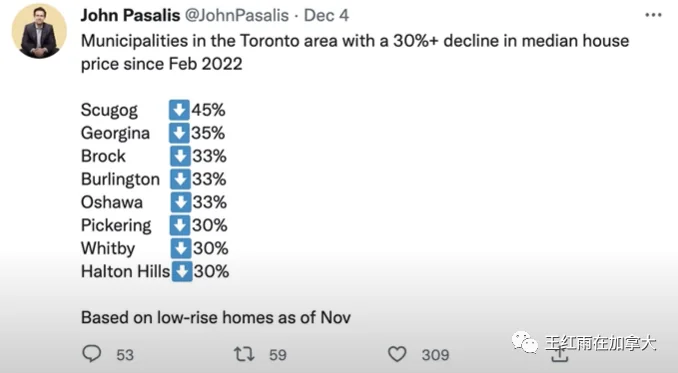
Land housing around the GTA in the Greater Toronto Area has experienced ups and downs in 2022. In a town called Scugog, house prices fell by 45% in one year, in Oshawa by 33% and in Hamilton by 30%. The argument that land-based housing has more investment value is simply not true. . On the contrary, compared with the highest point last year and the end of the year, the price of condos in the city center fell by only 13%. As of November 2022, compared to the same period in 2021, CONDO prices have only dropped 1%. CONDO prices in downtown Toronto are more resilient. In addition, rents in CONDOs in the city center have risen rapidly. For a one-bedroom unit, the rent will be 2,000 dollars per month in 2021, and will rise to 2,400 dollars in 2022, an increase of up to 20%.
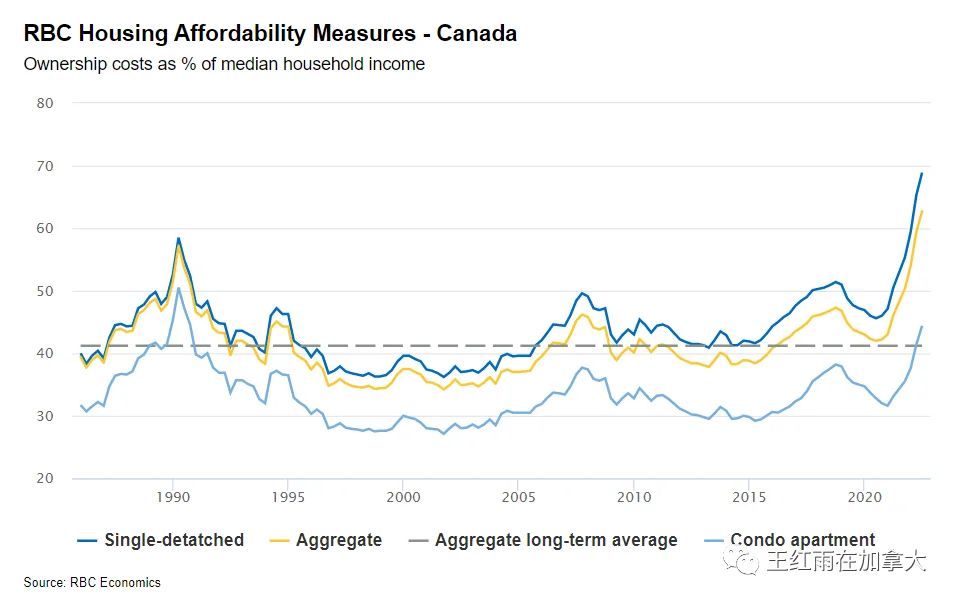
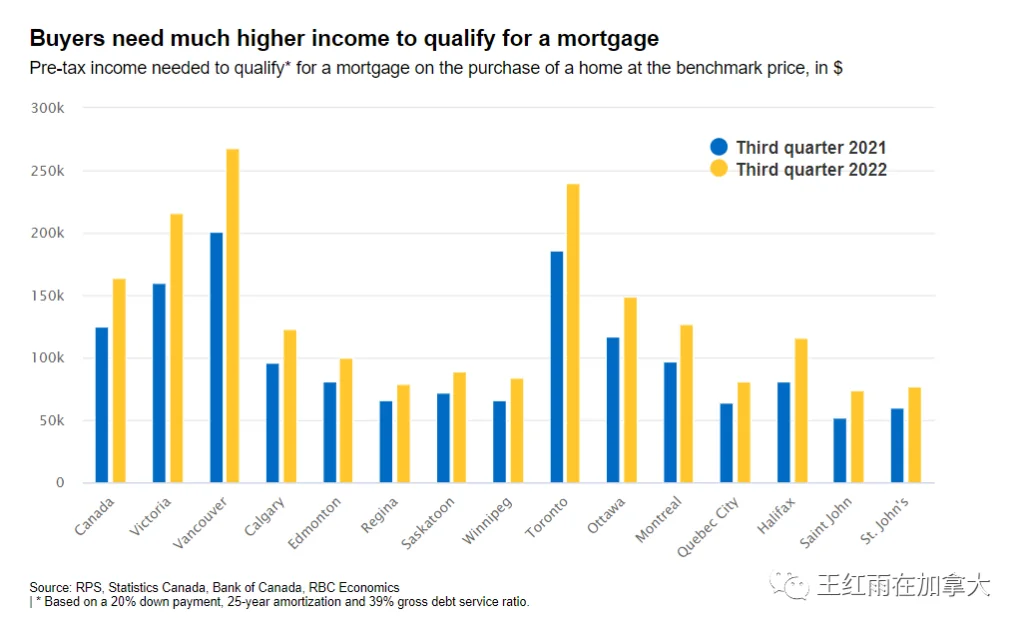
CONDO will become the best choice for first-time home buyers . Housing prices in the Greater Toronto Area have soared with interest rates, and affordability has deteriorated rapidly. To buy a property with an average housing price, the monthly payment required will be as high as 63% of the average income. If you want to borrow 80% of the average housing price, the annual household income needs to reach 240,000, which is out of reach for most first-time homebuyers. If you want to buy a property with an average price, it is possible for families who want to change their houses. Only by selling the original home or adding a loan to the original home as a down payment can you buy a property with an average price. Without buying a home for the first time, there is no possibility of changing houses in the future. Many renting families have clearly seen this fact, instead of waiting for the average house price to drop within their affordability range. The current affordability of condos in GTA is 44%, that is, to purchase an average-priced condo, monthly expenses account for 44% of the average income, which is exactly in line with bank loan standards. If CONDO prices stabilize and rise and interest rates remain high, more renting households will be squeezed out of the affordability range of buying a home. In the past, the affordability of CONDOs in Greater Toronto has never reached the 44% loan threshold. It will be different in 2023. If renting families continue to wait and see, they may never be able to get to the first step. What modern people are best at is rational calculations. Families who rent a house are well aware of the issue of loan capacity and affordability and do not need too many reminders.
Starting from July 2022, loan capacity will continue to decline as interest rates rise. Many real estate investors find that when they are pre-approved for investment mortgages, the loan amount is only enough to buy a CONDO. If most real estate investors want to continue buying real estate in 2023, they may only choose CONDO. It is too difficult to invest in other types of real estate. Property investors and first-time homebuyers are crowded into the same space.
The competition between first-time homebuyers and real estate investors does not necessarily have to be fierce because of the huge number of new homes to be delivered in 2023. CONDO transactions will be very active in 2023, but this may not necessarily be reflected in the second-hand housing trading system MLS. According to industry estimates, as construction costs rise sharply in 2021 and 2022, developers' desire for survival will push projects that have already been started to be completed. It is expected that 18,000 new CONDO units will be delivered in the first half of 2023 alone, requiring buyers to spend real money to complete this futures transaction. It is estimated that more than half of the pre-construction property transactions are for speculation or investment purposes, and The biggest challenge in 2023 is the difficulty of getting loans , the delivery of these new homes will inevitably trigger a surge in the volume of pre-construction property transfers, and the prices and quantities of these transfer transactions will not be reflected in the second-hand housing trading system MLS. At the end of last year, I had received some inquiries about loan issues for pre-construction property settlement in 2023. Generally speaking, the inquirers' borrowing capacity was insufficient and their cash preparations were insufficient. This means that there will be a large number of pre-construction property transfer transactions, and investors will have the opportunity to find investment opportunities in the embarrassment of futures buyers being unable to deliver.
03 Forecasts and Outlook
At the end of last year, two institutions invited me to talk about their forecasts of macroeconomic trends and my views on real estate investment, but I declined. I neither have the ability to analyze the macroeconomic situation nor make predictions. More importantly, I do not believe that investment returns can be improved through macroeconomic predictions. Keynes worked in the British Treasury in his early years, and his opinions were highly valued, so he thought he could improve his investment returns through macro forecasts. However, he lost everything and eventually returned to value investing. Remember, even at the decision-making level in the macro field, you cannot rely on macroeconomics to make a living, so if you want to rely on a crystal ball to make a living, you will end up eating glass stubble. Some people simplify investing following macroeconomic fluctuations into the Merrill Lynch Clock, telling everyone that Merrill Lynch no longer exists. If the Merrill Lynch Clock can work, Merrill Lynch will never disappear. I visited Merrill Lynch when I was working in New York, and I still have a ball cap with the Merrill Lynch logo on it. Don’t look back on these old almanacs from the industrial era. Merrill Lynch clocks were useless before, and they are even more useless now. On the contrary, Merrill Lynch's idea of allocating assets in various categories is harmful to salaried investors, because Leviathan always intervenes in the macroeconomy, so the signs of the economic cycle are not obvious. If you invest based on your own judgment of the economic stage, you will continue to buy and sell various assets, and you will continue to be a leek in different markets, and you will continue to be harvested. Hobbes compared a country with absolute rights to the Siren, Leviathan. Let’s briefly review what happened in the past three years: After the outbreak, when the economy did not show a significant recession, the central bank, as a representative of Leviathan, began to cut interest rates and print money. No one could predict this situation before the outbreak; in the middle of the epidemic, when people did not know the direction of the epidemic, the central bank called on everyone I borrowed money to buy a house, but there was no sign of economic recovery at that time; in the late stage of the epidemic, no one felt that the economy was booming, and the central bank had already begun to raise interest rates; after the epidemic control was fully liberalized, interest rates were already very high, and people began to worry about recession again, but the central bank repeatedly came out to reassure that inflation would be under control and the economy would have a soft landing. People who worship Merrill Lynch's clock cannot identify the various stages of the economic cycle no matter how carefully they analyze it. If they continue to buy and sell various assets in the past three years, the final result of this kind of messing around can only be harvested by various assets and markets.
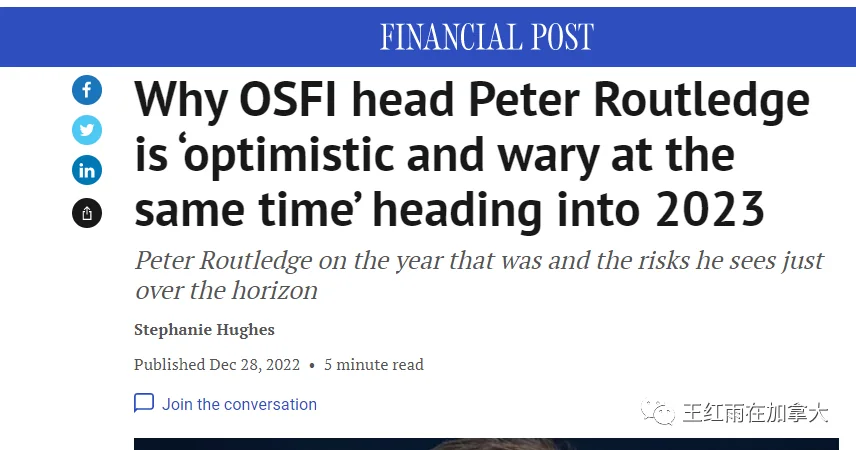
There are currently only two cycles that we can distinguish, one is the monetary policy cycle and the other is the debt cycle.2023 is in the period of tightening monetary policy in the monetary policy cycle; it is in the period of hedging debt and speculative debt in the debt cycle. The characteristic of the period of tight money is that interest rate sensitive industries are in a period of contraction. For example, real estate development companies and automobile manufacturing companies are faced with the pressure of high interest rates and are bound to shrink in preparation for the winter. Currently, Canada's real estate development industry is the industry with the most pessimistic outlook on economic prospects, and the U.S. automobile manufacturing industry is the industry with the most pessimistic outlook. A public account reader, who is said to work for a real estate development company, kept leaving messages saying that real estate developers predict that the real estate market will be very difficult in 2023, and housing prices will still be sluggish. This kind of egoistic prediction reflects their own mentality and situation. If developers want to launch new properties in 2023, they are bound to receive a cold reception, but the situation of developers has little to do with the second-hand housing market. Yilong's main job recently is to criticize the Federal Reserve, because Yilong's main business is making electric cars. Most Tesla buyers need car loans. With interest rates so high, it is difficult to sell cars produced by Yilong. Therefore, he predicts a severe economic recession in 2023 and calls on the Federal Reserve to cut interest rates all day long. I think Apple’s Cook is not necessarily as pessimistic as Yilong, and he will not pin the rise and fall of his company on the Federal Reserve, because mobile phone buyers do not need loans, and ordinary consumer goods are not interest rate sensitive goods. Only large-scale durable consumer goods, such as cars and houses, which require loans to afford, will be very sensitive to interest rates. Many people hope to have a telescope to see the future clearly, especially the macroeconomic trends in the past one or two years, so they constantly search for the opinions of various so-called "big names" on the Internet. A guy like Yilong is already big enough, but his predictions are still very subjective. Rather than making predictions, he is more like shouting to Leviathan, hoping to loosen his grip. If Leviathan could listen to him, it wouldn't be Leviathan.
Outlook is an estimate of the future based on historical experience and relatively certain current conditions, but it is not really a prediction. People who write outlooks make subjective inferences based on their own experience and logical reasoning. Readers need to make judgments and decisions based on their own experience and logic, while maintaining awe of the uncertainty of the future.
04 Competition between yourself and yourself
Specific to everyone, we can predict that after retirement, we will still need consumption to maintain the survival of our lives without active income. To maintain consumption, you must have money. Currency depreciation is happening right in front of our eyes, no need to predict. After retirement, when there is a lack of active income, currency depreciation will not stop. Everyone faces the risk of unexpected longevity but not enough money to sustain consumption. "When I was young I thought money was everything, but now that I am older I know it is." - Oscar Wilde.
When we have active income, we will clearly feel the competitive pressure from peers and peers. However, the competition we need to face is not limited to this. We also have to compete with our future selves. Should we defer some consumption power to ourselves after retirement, or should we enjoy ourselves in time and leave our retirement life to the welfare system? This problem can be said to be the origin of financial insecurity. Most of modern people's anxiety stems from the dilemma of choice caused by the competition between the present self and the future self. Investing hard today means delaying gratification, accumulating assets that can generate passive income, and preparing for retirement. Today, we are also faced with financial pressures such as household consumption and preparing tuition fees for our children. In order to cope with current problems, many people choose to postpone investment and leave the problems to their future selves and their retirement selves. If you don't invest hard today, but you still worry about unexpected longevity and being homeless, you will have financial anxiety. There is an allusion to "Bulidan's Donkey", which is a joke about the Buridan family's donkey who didn't know what to choose between two piles of grass and starved to death. Middle-class families have some reserves, but not much. As a result, many families are unable to choose between the present and the future, falling into the embarrassment of Buridan and missing many investment opportunities.
Some middle-class people hope to imitate the successful experience of small-town problem solvers through reading, or even join reading clubs, and first find foolproof investment methods from books before starting to invest. This approach is like burying one's head and avoiding reality, and cannot solve the problem at all. In life, there are no textbooks, no after-class exercises, no mock tests, and no chance to practice questions. Every day is a practical battle and a test. In existential terms, human existence is self-existence. What you do next minute determines who you are, not what you want to do next minute. Investment, like life, requires action, not fantasy. There are no simulation questions for you to complete. Like the tax avoidance maniacs, bookworms constrain themselves when it comes to investment. The more they study, the more they look forward and backward, and the less they dare to act. Investment is a field where true knowledge comes from practice. No matter how many books you read or how many test scores you get, it won’t help. Many people have worked hard to get the securities analyst qualification certificate, but they are still not good at investing. The effect of managing money on behalf of clients can only be imagined. People who hold the securities analyst certificate and change careers to make a living can be seen everywhere.
For middle-class families in Canada, the best way to balance their lifetime income through investment is to invest in real estate. Real estate is the physical asset with which we are most familiar. Its value is easier to test than securities and the certainty of its return is higher. If you accept that there is a housing crisis in Canada, you should take advantage of this opportunity. After the Goose-Bird War broke out, Buffett increased his position in oil stocks, which was taking advantage of the crisis. Isn’t the investment opportunity that investors are looking for so hard to buy valuable property at a low price? How can a good asset be sold at a low price? When others are panicking, when there is a crisis, when others have no courage or ability to buy, it is a good time to invest.. Many middle-class families have the ability to invest in real estate. If they don't invest in real estate if they have the ability, they would be sorry to pay so much tax. Real estate investors do not need to be proficient in investment terminology, but they need the ability to take action. Learning through investment practice is true learning. A few years ago, after a family approached me for a mortgage, they didn't listen to my advice and used the money from the mortgage to buy an pre-construction property. After that, I saw the price of second-hand houses soaring, and I was no longer able to invest. After I came to Canada to mortgage another property for the second time, I learned my lesson and used new money as a down payment to buy a second-hand house. Recently, I was discussing a plan to increase my mortgage, because my child is going to study abroad and will need about 400,000 in tuition and living expenses in the next four years. The plan we finalized includes two additional mortgages and a move. This plan can not only save all the properties in hand, but also cover the expenses of my child's study abroad. This plan can bring about a win-win situation for both the present self and the future self: the children can study the major they like; the parents can use the net worth of their property to support their children’s ideals; the parents can rely on themselves in old age and retain the investment property as spiritual and material security after retirement. They said that after the first mortgage increase, it would be better if they did not buy an pre-construction property, but they did not have this lesson and could not understand the advice I gave them about not buying an pre-construction property. After two mortgage increases, they completely understood the principle of additional mortgages and remembered the book "Secrets of Capital" by De Soto that I recommended. De Soto is a Peruvian economist. This booklet he wrote reveals an infinite cycle of borrowing capital to buy assets, then using the assets as collateral to obtain capital, and continuing to buy assets again. This is a cycle of wealth creation. This cycle can only occur in countries with sound property rights systems and full financialization. It cannot be done in Peru, nor can it be done in the countries of the former Soviet Union. People who do not practice but only read books cannot actually understand "The Secret of Capital". Because they do not empathize with it, they always think that the content in the book is too abstract, too idealistic, and too theoretical. When it comes to real estate investment, you can practice it first and then study, or even not study at all. How much spending power you can leave to your future self after retirement depends on your current ability to act if you work hard today. If you only read a few financial management books without taking action, you are deceiving your future self. The best inheritance of wealth is to let the next generation do what they want to do. Parents only need to provide a pair of invisible wings when their children take off. Children do not need to win at the starting line, and they do not have to work as hard as young people in small towns. Winning at the take-off line is the most efficient.
Conclusion:
In 2023, the short-term financial environment will be much more stable than in 2022, because as bond yields stabilize, the stress test interest rate stabilizes at around 7.5% and does not change with the central bank's interest rate adjustments. Families can make long-term investment plans based on the relatively stable financial environment.
"If your neighbor is unemployed, it means that the U.S. economy is in recession; if you yourself are unemployed, it means that the U.S. economy is in depression; if Carter is unemployed, it means that the U.S. economy is growing." - Ronald Reagan. Economic recession also varies from person to person. When it is not your turn, you should seize other people's crises and invest instead of worrying and doing nothing all day long. Families that missed the investment opportunity in 2022 need to consider making amends in 2023.
Most of my clients, about 60% or more, have paid off their home mortgages. This is the result of proactive debt management. It is hoped that more families will pay off their mortgages in 2023, laying the foundation for buying more investment properties at any time and preparing for retirement at any time.
In 2023, housing affordability in the Greater Toronto Area has reached its worst level in history, borrowing capacity has dropped significantly, rents have risen sharply, and there is a real housing crisis. This is a year when households that still have borrowing capacity have an absolute advantage and cannot be missed again. The sales of new homes are seriously hindered, which means that the supply of new homes will be greatly reduced in five years. The market value of second-hand homes bought this year will be very considerable in five years. Families who invest in real estate this year will thank themselves in five years.
When competing with your future self, GTA's real estate investment can help ordinary middle-class families achieve a win-win situation. There is no need to study the investment mentality exhaustively. You only need to have goals, a plan, dare to practice, and it would be better if you can meet a good person to correct you.
In addition to the monetary policy cycle and the debt cycle, there is a third cycle that can be clearly identified - the fear and greed cycle. In a period of market psychology where fear outweighs greed, investing bravely is the time when returns are most guaranteed. At this time, the decline in asset prices is limited but the rise is huge. In 2023, we are in a psychological period where there is more fear than greed.
In the Greater Toronto Area, as an area with an increasingly concentrated population in the post-urbanization stage, it must be increasingly difficult to buy a house. Central cities, especially the first cities, will gradually become New York-like, Tokyo-like, and Hong Kong-like. CONDOs will become the main residential real estate for GTA urban residents, and single-family houses with front and back yards will be promoted as luxury goods. 2023 will be an important watershed for this trend, with more and more people accepting this change actively or passively.
In Canada, where the housing crisis has existed for a long time, real estate investment is a one-stop investment. The key is to take action. In 2023, the key word for real estate investors is “take action”.