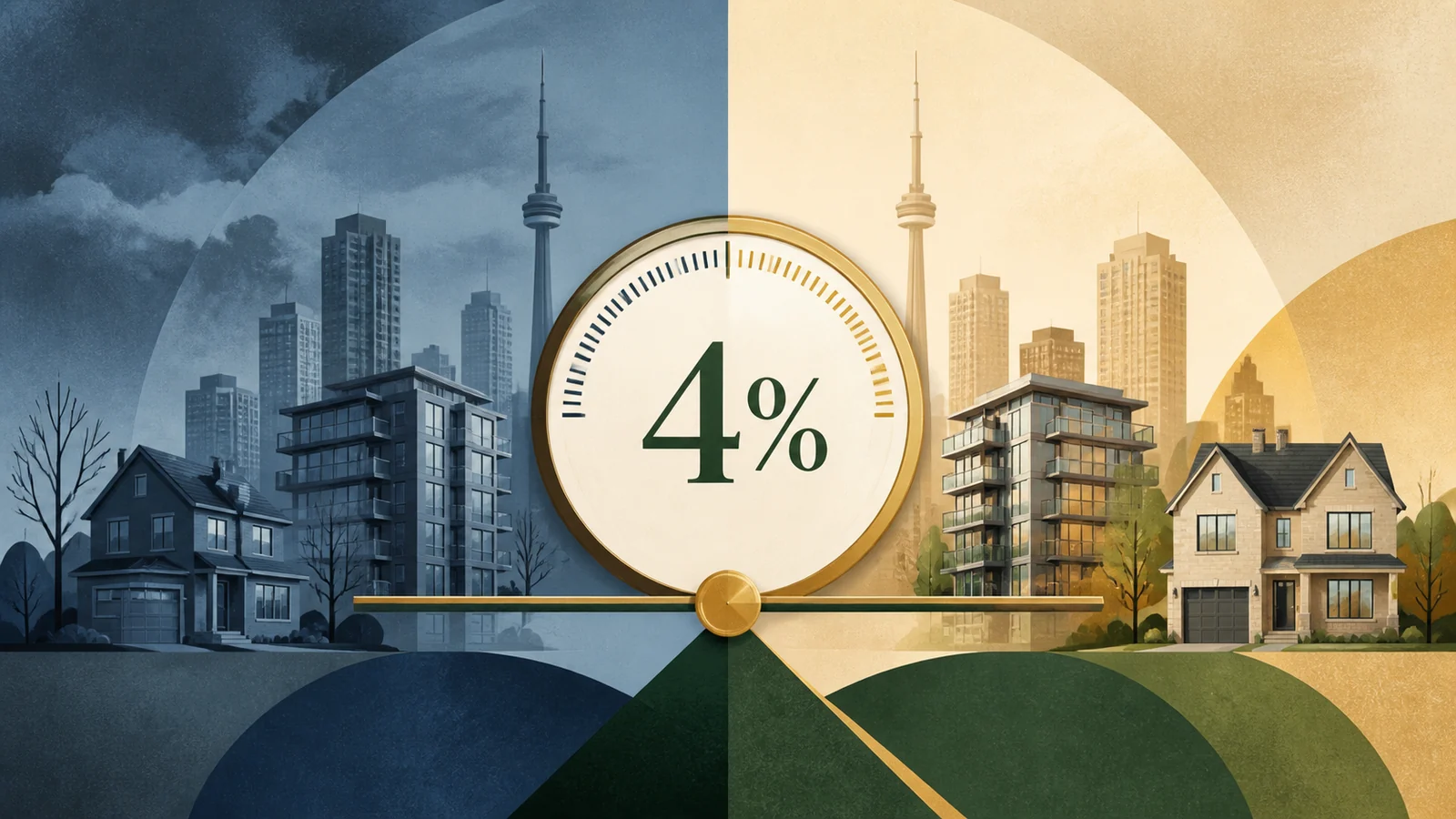
Xidapuben, on October 29, the Bank of Canada cut interest rates for the fourth time in 2025 by 0.25%. The central bank interest rate has dropped from a high of 5% to 2.25%, and the commercial bank P interest rate has dropped from a high of 7.2% to 4.45%. Mortgage interest rates returned to 4%.
A first-time mortgage applicant recently bought a Toronto CONDO with a market price of 500,000 for his own residence. I asked the real estate agent what the market rent for the apartment was, and I discovered why this client was buying the property at this time. When mortgage interest rates are around 4%, the cash outlay of owning a condo in Toronto is about the same as renting the same house. Part of the holding cost is the principal of the monthly loan payment, which should be part of the homeowner's mandatory savings and should not be included in the cost of living. In 4% of cases, excluding the principal part of the monthly mortgage payment, the actual housing cost for property buyers is lower than the rent.
For real estate investors, a mortgage interest rate of 4% is the balance between offense and defense. When it is lower than 4%, it is better to attack to obtain more investment properties; when it is higher than 4%, it is better to defend with all your strength to keep the fruits of victory. Let me tell you the truth slowly.
01 Buy or rent, the interest rate of 4% is a watershed
June 2023 to June 2024 will be the year with the highest mortgage interest rates, with interest rates above 6%. The rent for a 500,000 Toronto condo is about CAD 2,400. If the down payment is 20% and the interest rate is 6%, the monthly payment will be as high as CAD 2,380. Including property taxes and management fees, the monthly cash expenditure for holding the property is approximately CAD 3,122. The holding cost is 722 dollars higher than renting a house per month. For young people with limited income, the burden of renting is significantly lower. In addition, Canadian mortgage rules require banks to conduct stress tests based on the contract interest rate + 2%. If the contract interest rate is 6%, the stress test interest rate is as high as 8%, and borrowers can borrow up to four times their annual income. Therefore, many buyers are blocked from buying a house by the mortgage stress test.
Entering the second half of 2025, the mortgage interest rate available to real estate buyers has been as low as 4%, and the situation is completely different. The central bank has cut interest rates again, ensuring that mortgage interest rates will remain around 4% for a long time. For an apartment unit in Toronto worth CAD 500,000, the market rent is CAD 2,400, the land tax is CAD 218 per month, the building management fee is CAD 524 per month, the down payment is 20%, and the interest rate is 4%, the monthly loan payment is CAD 1,902, and the total holding cost is CAD 2,644, which is only CAD 244 more than renting a house per month. Of the monthly loan payment of 1,902 Canadian dollars, the principal is about 590 dollars and the interest is 1,312 dollars. The principal is the homeowner's compulsory savings and is not a living cost. If you buy and hold such a unit, the actual housing expenses should be interest plus property taxes and management fees, totaling 2,054 Canadian dollars, which is 2,400 Canadian dollars lower than the market rent. That’s why the first-time homebuyer at the beginning of this article is buying a home right now.
In December last year, the federal government introduced a policy that allows mortgage loans with a down payment of 5% to have a 30-year repayment period. Nearly a year later, the policy has failed to stimulate housing demand. I used the above case to calculate the holding cost of buying a house with a down payment of 5%. A down payment of 25,000 is required, and a loan of 475,000 is required. If the repayment period is 30 years, the loan default insurance rate is 4.7%. After the premium is added to the loan principal of 475,000, the total loan amount is 497,400. At an interest rate of 4%, the monthly payment is 2,365. Including property taxes and management fees, the total holding cost is 3,107 Canadian dollars, which requires an additional monthly expenditure of 707 Canadian dollars compared to the rent of 2,400. Unless buyers think that house prices will rise rapidly and need to quickly lock in the price with a 5% down payment, otherwise, after comparing the holding costs of low-down-payment buyers with rent, delaying the purchase of a house and saving more down payment should be a wiser choice.
First-time homebuyers, in addition to getting pre-approved for a loan, also need to do some homework to take advantage of the preferential policies for buying a house. Using the HBP plan, you can advance 60,000 from your RRSP as a down payment, but this amount needs to be deposited for more than 90 days before it can be withdrawn in advance. Last year's new financial product, FHSA, can be tax deductible or deferred when making payments. Investments can grow tax-free. There is no capital gains tax when withdrawing for down payment, and it is very flexible. For example, if you place an offer on October 1st, the property is delivered on December 1st, and you open an FHSA account on November 1st, you can take advantage of the above policies.
It can be seen that when the mortgage interest rate reaches 4%, the critical point of "renting is worse than buying" becomes clear. The most important factors for first-time homebuyers to decide whether to buy or rent are down payment, income, carrying costs, and actual living expenses. When interest rates drop to 4%, renters need to recalculate holding costs and rental costs. Tenants who are ready to buy a house need to eliminate the noise and make wise financial decisions based on their own situation. Many people become sensitive when they hear the word "buying a house" and reflexively come up with the following excuses to delay the decision to buy a house: "Economic downturn", "Rising unemployment rate", "Young people are no longer buying houses", "House prices will continue to fall", "Poor public security", "Reduced new immigrants", "U.S.-Canada tariff war" and so on. Housing is a basic need. For most families, solving the housing problem is nothing more than a choice between "buying" and "renting." When the actual holding costs and rental expenses tend to be close, these overly pessimistic arguments appear to lack sufficient financial basis.
02 Should real estate investors attack or defend?
Most of the time in Canada is a good time for real estate investors to take advantage of their borrowing power and the scarcity of property relative to population to go on the offensive unless interest rates are too high. The long period before the interest rate hike in March 2022 was a good time for real estate investors to attack. Many real estate investors took advantage of the once-in-a-lifetime low interest rates to increase mortgages on existing properties, replenish ammunition, and continue to purchase more properties. After raising interest rates, they move into defensive positions. Now that interest rates have returned to a low-interest environment again, the wealth of families that have successfully held on to their properties has jumped to new heights. If you dare not acquire real estate when it is time to attack, you will never have real estate wealth; if you cannot hold your position when it is time to defend, the psychological shadow after gaining and losing will linger for a long time. The mortgage interest rate of 4% is a turning point for real estate investors.
Take the 500,000 CONDO mentioned above as an example. If it is purchased by a real estate investor, there are two options. One is a 20% down payment, which will have negative cash flow; the other is a 30% down payment, which will break even every month. Okay, while we’re chatting, we’re going to start talking about negative cash flow again.
In the case of 20% down payment, the investment amount is 100,000, the monthly payment plus land tax and management fee, the monthly expenditure is 2,644 Canadian dollars, and the income is 2,400 Canadian dollars. The investor needs to make an additional monthly down payment of 244 Canadian dollars. If you insist that the 244 Canadian dollars is a negative cash flow and a loss, that's fine, but I don't think so. After one year, the total down payment is 100,000 dollars, plus 12 244 dollars, which is 102,928 Canadian dollars, the gross rental income is 28,800 Canadian dollars, the interest expense is about 12 1312 equals 15,744 Canadian dollars, and the property tax is 2 616 Canadian dollars, management fee 6288 Canadian dollars, total expenditure is about 24,648 Canadian dollars, taxable net rental income in one year is 4152 Canadian dollars, down payment return on investment is 4152 divided by 102,928 equal to 4%. This is the pre-tax rental return rate in the first year. The interest rate in the monthly mortgage payment will be reduced in the next year, and the principal will continue to be added, so the pre-tax rental return rate is still around 4%. If the property does not appreciate in value, and the loan interest rate is 4%, the return on the down payment is only 4%. Therefore, the 4% mortgage interest rate is a watershed. If interest rates continue to fall, the return on investment will exceed 4%. Even if housing prices do not rise, investment will be more profitable.
With a 30% down payment and an investment of RMB 150,000, the monthly payment plus land tax and management fee would result in a monthly expenditure of CAD 2,400, which is exactly the same as the rent. One year's interest expense is 13,800, land tax is 2616, management fee is 6288, net rental income is 6096 Canadian dollars, and the pre-tax investment return rate of the down payment is still 4%.
Careful readers may find that the pre-tax rate of return on the down payment is the same for a 20% down payment and a 30% down payment. Is it better to have negative monthly cash flow, or to pay more down payment at once? In fact, the investment advantage of 20% down payment is very obvious. If the investor's marginal tax rate is 30%, with a down payment of 20%, the net rent will need to pay income tax of 1,245 Canadian dollars; with a 30% down payment, a tax of 1,829 Canadian dollars will be required. Income tax, once you pay it, you can never get it back. The above calculation proves: 1. The essence of negative cash flow is the installment payment of the down payment, not a loss; 2. Compared with a down payment of 20% and a down payment of 30%, the income tax is lower, that is, the after-tax return on investment is higher. Therefore, at the offensive-defensive balance point where the interest rate is 4%, we can easily clarify some investment misunderstandings and be ready to turn defense into offense.
03 Historical experience
The Asian financial crisis in 1997 caused the Hong Kong property market bubble to burst. By 2003, overall property prices had dropped 65% from the 1997 peak. During this process, interest rates remained high for a long time, with mortgage interest rates reaching over 10% in 1997. In 2003, Hong Kong entered an interest rate cut cycle. The one-year prime loan interest rate dropped from 10% in 1997 to 5.0%, and the monthly payment of a HK$1 million loan dropped from the peak of HK$13,000 to approximately HK$5,000. Taking a typical small and medium-sized unit of 40 square meters as an example, the monthly payment cost has dropped from HK$20,000 in 1997 to less than HK$8,000, which is close to the rental price of similar properties of HK$6,000, attracting funds to return to the property market, thereby ending the six-year real estate downturn.
In August 1981, Canada's five-year fixed mortgage interest rate reached a historical peak of 21.75%. This interest rate level far exceeded the average of 8%-12% in the 1970s. The interest rate rose from 10% to 21.75%, and the monthly payment burden increased by approximately 117%, which is far beyond the affordability of ordinary families. Many potential homebuyers were forced out of the market, and transaction volume shrank significantly. In order to control risks, banks increased the down payment ratio to 20%-25% and strictly reviewed loan qualifications, further suppressing market demand. In 1983, just two years after interest rates peaked, five-year fixed rates had fallen to nearly 10%-11%, a drop of more than 50%. After interest rates fell, some home buyers returned to the market, especially investors and improvement demand groups, but the overall transaction volume recovered slowly.
Interest rates are far from the only factor affecting the housing market. However, the level of interest rates determines the difference between the holding costs of buying a house and the cost of renting. Hayek said that knowledge is distributed and everyone has his or her own unique knowledge. Everyone knows their own economic accounts best. Therefore, constantly calculating their own gains and losses based on changes in economic factors such as interest rates is the only way to make rational decisions. When interest rates change, the costs related to gains and losses also change, and knowledge is updated. Everyone has to calculate their own accounts every day. Sooner or later, people will discover the changes in the difference between buying a house and renting a house, and make corresponding adjustments. Lower interest rates are conducive to owning properties, so the sluggish real estate market is about to bottom out.
Conclusion
Real estate is the mother of the economy. If one whale falls, everything will decline. Many people hope that house prices will drop so that they can have the opportunity to buy a car. High interest rates in the past three years have caused housing prices to fall, but households who rent have less motivation and ability to buy cars. Families that are capable of overtaking in corners are already far ahead on the straights; families that want to overtake in corners are prone to overturning in corners. Real estate investors are moving out of the curve of high interest rates and high risks, and on the road to low interest rates. Renting households can easily find out by referring to the above calculation that the part of the rent that helps the landlord repay the loan principal is increasing. Whether a tenant is "working for the landlord" depends on how much of the rent is used to repay the landlord's loan principal. Real estate investors, from the above calculations, we can more clearly see that an investment method with a low down payment and negative cash flow has more advantages in after-tax returns than an investment method with a high down payment and positive cash flow. Negative cash flow is not a loss, but an installment of the down payment, which is a preferential policy provided by banks to real estate investors.
The golden opportunity for a CONDO unit with a market monthly rent of 2,400 Canadian dollars, priced at only 500,000 Canadian dollars, will gradually decrease as more and more families return to the home-buying market after calculating their gains and losses. The doomsday music for real estate has ended, and home buyers or investment property buyers are getting ready to move forward. Congratulations to the real estate investors who have withstood the period of high interest rates. We did not exit at the corner and successfully completed the defensive task. Taken together, the 4% mortgage interest rate does constitute a key watershed in the real estate market from cold to hot. The restoration of market confidence is already on the way. The winter vacation in the Toronto real estate market is coming to an end. Students, get ready for the new semester.
Henry Wang in Toronto on October 30, 2025