The hottest topic in Canada in 2022 will be interest rate hikes; the keyword that appears most frequently in news headlines in 2023 will be housing crisis. The Conservative Party accuses Trudeau of creating the housing crisis on his own every day. The most interesting thing is that Trudeau made a major change in the cabinet in a whirlwind manner. He spent several days in Prince's Island to study countermeasures and came up with several clever ways to deal with the pressure of public opinion, including: exempting the construction of rental apartments from GST, launching a rapid housing construction fund, etc. Local governments were not idle either. In the Toronto mayoral by-election, the man who promised to solve the housing crisis was easily elected. The excitement has returned to excitement, and the housing crisis has slowly turned from benign to malignant under the watchful eyes of the public, and there is increasingly no place to start to solve the problem. The economic crisis and financial crisis that people have been waiting for have not appeared for a long time, so that there is no hope of interest rate cuts in the short term; the housing crisis, which is really related to the interests of thousands of households, has quietly arrived and intensified. "Housing crisis" is actually a polite way of saying "unaffordable". It is mainly reflected in the excessive increase in rents, which has increased from single digits to double digits annually.
Before the interest rate hike, people were talking about the "housing bubble", and after the interest rate hike, they were talking about the "housing crisis." These are two completely different problems. The former is that people can no longer afford it, and the latter is that they can no longer afford to live in it. The root of both problems is the same: Canada doesn't have enough housing. Some experts have always believed that the supply of housing can fully meet the growth in the number of new immigrants, and that housing prices are rising only because of speculation. This argument is no longer mentioned after the sharp increase in rents.Because rent reflects the real supply and demand relationship of real estate and the competitive relationship between tenants, tenants will never speculate among themselves.In short, the crisis caused by insufficient housing is a real contradiction between supply and demand, without water injection or adulteration.
The housing crisis is not caused by ordinary middle-class families, but middle-class families cannot sit idly by in the face of the crisis. If you are a victim of this crisis, for example, a family that has not bought a house in Toronto for 15 years, the dream of buying a house will become increasingly difficult to realize, which will affect the next generation; if you are a beneficiary of the housing crisis, you need to seize the opportunity of the worsening crisis and continue to widen the moat of financial security. Many families still have the opportunity and time to make a big difference in real estate investment.
Buffett summed up several life investment experiences at this year's shareholder meeting. The first one is: "When others do stupid things, investment opportunities will arise." The Canadian government and some Canadian families continue to do stupid things on the housing issue, so that the crisis is getting deeper and deeper, creating good opportunities for real estate investment. Many people ridicule and complain that various policies are unreasonable, but truly wise people take timely response measures when most people complain about the government's inaction and policymakers' stupidity, and become the beneficiaries of existing policies, no matter whether the policies are good or bad. For the natural world, wind, rain, thunder and lightning are all natural phenomena. Only humans can distinguish between good weather and bad weather. The same is true for human society. All policies are human factors.Only the weak can distinguish between good and bad policies, while the strong will use all policies to make themselves stronger.For more than 80 years, strong men like Buffett have focused on the opportunities created when others do stupid things, which is why they have achieved what they have today.

01 On the housing issue, what have Canadian governments at all levels done right?
After World War II, many capitalist countries made it a national obligation to provide public housing, that is, low-cost or free housing. Except for Germany, which has persisted to this day, other countries gave up halfway in the 1980s.
In 1987, Margaret Thatcher implemented the privatization reform and sold all 1.5 million public housing units in the UK to families. This resulted in a large sum of cash being used for rental subsidies. This also freed the government of the burden of providing low-cost housing. The government no longer built public housing, and accordingly, it no longer had to fill the large hole in maintaining public housing that was unable to make ends meet every year. Almost all capitalist countries followed Margaret Thatcher's lead. Before 1989, Canada built 20,000 new public housing units per year. After that, the number was 2,000 units per year, a sharp drop of 90%. China also commercialized housing in 1998, and the government and enterprises no longer bear housing responsibilities. Due to this change, the living conditions of families who rely on the market and have the ability to buy houses have greatly improved. Before 1998, the average living area of Chinese families was 5 square meters, but now it is about 50 square meters. All those who are satisfied with the current situation in which they live should be grateful to Mrs. Thatcher for her revolutionary initiative.
Over the past 30 years, Canada's housing marketization has been very successful. More than 95% of housing resources are allocated by the market, ensuring a fair and equitable distribution of housing according to ability. At the same time, there is also some debt incurred in providing public housing. Currently, Canada has a population of 40 million, with more than 14 million residential units, and only 560,000 public housing units, accounting for about 3.6% of the total housing stock. Some experts say that Canadians' demand for public housing "should" account for 10% of the total housing stock. Therefore, they believe that there is a serious shortage of public housing. The government should invest heavily in public housing and rent it to families in need at low prices. The current shortage of public housing in Toronto is roughly like this. Families with housing difficulties according to the standards set by the city government can apply for affordable public housing. Qualified applicants, if approved today, will need to wait 12 years before they can move in. Although the length of this queue scares away some families who want to hitchhike, it also makes families with real housing difficulties wait longer. The current overall housing situation in Canada is that housing prices and rents are determined by the market. Housing demand can be allocated according to the principle of merit. The market determines the level of rent. Although Ontario and British Columbia implement rent control, it cannot stop the power of the market. Rent can objectively reflect the relationship between supply and demand. There is a serious supply shortage in public housing, but according to Say's Law, supply creates demand. The better public housing is solved, the more people will be attracted to apply for cheap public housing, and the waiting time will not be shortened. Generally speaking, the Canadian government is right to encourage the market to allocate resources when it comes to housing issues.
The main factor affecting housing prices and rents is the contradiction between supply and demand, and immigration policies have intensified the contradiction between supply and demand. The baby boom period in Canada lasted from 1946 to 1964. Now is the peak period for the baby boom generation to withdraw from the labor market. 300,000 people retire every year. If a retired person has an annual income of 100,000 yuan and receives a government pension of 20,000 yuan per year after retirement, then Do you need someone with an annual income of 120,000 to replace him in order for the government's revenue and expenditure to be balanced? If a new immigrant earns 40,000 per year, the government needs to absorb 3 new immigrants for every retired person to make up for the tax "loss" caused by this retiree. The current immigration policy meets the above-mentioned economic needs. It is economically reasonable and necessary to absorb 500,000 new immigrants every year.
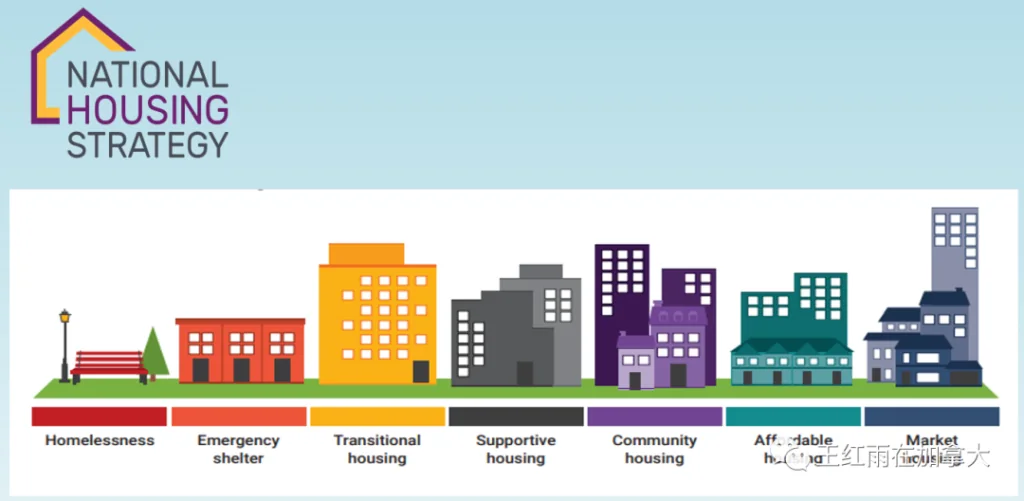
Canada’s electoral system acts as a huge painkiller when it comes to housing. According to my observation, in every election, whether it is a federal election, a provincial election, or a municipal election, there is never a time when the housing issue is not brought up as a major issue for intense discussion. The most touching thing is that no matter how mercilessly the competitors accuse each other, as soon as the voting day is over, the housing issue disappears. Everyone who voted and those who did not vote think that the housing issue has been solved with a complete question mark. From then on, there is no need to worry about the housing issue until the next election, when the housing issue will be discussed again, in an endless cycle. This electoral game is by no means a pointless waste of people and money, but can make people forget their pain like taking painkillers. If people feel that the housing crisis is serious, what is needed most is frequent elections at all levels. Efforts at all levels of government in Canada to use promises to address the housing crisis as a painkiller in election campaigns are evident.
02 What have Canadian governments at all levels done wrong when it comes to housing?
In addition to the contradiction between population and housing, another factor affecting housing prices is monetary policy. When currency is in excess, the central bank releases base currency into the market by purchasing government bonds. These high-energy currencies first flow to the capital market and commercial banks, so those who can obtain funds from the capital market and banks get the money first. The order in which you get the money is very important. Those who get the money first can purchase assets and commodities before prices rise. People who get the money later will have their purchasing power reduced because asset prices have risen. This is the "Cantillon Effect" of currency issuance: people close to the source of new money get rich first, the prices of financial assets such as stocks rise first, and rich people benefit first; real estate investors who can obtain mortgage loans from banks buy real estate before housing prices rise. Prices rise only after stock prices and house prices rise. People who lack financial assets and real estate cannot enjoy the benefits of rising asset prices caused by excessive currency issuance, but their purchasing power has declined due to inflation. In the case of inflation, the only effective way to curb inflation is to raise interest rates. History has proven that other means are ineffective. The pressure caused by interest rate hikes is mainly borne by households with heavy debts. At the same time, companies that rely on financing to operate will encounter huge difficulties. Real estate developers are the biggest victims of high interest rates. The result of the shift in monetary policy from excessive easing to excessive tightening is that people who decisively buy houses while taking advantage of low interest rates take advantage of the opportunity and enjoy the benefits of rising housing prices; the development plans formulated by developers when monetary policies were loose cannot be implemented when interest rates rise rapidly, reducing the supply of new homes. Both the United States and Canada use national credit as their currency standard. The anchor of the currency is not precious metals but treasury bonds. The ultimate source of money supply is the issuance of treasury bonds. The result of the government's large-scale bond issuance to make ends meet is a series of reactions: the Ministry of Finance issues bonds, the government consumes, the central bank purchases the treasury bonds issued by the Ministry of Finance, releases currency, causing existing asset prices to skyrocket, followed by rising commodity prices, and then raising interest rates to suppress inflation.Developers cannot afford to build housing. The result of this series of effects is that when houses need to be built, developers are unable to build them.The government's uncontrolled overdraft of the future is the source of the entire incident.The amount of overdrafts by the Trudeau government during the epidemic is equivalent to the total financial overdrafts of all previous prime ministers since the founding of Canada. The housing crisis is one of the consequences of the government's unbridled overdraft of the future. Therefore, the federal government is the cause of the housing crisis, not anyone else.

In terms of local governments, Ontario and British Columbia implement rent control policies, which is damaging to the market economy. Nowadays, it is as difficult for renters to find housing as it is to find a job. Applicants with credit records or other deficiencies have no choice but to submit to Guangmeng Tuku. During the epidemic, the Ontario government suspended the eviction of defaulting tenants, allowing landlords to block the loopholes at the most critical moment, hurting landlords' hearts and wallets, and making landlords more vigilant towards tenants. After the epidemic, the conflicts between landlords and tenants escalated, and vicious incidents often broke out. This is the inevitable result of the existing rent control system. When the inflation rate is 8%, the government stipulates that rents can only increase by 2.5%. This requires landlords to provide subsidies for tenants. Therefore, landlords are unwilling to repair the property and improve facilities, and hope that tenants will move out early every day. These are not harmonious landlord-tenant relationships.
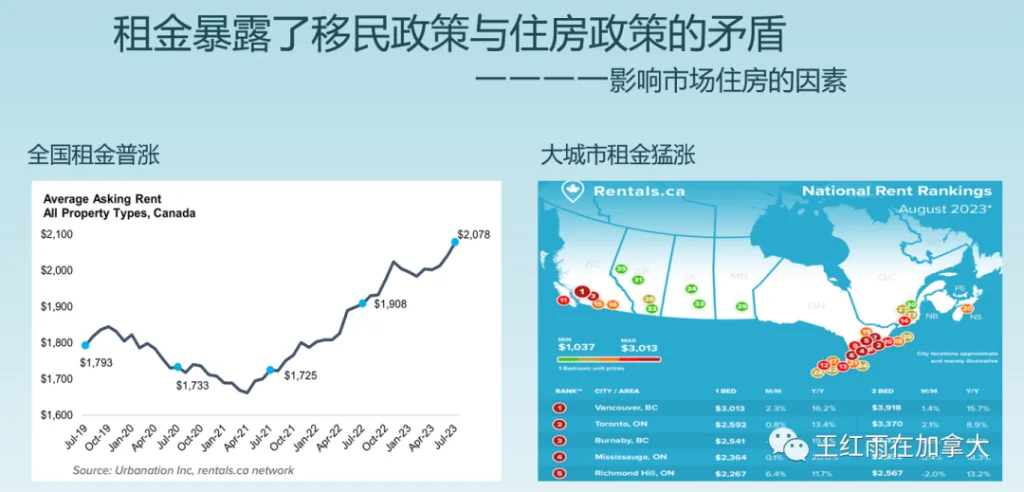
House prices and rents are determined by supply and demand. Under the established immigration policy, increasing supply is a top priority. The current Trudeau government’s anti-rich mentality is hampering housing supply. The latest big news is that the federal government has announced that it will cancel the GST on newly built properties for long-term rental in the next seven years. That is, if the developer's new house is not sold but used for long-term rental, the federal government will exempt the developer from the GST tax. The announcement specifically added: If the house is built for sale, market housing will not enjoy this treatment, so as to prevent people with better living conditions from free riding. During the 2021 federal election, the Conservative Party proposed that in order to increase the supply of second-hand housing, capital gains tax on the sale of investment properties should be exempted for a period of time. As a result, Trudeau also criticized it as making profits for the wealthy.
Bill 23, Ontario's well-thought-out bill, was rejected by most city councils as soon as it was introduced. The provincial governor was not discouraged. He first marked out a green belt and was ready to work on it. As a result, the audit agency took advantage of the situation and accused the provincial governor of operating in violation of regulations and abusing power for personal gain.
Toronto's mayor-elect announced in a familiar tone of excitement at a recent groundbreaking ceremony for a public housing site that she is using taxpayer dollars to preside over the construction of affordable housing, not just one-bedroom units but four-bedroom units that are not only affordable but also spacious. The comment section below the video was in an uproar.
03 The Imperfect Victims of the Housing Crisis
Families who have rented a house in Toronto or Vancouver for many years and have been waiting for house prices to be halved are the victims of the housing crisis. They believed the Prime Minister’s words that “house prices cannot rise anymore.” They actively participated in the big discussions about the housing crisis before the previous elections, and each time they received the comfort they deserved after the vote. Excuse me, has the market listened to the Prime Minister’s words? In addition, if housing prices have been cut in half, will there be more housing supply? The biggest imperfect victims of the housing crisis are families who fool themselves.
Families who think renting is cheaper are also victims of the housing crisis. Renting families originally thought that big cities have rent control and tenants have the freedom to move out at any time after one year. However, they did not expect that rents are only controlled if they do not move. Once they move, they have to face market rents. In the past two years, average rents in Canada have increased by 21%, and rents in Vancouver have increased by 12% in one year. More and more tenants are feeling trapped in their existing rental properties, unable to move. The reason is simple. Rental housing is bought by the landlord. With rising housing prices and sharp increases in interest rates, it is impossible for rents not to rise. Currently, renting a house is more inconvenient than buying a house. If you want to move, you must be able to afford market rent.
The current Canadian immigration policy is to score applicants, and this scoring system focuses on those who wear long gowns. Families who have been approved as new immigrants to Canada always feel that they are educated and have been screened to land in Canada, so they should be able to afford to buy or at least rent a house. The actual situation is not the case. Not only do new immigrants without financial resources find it difficult to settle in the Greater Toronto or Greater Vancouver, but also the old residents of these two megacities. If they miss the time window of being able to buy a house, sooner or later they will be squeezed out by housing prices and rents to live in the suburbs or other provinces. New immigrants with insufficient financial resources are victims of the housing crisis, especially new immigrant families who refuse to take off their caftans. If you come to Canada and you have to live in a megacity to find a job, but you can't afford to live there, it may be the wrong choice to immigrate. Big cities don't believe in tears, and it's the same all over the world.

Families forced to buy homes with usurious loans are victims of the housing crisis. Seeing that housing prices have risen to unaffordable levels, some families have given up completely. 63% of renting families have completely given up the idea of buying a house and are renting instead. There are also some families who made a last-ditch effort, but the results were not ideal. In 2021, buyers in the Greater Toronto Area who bypassed bank stress tests and used loan sharks from non-bank financial institutions to force their way into the vehicle accounted for a quarter of all transaction volume, which is a very high proportion. Buying a house with a loan shark is an extremely dangerous and risky behavior, no different from gambling. The buyer actually knows it well, but is forced to take the risk by the speed of rising house prices. Adventurers in 2021 are out of luck. Although they got into the car, the bumps were too violent. Good luck to these families.
The families who "wait a little longer" cried until the end. Housing prices keep rising, and although there are occasional corrections, they usually last about 7 months after falling from their highest point, with a decline of less than 18%. Such a narrow time window is simply not enough for the "wait any longer" people to waste time. Rising interest rates and tightening lending policies are two other strong forces that erode the ability to buy a home. The "wait a minute" family's dream of buying a house was shattered by themselves. Many families don’t understand the reason why the “ability to buy a house” expires. When the car "Ability to Buy a House" stops in front of you, you say "wait a little longer" and the car drives away. Time cannot be turned back. Strictly speaking, those families who miss out on the ability to borrow money and the time window when they can afford to buy a house will eventually become victims of the housing crisis. They will stay in the tenant queue for a long time and compete with other latecomers, which in turn aggravates the crisis of excessive rent increases.
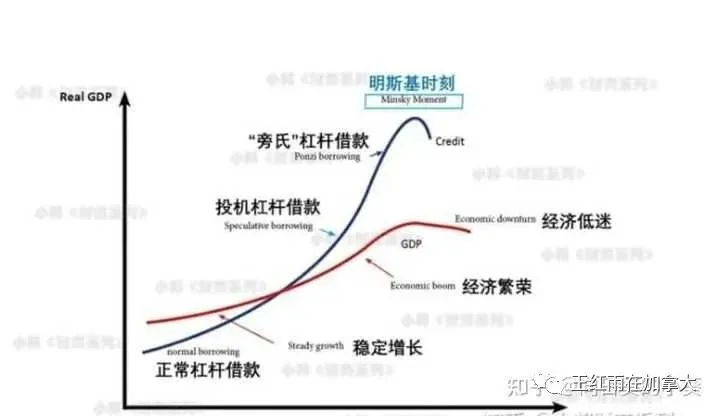
Families with multiple homes and experiencing financial difficulties are not victims of the housing crisis. One of the most discussed issues recently is whether you should sell in tears when you own multiple properties and are unable to maintain the rising negative cash flow. This question is actually not open to discussion because there is a standard answer. Hyman Minsky divided the evolution of debt into three stages: the first stage is hedging debt, which can repay the principal and interest; the second stage is speculative debt, which is no longer able to repay the principal and can only pay interest; the third stage is Ponzi scheme debt, which can only use loans to support loans and borrow more debts with higher interest rates to repay the usury loans due. Borrowers who cannot survive the third stage will reach the famous Minsky moment. Once the debt is thundered, innocent people may be harmed. Therefore,Families that rely on debts to support debts and loans to support loans should not take any chances. They should actively look for opportunities to sell their properties as soon as possible. If you sell a house, the sky will be brighter.
The completely innocent victims are quasi-new immigrants who have not yet landed. They have done nothing, but they have become perfect victims. Old immigrants who have lived in big cities for many years, have been hoping that house prices will be cut in half, and have always thought that renting is more economical and convenient, and have been waiting, have their own responsibilities, so they are imperfect victims. Homeowners who forcefully get into the car with usurious loans are imperfect victims of their own behavior. The housing crisis only promotes reckless behavior. Homeowners who hold multiple properties and have cash outflow problems can reduce the risk of supply cuts by reducing their holdings instead of persisting, and are basically not harmed by the housing crisis.
04 Current real estate investment opportunities
"Investment opportunities arise when others do stupid things." This saying applies to mature investors. The contradiction between supply and demand is obvious, and it is a serious crisis that has accumulated over a long period of time and will take longer to resolve. This is an opportunity for investors, who can roll their own snowballs on the long snowy slope. The stupid things done by Canadian governments at all levels, coupled with the misjudgments of some Canadian families, have made the road to real estate investment less crowded.
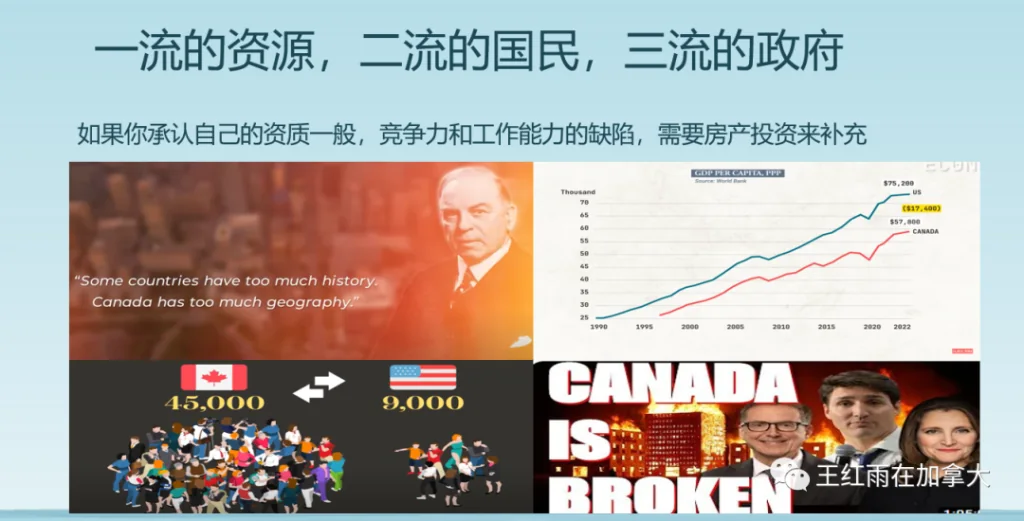
Canada's most attractive feature for newcomers is its inclusiveness, not its speed of economic development. Musk’s mother immigrated to Canada from South Africa, and Musk immigrated from Canada to the United States. Robert Mundell, the father of the euro, was Canadian but spent most of his life working in the United States. My favorite economic book author is John Kenneth Galbraith. He was born in Ontario and immigrated to the United States at the age of 30. He has served as economic adviser to the President of the United States many times and once served as the U.S. Ambassador to India.Canadians with outstanding qualifications can immigrate to the United States if they feel that Canada limits their talents.Currently, about 45,000 people immigrate to the United States from Canada every year, and less than 10,000 people from the United States immigrate to Canada. The old immigrants said,Canada has first-rate resources, second-rate citizens, and third-rate government.This is indeed the case. Most people who have stayed in Canada for a long time admit that their qualifications are average. In the TV series "All the Way to the Sun", there are two law school graduates who are determined to take root in Beijing after graduation. Li Mujia focuses on investing in himself, living well, using good housing, working 996, being on call, traveling alone, and working hard in a big law firm; Tian Rong, who considers that her qualifications are mediocre, has not engaged in legal work after graduation, and has become a real estate agent in a second-hand housing agency. Since 2007, she has been boldly investing in Beijing real estate. In the end, both protagonists realized their dreams: immigrating to Beijing. People with different qualifications, choosing different paths, can all take root in metropolitan areas. The original title of this TV series is "A Small Room in a Big City", which reveals two completely different ways for outsiders to take root in Beijing. Among them, buying a house is crucial for people with average qualifications. Many people think of Canada,Responsibility is severe, but stay for a long time, now that you have decided to stay, just shut up and stop complaining,No matter whether the policy is good or bad, we should strive to be the beneficiary of the policy, not the victim. This is the thinking of the strong.
The most important thing when investing in real estate is the choice of location. Greater Toronto and Greater Vancouver are the two top cities for real estate investment in Canada. As the division of labor becomes more and more detailed, if all family members want to find professional jobs where they live, it may not be possible in small cities. This is why metropolitan areas are becoming more and more crowded. Many people feel that the cost of living in Toronto is too high. The city government is still raising taxes and parking fees. Will people no longer be able to afford housing in the future and move to other cities? The current average rent in New York is US$5,500, and the average rent in Toronto is 2,800 Canadian dollars; parking on Manhattan Island in New York costs US$1 per minute and US$30 for half an hour, while Toronto is far from reaching this high level. With the influx of more and more people, the cost of living in Toronto will continue to increase, and the cost in New York will not stay at the current level. The principle of survival of the fittest applies not only to biological evolution but also to metropolitan life. Among the people who immigrate to Canada, not many come to seek gold, but most come to pursue a stable life. Putting down roots is a top priority. If your qualifications are mediocre, just learn from Tian Rong and be down-to-earth while actively buying a house. After you gain a foothold, continue investing in real estate and strive to widen the moat of financial security. If you have excellent qualifications, you can learn from Musk, Mundell and Galbraith, immigrate a second time, and go to the United States for development. For those who don’t move out but keep complaining, listen to what Li Jiaqi said: “Sometimes you have to look for your own reasons. Has your salary increased over the years? Have you worked hard?”
The best time to invest in real estate is when others can't afford it and you can still get a loan to buy a house; when others are fearful and you are greedy. There is no one-size-fits-all time to buy a house. On the contrary, everyone’s ability to buy a house is time-sensitive. The faster housing prices rise, the faster the window of affordability closes. For countries with a housing crisis, the right time should be: "Now is the best time to buy a house." Unfortunately, because it has been said so many times, no one believes this sentence. Judging from the history of the past 30 years, buying early is the best time; buying more is the best strategy. It is difficult for a tree to grow ten meters high in a year, but it is possible for ten trees to grow one meter high every year.
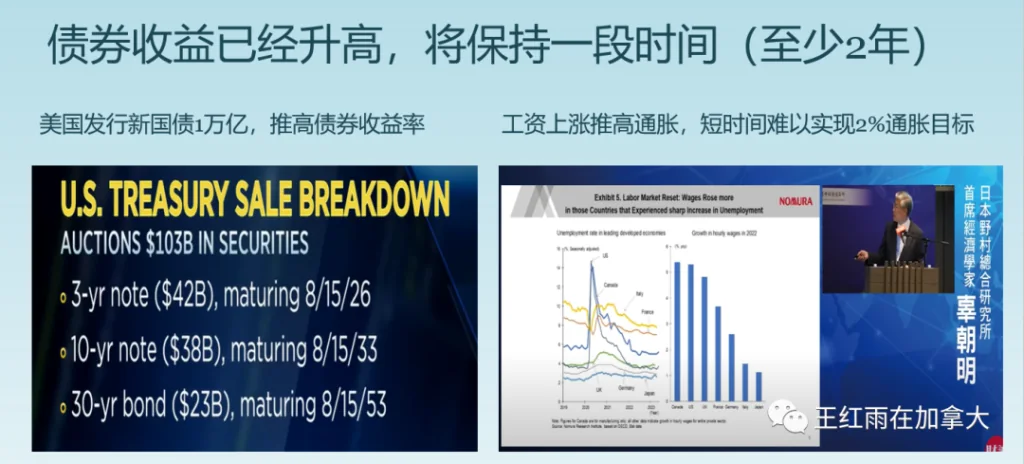
It is becoming more difficult to invest in real estate in Greater Toronto and Greater Vancouver every year. Mainly reflected in borrowing capacity and borrowing costs. Income cannot keep up with the rise in housing prices, coupled with ten interest rate increases, the borrowing capacity has been greatly reduced, which is reflected in the loan amount: the amount of each loan has shrunk significantly. This round of interest rate hikes is as powerful as a storm. In a very short period of time, many families with heavy debts feel suffocated. A Ponzi debt crisis has emerged in which they use loans to finance loans and borrow new debts to pay off old debts. Therefore, some people have unrealistic illusions in their minds. They are always rushing to have a catastrophe and the central bank can immediately cut interest rates, imagining that they have the power to distort reality and change the world with their wishes. The public should not be misled by this illusion.Because the current real interest rate has turned from negative to positive, and long-term interest rates have increased. The situation of negative real interest rates and low long-term interest rates has undergone a paradigm shift. Even if the central bank stops raising interest rates or even cuts interest rates, real interest rates will remain positive for a certain period of time, and fixed mortgage interest rates will be inThe 5% to 7% range will remain volatile for a long time.In July last year, the inflation rate was 7.6%, the mortgage interest rate was 5.2%, and the real interest rate was the nominal interest rate of 5.2% minus the inflation rate, and the real interest rate was negative 2.4%. In July this year, the inflation rate was 3.3%, the mortgage interest rate was 6.3%, and the real interest rate was positive 3%. The era of depositors being fleeced by borrowers has come to an end, and the time window for real estate investors to profit has closed. After the U.S. government broke through the debt ceiling again in early June, it eagerly issued $1 trillion in new Treasury bonds in August. Due to the global shortage of money, the Treasury bonds issued by the U.S. Treasury need to offer higher yields to attract enough buyers. As a result, bond yields have risen sharply and the face value of bonds has dropped significantly. Debt yield is a reference factor for the capital cost of long-term loans, so the interest rates of mortgage loans have not only risen to a higher level, but will also remain high for a period of time.
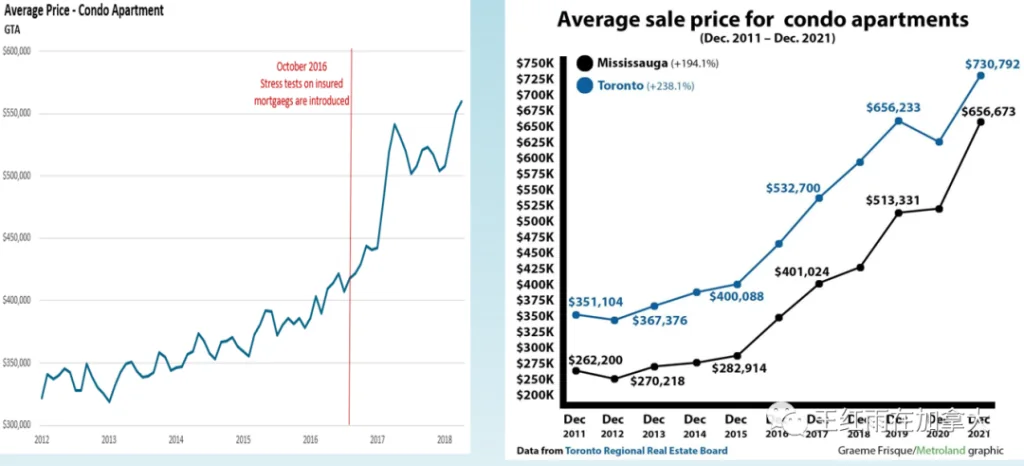
The future of real estate investment is bright, but the road is bumpy and difficult.Judging from past experience and lessons, the biggest feature of real estate investment is that those who are able win. A capable person refers to a person who can get a loan, can distinguish between noise and signals, can manage his debt well, can hold negative cash flow properties for a long time, can balance a lifetime of income as an investment purpose, can seize the time window of his ability to buy a house, and can make prompt decisions.In contrast, for brave speculators, returns are uncertain and increasingly difficult to profit. The most suitable properties for long-term investors right now are CONDOs in Greater Toronto and Greater Vancouver. Due to the impact of the epidemic, the completion of many new CONDOs has been delayed. 2022, 2023, and 2024 are the peak periods for the completion of new CONDOs, and there may be a short-term oversupply in the market. Due to sharp increases in interest rates and rising labor costs, the prices of newly launched CONDOs in 2022 and 2023 are too high, making it difficult to sell 70% of them in a short period of time. Only when 70% is sold will builders be able to obtain construction loans. Therefore, the number of newly built CONDOs will drop sharply after 2025, further exacerbating the housing crisis. Long-term investors can seize the short-term supply glut and invest in second-hand CONDO. Investors need to be patient about the returns of CONDOs. From 2010 to 2016, Toronto's CONDOs increased very slightly, about 4% per year, but there was a sharp increase from 2016 to 2020. From 2010 to 2020, the yield on CONDO investments is no lower than that of other types of real estate. The most important thing is that there are currently many constraints and the amount of each mortgage is limited, so investing in second-hand CONDO is a more feasible option.
Canada has a population of 40 million. With a history of more than 150 years, less than 15 million houses have been built. On average, 100,000 houses are built every year. Last year, 220,000 houses were built, but there were 1 million new people. If all the new people live in new houses, five people will live in one house. The CMHC report predicts that Canada will need 3.5 million new homes by 2030, with an average of 500,000 units built each year. There is a huge gap between demand and supply. The housing crisis has been frozen thirty feet, and no one can solve it in a short time. Although the slope is very long, each family has a short time window to buy a house, so they need to seize the day.
Conclusion:
To achieve steady and long-term development, real estate investment cannot be a temporary act of courage, otherwise it will fall into a debt vortex.
Real estate investment is an exam that tests a family's comprehensive abilities, including income level, debt management ability, ability to seize opportunities, and whether they have a clear understanding of long-term investment goals, etc.The housing crisis is here, it's the result of the past 30 years of history, and middle-class families don't need to be involved in solving this crisis.
The strong ones in life are actually the survivors in a survival environment of the fittest. No one in any country can live a financially secure life without working hard. Everyone needs to work hard. Canadians are indeed seriously involved in the housing field. After all, most people immigrate to Canada for a stable and dignified life. Becoming a beneficiary, rather than a victim, of the housing crisis is an effective way for middle-class families to achieve financial security. Although it is not a smooth road, after all, other paths may be more difficult and uncertain. Just like the financial crisis and economic crisis, not everyone in the housing crisis can be a victim. There must be survivors and beneficiaries. The situation of every family may change because of the crisis, but the direction of change may be for the worse or for the better. I hope everyone reading this will benefit from Canada’s housing crisis, rather than suffer from it.