On October 23, the Bank of Canada cut interest rates for the fourth time this year. The central bank's interest rate has now been reduced to 3.75%. Since June 5 this year, the central bank's interest rate has dropped from 5% to 1.25%, which is equivalent to a monthly interest rate cut of 0.25% in 5 months. This speed and magnitude of interest rate cuts is good news for households with high debts. For market observers who hold money to buy real estate, their hopes of falling house prices are being dashed.
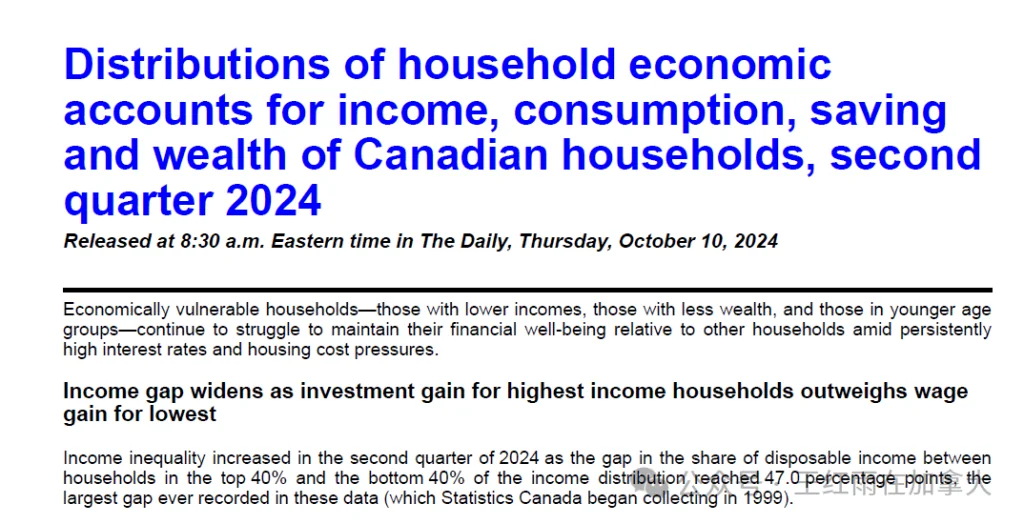
As high interest rates go away, their impact on our wealth is gradually becoming apparent. On October 10, Statistics Canada released the household financial status report for the second quarter of 2024, hereinafter referred to as"Report", reveals the impact of high interest rates on household finances. Let me share the main contents of the Report below.
Under high inflation, due to the Phillips curve effect, the number of vacant jobs increases, pushing up wage increases. Therefore, changes in income have little impact on life. The "Report" shows that "lowest incomeFor 20% of households, the income increased by 417 yuan, and the cost of living increased by 218 yuan. After offsetting, the net income increased. "
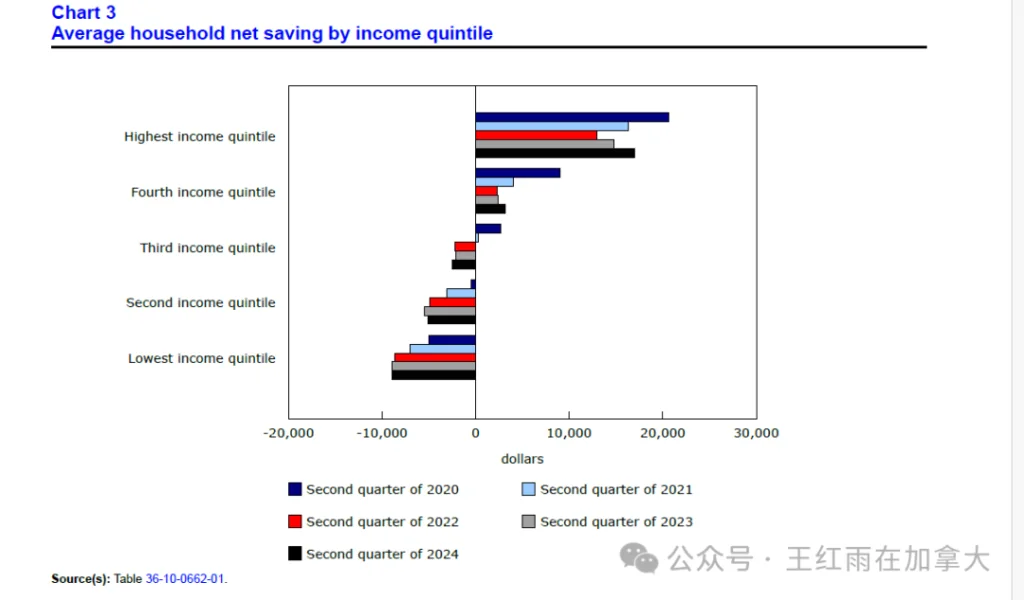
The decline in savings was most pronounced among middle-income households. Since the net income of low-income households has increased, their savings have actually increased. Heavily indebted middle-income households have greater debt expenditures, so their savings are quickly depleted.
The largest increases in assets have been among high-net-worth households, especially those holding large amounts of financial assets. As housing prices stagnated and financial asset prices soared, households with a larger proportion of financial assets benefited the most.
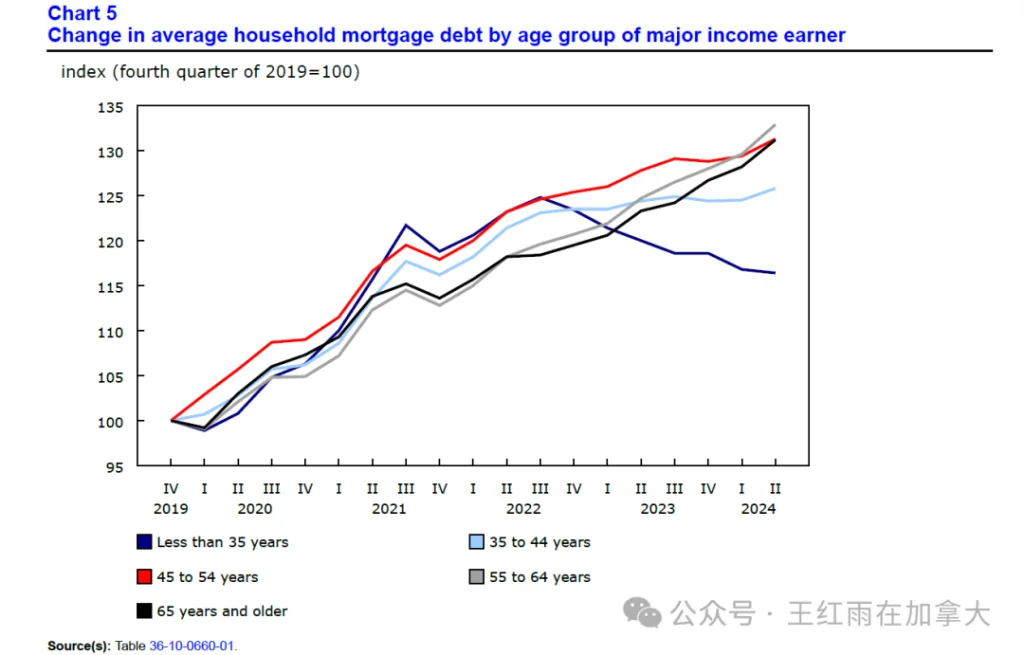
The group with the fastest decline in household debt is eye-catching, the report shows: “ageHouseholds under the age of 35 are deleveraging at an alarming rate. Since the interest rate hike, their debt has fallen by more than 3% every quarter, while household debt in other age groups has all increased. "
High inflation coupled with high interest rates is a real test of life.The characteristics of young people are that they are anxious and only focus on the present; middle-income families use their savings to tide over difficulties, showing good financial resilience; among high-net-worth families, those who dare to invest in financial assets are the biggest winners in this test.
Based on the Household Financial Status Report for the Second Quarter of 2024 released by Statistics Canada, this article analyzes and interprets the intergenerational wealth gap among Canadians and its impact on our life planning.
01 Should young people become the main force in deleveraging?
The "Report" shows that since the interest rate hike in 2022, except for those under the age of 35, the mortgage debt of households in all other age groups has increased. Under high interest rates, the speed and extent of deleveraging among young people is astonishing. The decrease in the total amount of mortgage loans for young people is not because young people are the most capable of accelerating the repayment of mortgage loans, but because the number of people buying houses has decreased, resulting in a decrease in the total amount of mortgage loans. Mortgage corresponds to real estate wealth. Therefore, the real estate wealth of young people has declined relative to other age groups.
Since the interest rate hike, many young people have been attracted to rent because the cost of renting a house is lower than buying a house. This is illustrated by the continued rise in rents during a period of rising interest rates. During a period of high inflation and interest rates, it is a very natural choice to only focus on the immediate future. Being able to overcome immediate difficulties and make long-term and painful choices is not the first choice for most young people today.
In June 2022, Canada's CPI reached a peak of 8.1%. According to the Phillips Curve, job vacancies were the highest at that time, and it was easiest for young people to find jobs. Young people or their parents who have common sense in economics should know that when inflation is high, they should graduate as early as possible and get employment as soon as possible. Thereafter, job opportunities gradually decrease as inflation decreases. At that time, a young man who had graduated from an undergraduate degree and studied for two years as a graduate student used his own experience to verify the validity of the Phillips Curve. The result of competition for jobs between young people and recent immigrants over the past two years has been very high unemployment rates for both groups. Without income, you cannot apply for a mortgage.Why are some young people struggling to afford property? Because there is no job.The number of unemployed young people has increased, so the mortgage balances of young people have continued to decline.
Working young people may not have a down payment. The federal government has proposed an assist plan. That is, starting from December 15, the maximum repayment period for first-time homebuyers with a down payment of less than 20% will be extended to 30 years.This policy increased borrowers’ borrowing capacity by the equivalent of one year’s income: NowA household with an annual income of 80,000 yuan will have an increased borrowing capacity of 80,000 yuan after the new policy. A household with an annual income of 150,000 yuan will have an increased borrowing capacity of 150,000 yuan after the new policy.Loan interest rates have been falling, coupled with the relaxation of loan policies. Whether young people can kick the ball into buying a house depends entirely on their own foresight and courage.
Generation Z, the young people born after 1995, show strong characteristics of their times in many countries: they prefer the sharing economy, especially sharing their parents’ houses. Some countries call this phenomenon "boomerang", as parents cannot get rid of their offspring no matter what; some countries call this phenomenon "kangaroo", because the baby kangaroo always refuses to leave the mother's pouch; some countries call this phenomenon "gnawing at the old", and how long it can nibble depends entirely on the strength of the parents. The later young people become financially independent, the worse their financial intelligence will be and the stronger their dependence will be. On the one hand, parents need to draw a red line for their children and require their children to be financially independent by a certain age; on the other hand, they need to implement the intergenerational inheritance of wealth as early as possible.childWhen a child is 25 years old, a 50-year-old parent gifts a down payment of 150,000 to buy a house, which is more effective in completing the intergenerational transfer of wealth than a 75-year-old parent gifting a child 500,000 yuan as a down payment when the child is 50 years old.
It is indeed becoming more and more difficult for young people to buy a house. If you want to buy a house, you need to meet many conditions: you must have a job, have a good credit record, pay off student loans, have affordable interest rates, loose mortgage policies, financial support from parents, and most importantly, you must have foresight, take the initiative to take long-term responsibilities, and make difficult but right choices. When some young people choose to deleverage, young people who choose to increase leverage need extra courage, strength and responsibility. After the rate of interest rate decline changes from quantitative to qualitative, there will definitely be a group of young people and their parents who can figure out what others can't and buck the trend of leverage.
02 Middle-aged middle-class families will retreat if they don’t advance.
The recently popular domestic TV series "Mortal Song" and Xu Zheng's movie "Retrograde Life" are about the same theme: how middle-aged middle-class families are reborn after their careers are derailed. Every country has its ownSocial Contract Networkandsocial safety net. In the social contract network, people go to school, work, pay taxes, apply for loans to buy houses, retire, and receive pensions. Once things go off the rails, a social safety net is needed to cover things up. The families of Lao Na and Lao Gao in these two film and television works were both in their prime, but derailed when their mortgage loans were at their highest. The social welfare network was unable to catch them, and they needed to rejoin the social contract network through their own efforts. Unlike many young people who suffer from not having a job and being unable to join the social contract network, the pain and impact of derailment in middle age is even greater. Lao Na and Lao Gao finally chose to rent out their own homes and move to a more remote and smaller rental house. Although this consumption downgrade was painful and embarrassing, it was much better than not having their own homes as a bottom line. At least it bought them precious time to get back on track. The consumption and life of industrial workers in the United States have been degraded for many years, and China has only just begun. Trump's promise to help bring back families that have been derailed from the social contract is probably just a slogan. The overall sinking or even disappearance of the industry caused by technological advancement cannot be saved by politicians' slogans.AI may replace anyone’s job at any time, and those who are most afraid of losing their jobs are middle-aged and middle-class families.

Compared with middle-aged and middle-class families in China, this group of people in Canada is currently in a better situation. According to the data in the Report,The main impact of high inflation and high interest rates on middle-class Canadian households is a decline in savings balances. In the middle of the income distributionTwenty percent of households saw their net savings situation worsen in the second quarter of 2024 compared with the same period last year as their higher spending, especially on housing and utilities, continued to outpace income growth.
Middle-aged people, mainly those born in the 1980s, are those who are older and younger, and are climbing the career ladder. In the past, there was a wealth gap between those born in the 1970s and those born in the 1960s, and in the latter, there was a huge pressure to catch up with the advantages of new technologies between those born in the 1990s. At the same time, this generation of middle-aged people are also facing more temptations in investment choices, and they often waver between long-term investment and short-term speculation. Those born in the 1970s and 1960s rarely try to invest in digital assets such as Bitcoin, and rarely participate in Robin Hood-style stock market speculation. However, those born in the 1980s are easily affected by speculation, are easily attracted by windfalls, and gamify investment. To put it simply, this generation of middle-aged people still lack experience in investment. Whether it is financial assets or real estate, the results of long-term investment are generally better than short-term arbitrage. This generation of middle-aged people need to be more patient and long-term planning.
03 Among the elderly at the top of wealth, there are also some who are unhappy.
《Report" shows that the most positive thing about adding leverage to mortgage loans isFor those born in the 1960s, the mortgage balance of households aged 55 to 64 increased by +6.5%; the mortgage balance of households aged 65 and above increased by +6.4%. Older households may add to their mortgage debt for a variety of reasons, such as purchasing an investment property, helping younger children purchase a home, or for a variety of other priorities.The elderly are the beneficiaries of real estate wealth. The increase in mortgage loans corresponds to the increase in real estate wealth. The elderly who have benefited from this situation will seize the opportunity to move forward and continue to expand their intergenerational advantages.
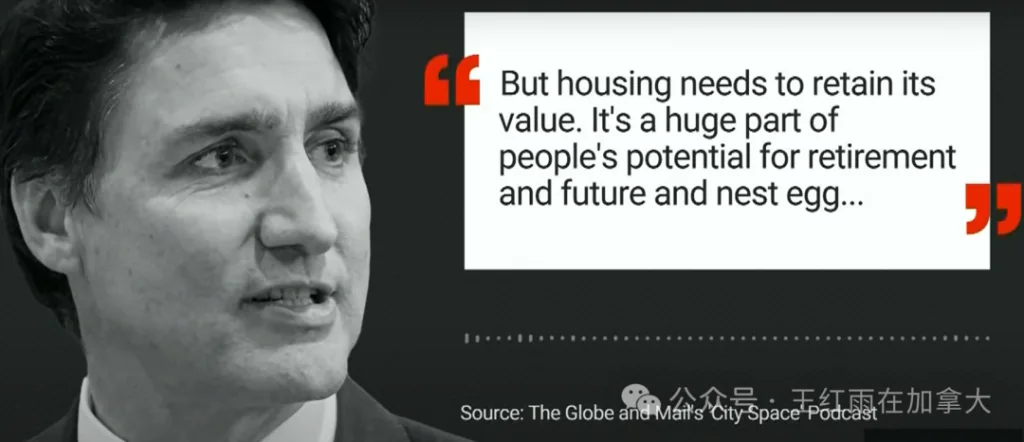
Prime Minister Trudeau said it loud and clear at the end of May this year: “Housing needs to retain its value. It’s a huge part of people’s potential for retirement and future and nest egg. So yes, we need to keep housing stable and valuable.”In Canada, house prices are protected by government put options.The government has never suppressed housing prices. It has only intervened when housing prices rose too fast, with the purpose of slowing down the rate of housing price increases. Families who have owned real estate know that housing prices in Canada are just like the S&P 500 index in the United States. They are secretly protected by the government, and investors can just hold it for a long time with their eyes closed. Families who have never owned real estate in Canada can see this but are unwilling to admit it because they are not in the car.The earlier you buy, the longer you hold the property, the wider the moat of wealth becomes, and the more difficult it is for latecomers to overcome.Buying early is a natural advantage for older people. Therefore, this intergenerational wealth inequality will only increase as time goes by, making new immigrants and young people feel uncomfortable.

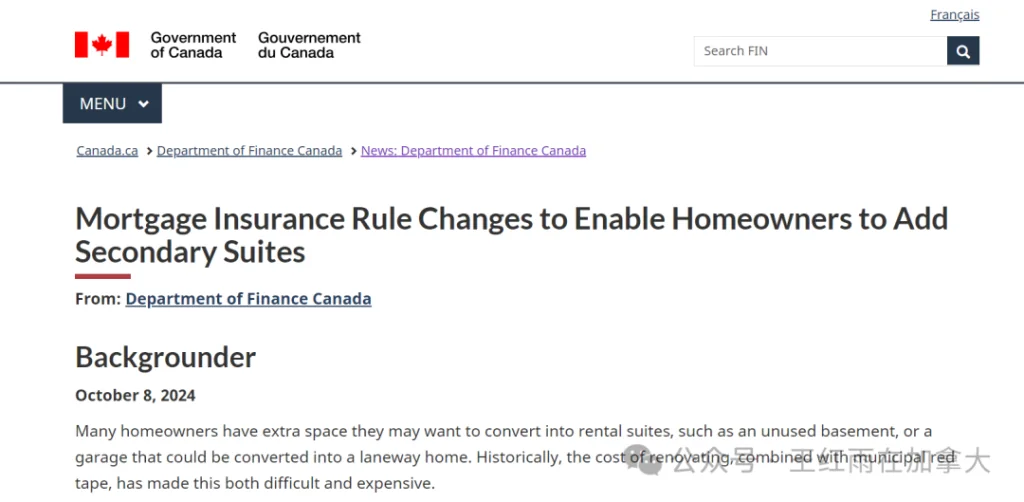
After the federal government announced a loan policy that would benefit first-time homebuyers on September 16, in order not to lose the votes of homeowners with vested interests, it announced a latest mortgage policy as a balance on October 8, which will take effect on January 15 next year. The operability of this new policy is extremely poor, and it is not worth introducing in detail. Simply put, the policy of refinancing owner-occupied housing is restored to 90% of the house price before 2011, but there are a lot of additional conditions, including: 1. The refinancing policy must be used The new funds are used to build the property, so homeowners of CONDOs and townhouses are excluded, and the added units can only be lived by immediate family members; 2. Valuation is based on the drawings of the added property, and the house price cannot be higher than 2 million; 3. The bank needs to provide the construction permit, as well as the project contract and construction budget; 4. The corresponding bank loan is essentially a "construction loan", but enjoys mortgage loan interest rates. This very special mortgage is called "progressive draw" within the bank. "mortgage", once approved, the bank will lend money one by one as the project progresses, which will take about 3 to 4 times. Before each loan, a property evaluation is required to confirm the project progress and funding requirements; 5. Refinance approval is based on the owner-occupied house and must undergo a stress test. Due to its poor practicality, this new policy is a policy that is only effective but not effective. It is a policy designed to gain attention and win over the votes of existing independent house owners.
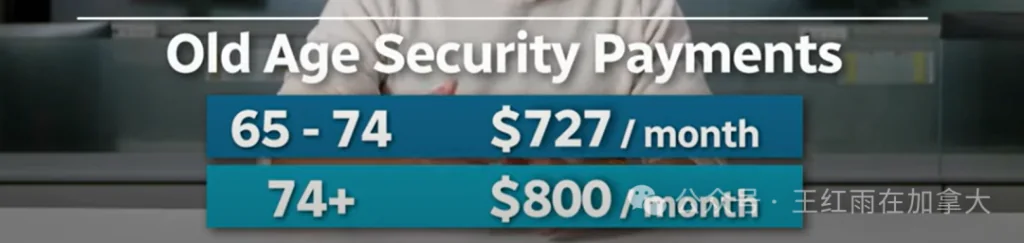
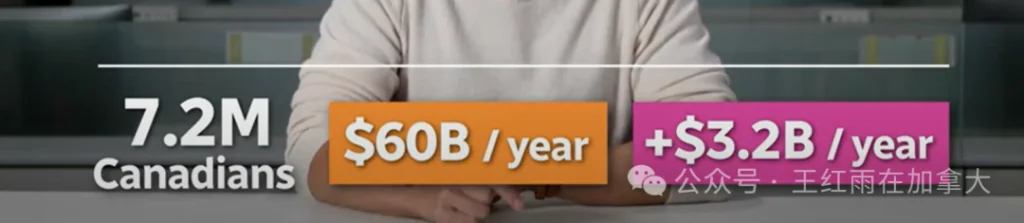
Retirement life in Canada is not easy for the elderly without real estate wealth, and the unconditional old-age pension is not high. OAS, Old Age Security, an important social welfare project for the elderly, is divided into two levels, CAD 727 per month for those aged 65 to 74, and CAD 800 per month for those aged 75 and above. Last year, the government distributed about 60 billion in OAS pensions every year. There are now 7.2 million elderly people in Canada over the age of 65, with an increase of 220,000 every year. The Trudeau government is a minority government and must unite with a small party to survive. The NDP, which was originally married, suddenly fell out of favor recently, and the Trudeau government faces the risk of collapse at any time. The Bloc Québécois extended an olive branch to Trudeau, but the condition was that the OAS amount for seniors aged 65 to 74 should be increased from $727 to $800 per month, making it the same as that for seniors aged 75 and over. If Trudeau compromises, he will need to add another $3.2 billion to the existing $60 billion in pension spending. Rich old people occupy a lot of real estate, and poor old people have been asking the government for more. There are also difficulties among the elderly due to the wealth gap.
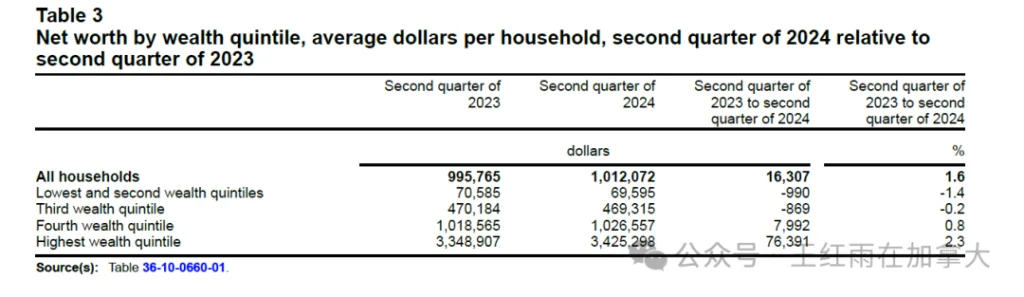
Families dominated by a strong culture rely on themselves and the market; families dominated by a weak culture rely on the government and welfare. Capitalism provides sufficient market and welfare space for all families. It depends on the family's choice. The "Report" disclosed the current wealth differentiation in Canada:richest20% of households accounted for 67.7% of Canada’s total net assets in the second quarter of 2024, with an average net worth of CAD 3.4 million per household.; And in the wealth distribution, it is at the bottomThe 40% of households account for only 2.8% of the total net worth, with the average net worth per household being $69,595.These data confirm Hayek’s famous saying: “Human beings have always faced a choice: whether to find equality in poverty or freedom in inequality."Obviously, Canada has chosen the latter: amidst inequality, let every family freely choose. Every family has the right to make free choices, but must bear the consequences of their choices.Real estate investment is not a fad. When house prices rise, people get excited about it. When house prices fall or stagnate, they are abandoned. Real estate wealth is the cornerstone of family wealth. Under any market situation, if you have the ability, you should buy it.Quebec's welfare is the best in Canada, so people have the highest degree of dependence on the government. There are also many people who have no homes to support themselves. This kind of dependence does not cultivate a strong culture, but endless demands. The Québécois took advantage of the situation this time, and if they succeed, they will ask for more and will not stop. There is only one way out for a family with a strong culture: continue to use market rules to increase wealth without stopping.
Conclusion
Parents often come to inquire about mortgage issues on behalf of their young children. Unfortunately, my final reply to these parents is often this: Your child does not have a loan problem, but a problem of not having a job and being unable to be financially independent. I can't help.Young people strive to join the social contract and pay more taxes, so that banks can lend out long-term, low-interest mortgage loans. Otherwise, what they lend to young people are usually short-term, high-interest consumer loans.
The danger of middle-aged people falling off the track of life is always there. The faster technological progress, the greater the risk. If you continue to speculate under such circumstances, you will only be more exposed to risks. The character Lao Gao in the movie "Retrograde Life" lost his entire family fortune because of his participation in Pedoupi. Later, he encountered unemployment and his life was completely derailed. He could only start over as a takeaway rider.Investing in gamification is actually gaming life.

The biggest dependence of the elderly is real estate. Sharing housing, sharing your parents' house without paying rent, and sharing the landlord's property is actually renting a house. Young people in the Z era prefer the sharing economy. The retirement life of elderly homeowners is guaranteed and stable by these young people. Elderly people who do not own real estate completely rely on government relief for their later life. Last year, the Canadian government’s Old Age Pension (OAS) expenditure was as high as 60 billion, which is almost equal to the total of 26.6 billion in unemployment insurance (EI) for young and middle-aged people, plus 28.1 billion in child benefits, and 6.6 billion in child care projects. Before the age of 65, you need to work hard and make long-term plans to balance your lifetime income. If the investment is unsuccessful, you will have to wait until you are 65 to be rescued by the government.
American economist Thomas Sowell believes that comparing income and wealth gaps across generations is sensational. There is no comparison in terms of income and wealth between a 25-year-old and a 50-year-old. To objectively compare income and wealth gaps, comparisons need to be made between peers. Intergenerational fairness and intergenerational justice are words only used by politicians. No country has ever seen a visible hand in smoothing the wealth gap between generations. The household financial status report for the second quarter of 2024 released by Statistics Canada perfectly verified Sowell’s insights. People of different age groups only need to compare themselves with their peers. There is no need to pursue intergenerational equality and justice. They can just do their own homework.
After four interest rate cuts, the central bank's interest rate has dropped from a high of 5% to 3.75%. After the emergency situation of "burning urgently and only focusing on the present" is lifted, many families need to consider longer-term planning. From now on, interest rate cuts will have a quantitative and qualitative impact on the lives and investments of Canadian families. Looking back at the choices and wealth changes of people of different generations since high interest rates and high inflation can help us see the future better. Saying goodbye to high interest rates will be a new starting point. I sincerely wish that adults of all ages can find their careers and wealth. I wish that young people will enter the social contract network earlier and achieve financial independence as soon as possible; young and middle-aged people will abandon speculation and the illusion of getting rich overnight and make solid progress. Make long-term investments, prepare for rainy days, and more importantly, keep learning and constantly consolidate your irreplaceable role in work; middle-aged and elderly people born in the 1960s and 1970s will continue to use the market and their own advantages to expand real estate wealth and supplement their retirement life. Happy interest rate reduction to all.
Henry Wang in Toronto on October 23, 2024