Canadian housing prices ended 10 consecutive months of decline in March 2023, with an increase of 0.2%. This housing price adjustment has officially ended. Judging from the history of housing prices in the past 50 years, the average housing price decline in Canada lasted eight months, with a decline of 18%. The housing price adjustment that began since the interest rate hike last year is perfectly in line with historical data. Housing prices respect the laws of history, and various assertions that "this time is different" were finally proven to be "this time it will be the same as in the past." In the past 50 years, there have been 7 house price adjustments, with an average of 8 months each time. The cumulative time for cumulative house price adjustments is 56 months, which is equivalent to 4.7 years, accounting for 9.3% of the 50 years. It can be seen that in modern Canada, house prices fell less than 10% of the time and rose more than 90% of the time. The number of people who can truly seize the opportunity of a 10% drop to buy a house is a minority, which is in line with the proportion of wealth distribution among the population, that is, a small number of people hold the majority of the wealth.
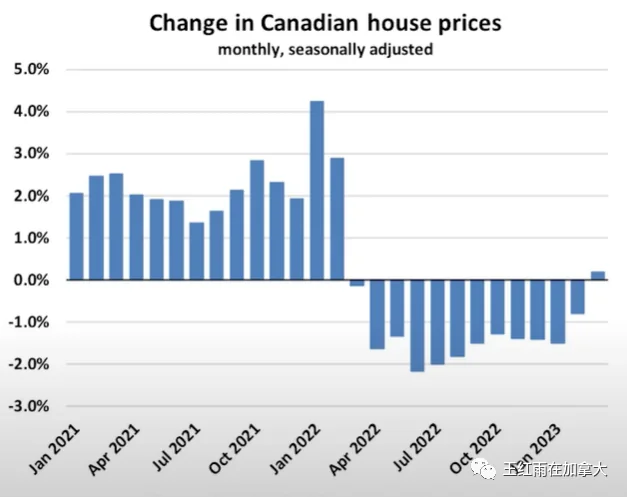
Whatever our views on house prices over the past 10 months, those debates are now over. After the excessive rise in housing prices during the epidemic, under the huge pressure of raising interest rates, housing prices have been adjusted, and housing prices have returned to the long-term trend line. The common challenge we face today is that to buy an average-priced property, you need a higher income. According to calculations from Ratehub, a website that has long observed the purchasing power of real estate in the Greater Toronto Area, the average house price in January 2022 was 1.257 million, and the required income was 199,300. One year later, the house price dropped to 1.078 million in 2023, and the required income was 207,000. The purchasing power has not improved with the decline in house prices, but has worsened. The latest data is that the average house price in March 2023 is 1.118 million, and the required income is 217,000. The affordability of the average house price has further deteriorated. The actual situation I have seen at work is consistent with the results calculated by this website. The decline in housing prices in the past 10 months has not improved people's ability to buy houses. The results of the "wait a little longer" people are not what they want to see. After 10 months of debate and waiting, we can draw this conclusion:House purchasing power is determined by both house prices and interest rates. The favorable factors of falling house prices will be offset by the unfavorable factors of rising interest rates. Interest rate factors have a greater impact on house purchasing power than house price factors.
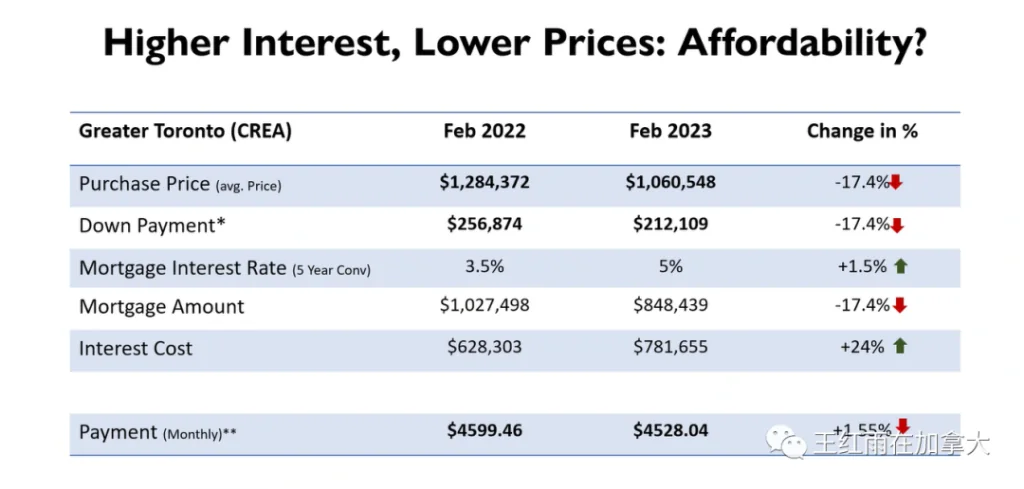
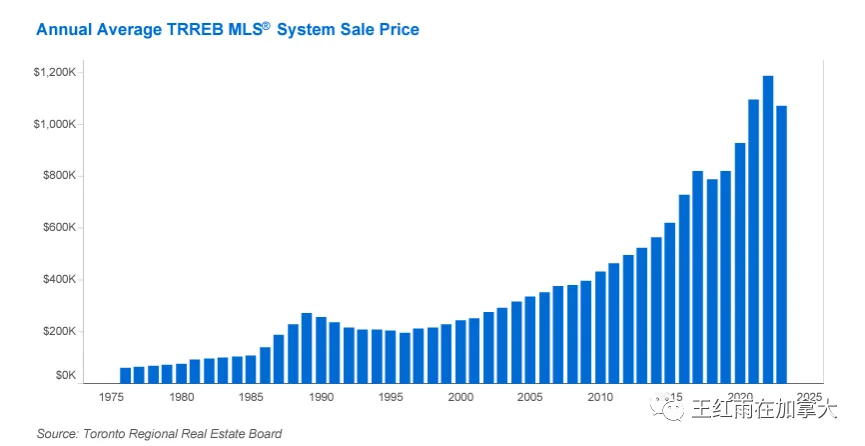
In the past 10 months, there has been a race between falling house prices and rising interest rates. If the positive impact of the decline in house prices is greater than the negative impact of rising interest rates, the "wait a little longer" group will win. Otherwise, the wait of the "wait a little longer" group will be lonely. Facts have proved that, from the perspective of the ability to buy a house, although most of the "wait a little longer" people are not worth it, there is indeed a part of the "wait a little longer" people who have waited for the results they want. These people did not have enough down payments when house prices were high. When house prices fell, the required down payments were reduced, so they can realize their dream of buying a house. Note that these people belong to families with strong borrowing ability and weak down payment ability. I hope these families seize the opportunity. If they do not act, the advantage will disappear as housing prices take off again. According to my observation, 99% of the people who hope that house prices will fall are like Mr. Ye. When house prices fall, people will crawl under the bed. In any case, the last game is over, and a new game has begun, that is, under the requirement of higher income, who can win the game after housing prices bottom out and based on their own down payment and borrowing ability. The average house price in the Greater Toronto Area reached 1.33 million in February 2022, which can be said to be an extraordinary increase and seriously deviates from the long-term house price curve. Now it has fallen back to 1.1 million, which can be said to have dropped to the normal level of long-term increase. Judging from the long-term housing price trend line in most regions since 1975, housing prices in 2020 and 2021 have deviated upward from the long-term trend line. Housing prices in 2022 have returned and will continue to move northeast on the long-term trend line in 2023. So if you want to buy a property with an average housing price, do you really need an annual household income of 217,000? If house prices continue to rise normally, won’t this income requirement become higher and higher? How can there be so many families with such a high income? Isn’t it because housing prices have no motivation to continue to rise? The eye-catching figures in the news are very different from the actual situation. If a family is buying a home for the first time,If you want to buy a property with an average housing price, you do need an annual income of more than 200,000, but this situation is rare in real life. Currently,Families that buy properties with average housing prices as their own homes are mostly those that want to downsize., use the funds obtained from selling the original home as the down payment, or add the funds after cashing out the original home loan as the down payment. Changing houses is an extremely micro topic and is not a very public topic, so it rarely appears in news headlines. Loan arrangements during the house exchange process are also individualized issues that are difficult to fully discuss in the public domain. Therefore, we see that the public discussion topic has become like this: "To buy a house in Toronto, you need to have an annual income of 217,000." All people who buy a house have been simplified into first-time homebuyers, and the income required to buy a house has also been simplified into that each family buying a house needs to have an income of more than 200,000. Oversimplified questions and conclusions will plunge families who have not yet bought a house into despair, leaving latecomers without any hope of buying a house. Housing prices are taking off again, what should people who haven’t gotten on the train do? This article attempts to explore the factors that affect housing prices, hoping to inspire newcomers.
.
01 house price promoter
The internal logic of housing prices taking off again needs to be reiterated, because in the past 10 months, many people have mistakenly believed that housing prices in February 2022 are the peak of Canadian housing prices, and that they should start to decline from then on. The slogan "If you don't escape from the top, you have to escape for your life" can be shouted, which shows that many people are looking forward to falling house prices day and night, and they should not get up again if they fall.
In Greek mythology, there was a king of Cyprus named Pygmalion, who was good at carving. He did not like mortal women and decided never to get married. He used magical skills to carve a beautiful ivory girl statue, and while working day and night, he gave all his energy, enthusiasm, and love to this statue. He caressed her like his own wife, dressed her up, named her Galatea, and begged the gods to make her his wife. Aphrodite, the goddess of love, was so moved by him that she gave life to the statue and married them. People draw a conclusion from this story, that is: when we have very strong expectations for something, what we expect will appear; when people are firm in their expectations, they can transform their expectations into reality through their own efforts. American psychologist Rosenthal calls this phenomenon of having all your wishes come true the "Pygmalion effect." Isn’t the fall in house prices consistent with the Pygmalion effect? Since so many people are looking forward to a fall in housing prices, why don't housing prices in Japan plummet by thousands of miles? The reason is actually quite simple. 65% of people in Canada own their own real estate, and the number of people who are looking forward to rising house prices is twice as many as the people who are looking forward to falling house prices. Therefore, the development of housing prices is consistent with the Pygmalion effect. In the past 10 months, people who have come out to say that housing prices will fall forever have been louder. Maybe it’s because they see a little hope, butThe silent majority is bullish, I just didn’t speak online.
In addition to the above-mentioned psychological factors that make it difficult for housing prices to fall, there are four objective factors that ensure that Canadian housing prices will rebound in the short term and rise in the long term. There are four driving forces behind housing prices: population, housing supply, interest rates, and mortgage policies.
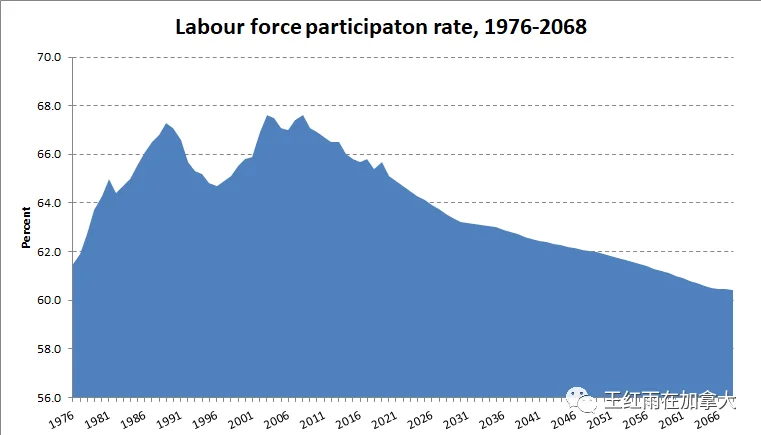
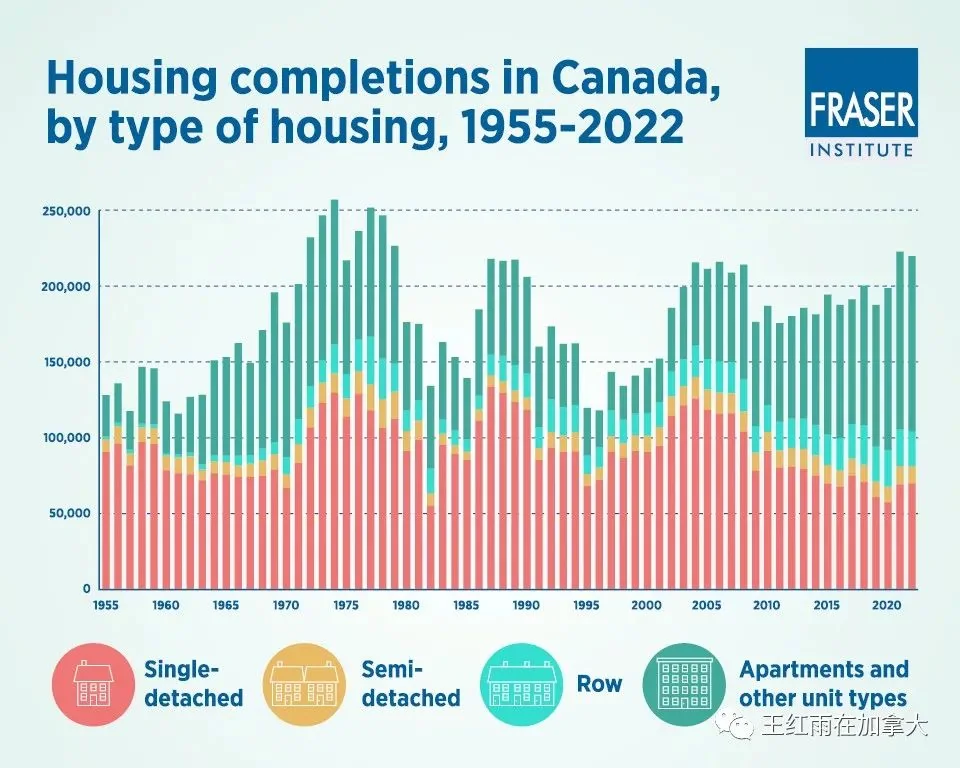
The population continues to increase significantly, which determines the general trend of continued long-term rise in housing prices. Canada has always implemented a radical immigration policy and is the most active among English-speaking countries in introducing new immigrants. The baby boomers born between 1946 and 1964 are exiting the labor market. At present, the number of Canadians retiring every year is as high as 300,000, so more than 400,000 new immigrants are needed to supplement the labor force. New immigrants are supposed to be the supplier of labor, but new immigrants who have just landed need time to adapt to the environment and skill requirements and cannot immediately become a labor supply. On the contrary, new immigrants will immediately increase consumer demand, especially housing demand. Without introducing new immigrants, Canada is likely to follow Japan's 30-year decline path: aging, low birthrate, low desires, and falling housing prices. The whole world has been trying to cross the river by touching Japan, and no one wants to fall into Japan's situation. Canada has always been very open-minded and bold in attracting population inflows, grabbing people from all over the world regardless of its endurance. The output value of Canada's service industry accounts for more than 70% of GDP and nearly 80% of the employed population. What Canada needs is mid- to high-end service industry labor. Many people joke that India has no manufacturing industry and that the service industry is a castle in the air. However, India's relatively developed information service industry talents are exactly what Canada urgently needs. Now and for a long time to come, there will be more and more new immigrants from India. Their language barrier is smaller than that of the Chinese, and their work skills are more suitable for Canada. The most important thing is that they dare to buy a house with a 5% down payment, and they also have the ability to borrow money. New immigrants, especially those of Indian origin, integrate into Canadian society relatively quickly and will have a great demand for real estate in metropolitan areas.Buying a house is a fair competition. Those who have the ability to borrow money first get first; those with strong borrowing ability get the most. There is no other shortcut.
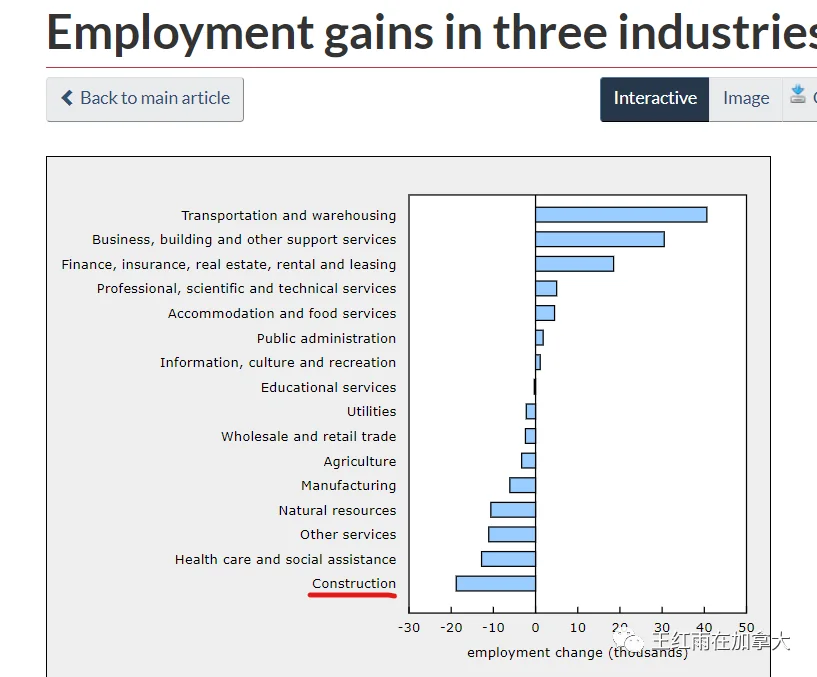
Housing supply has always been considered the most important factor in solving the housing crisis. Even if more immigrants come, won’t it be solved if we build more houses? This problem sounds simple, but in actual operation there are many obstacles. Employment data released by Canada in March this year show that the national labor force is divided by industry, with the construction industry experiencing the largest reduction in labor force. No matter how good the planning is, if no one builds it, the house will remain on the drawing board. The Bank of Canada's monetary policy of shrinking its balance sheet has not caused a shortage of mortgage loan funds, but it has had a great impact on construction loan funds. The asset risk-weighted index of construction loans is three times higher than that of mortgage loans. If banks want to increase construction loans, they must increase their equity capital. And the banking regulatory authority OSFI has just raised the capital adequacy ratio requirements, making commercial banks cautious in issuing construction loans. Projects that have already started are gradually feeling the dual pressure of "difficulty borrowing money" and "money is too expensive". Commercial banks have also used some brainpower to securitize some commercial loans that have been issued and cash them out to issue construction loans. So far, the results have been limited. Real estate development in Canada is facing a dilemma: no one and no money. Real estate developers must consider factors such as high capital costs and manpower shortages when planning projects. The plans they make must also make money, otherwise commercial banks will not approve construction loans. After increasing the price step by step, we see that the prices of off-the-plan properties on the market have skyrocketed, and there are very few down-to-earth projects. Therefore, we’d better leave off-the-plan properties to more powerful future immigrants. Old immigrants should seize the advantage of being the first to arrive and put their names on the second-hand houses they can buy as soon as possible.
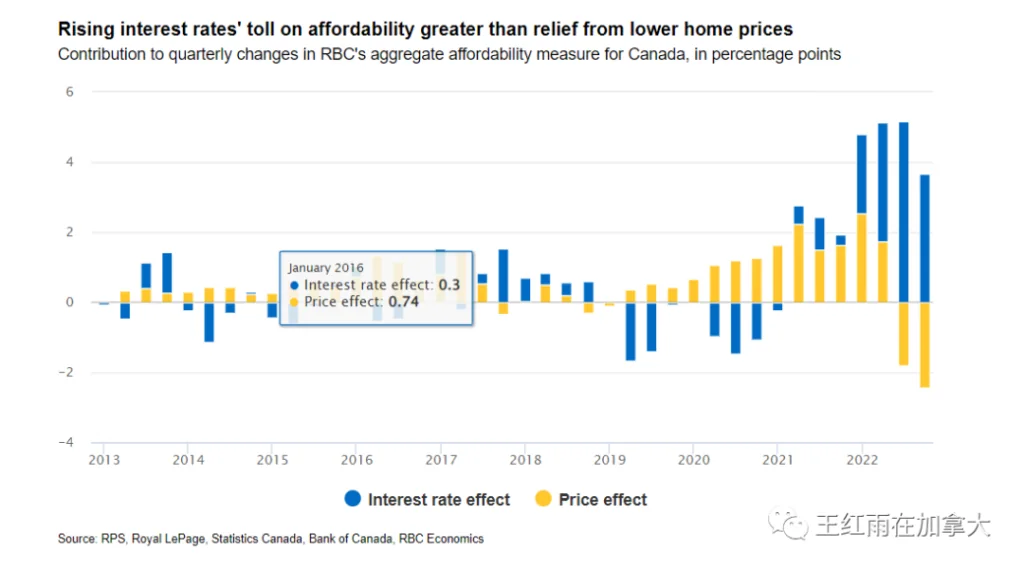
Interest rates have had a huge impact on real estate over the past 10 months, especially affordability. The decline in housing prices caused by the rapid and substantial increase in interest rates did not increase the purchasing power of housing because the increase in interest rates reduced the ability to borrow money. Some people wanted to "wait a little longer" in the past 10 months to see if their purchasing power could improve after housing prices fell. But now it's confirmed that they can't! And the negative impact of rising interest rates on purchasing power is greater than the positive impact of falling house prices on housing purchasing power. Some people are now starting a new round of "waiting" again, this time waiting for an interest rate cut. Both the subprime mortgage crisis and the COVID-19 epidemic have taught us that interest rate cuts are the trigger for skyrocketing housing prices. Whether during an economic crisis or during the outbreak of a deadly epidemic, interest rate cuts will lead to sharp increases in housing prices. From now on,It is only a matter of time before interest rates in Canada fall, and it is a high probability that housing prices will rise.My personal opinion is that it is too late to discuss the possibility of an interest rate cut until November this year. People who are discussing the topic of interest rate cuts now are too impatient. With such high interest rates, there are still people buying houses and vying for houses. The onlookers expressed their incomprehension. The reason is actually very simple. Once the interest rate drops and housing prices rise faster and faster, some people in the group will start to rebel. This is an unstoppable and avoidable differentiation. After all, no one wants to wait and see in the ranks of the proletarians for a lifetime.
Mortgage policy may be the biggest variable in housing price trends in the second half of 2023, and may cause short-term housing price fluctuations. In the long run, the direction of housing loan policies is getting tighter and tighter, and every time it is tightened, it will cause some market fluctuations. In the past 10 months, no institution expected that housing prices would take off, but to be precise, the financial regulatory authority OSFI announced as early as January 9 this year that it would tighten mortgage policies, which shows that the people in this institution are clear-headed. They know that the 40% drop in transaction volume last year means that there are many "wait a little longer" people and they will wake up soon, so they raised the stick first. April 18 is the last deadline for OSFI to solicit public opinions. Now, tighter mortgage policies may be introduced at any time, shutting out some people who can still buy a house today. Those who are determined to "wait a little longer" want to see whether the big stick will hit them just right when it comes down, otherwise they will not give in. What they want is that it will hit someone else. If they can avoid it, there will be fewer competitors, and housing prices may even drop.The contribution of Canada's mortgage policy to housing prices is mainly reflected in the fact that homeowners can cash out their existing properties through refinancing. This is a money creation process. The result is that the currency used to buy a house depreciates faster.A more detailed explanation will be given below.
02 How house price pushers push up house prices
At present, it can be said that it is difficult to find a house in Toronto worth more than 1 million, and wars for houses are going on every day, allowing sellers to benefit. Where did so many rich people come from? The average house price in the Greater Toronto Area is 1.18 million, which corresponds to a townhouse or semi-detached house. The minimum down payment is 236,000 yuan. The monthly loan payment is 550 yuan for every 100,000 yuan of loan, and the monthly payment is about 5,200 yuan. Such a large loan requires an annual income of more than 200,000 yuan. Properties with average price are out of reach for families with average income. In addition to the above-mentioned mismatch between the population increase and the number of new houses, there are two important driving factors that can push housing prices so high: one is rent, and the other is the funds to buy a house.
With more people and fewer rooms, it is inevitable that rents will rise. Both Toronto and Vancouver have rent control controls, which are the main reason for the sharp rise in rents. Old residents rent in properties with rent protection and do not change houses for a long time. The large influx of new immigrants has resulted in extremely low vacancy rates. Competition among tenants in the market is fierce, and price competition is the ultimate solution to the problem.Rising rents help real estate investors hold investment properties for a long time until capital gains taxes are most favorable before selling them. Therefore, even if interest rates soar and mortgage repayment pressures are high, there are not many properties for sale on the market.
Obviously, rental support alone cannot push housing prices so high. Over the past 15 years, institutions have been shorting Canadian real estate, but they have never succeeded. The predictions of various think tanks can be viewed upside down. Foreign institutions that think they are qualified to comment on Canadian housing prices still don’t understand why Canadian housing prices have risen so high. For Canadian residents, it is not difficult to understand the reasons for the rise in housing prices, but not many people know the real reasons for the continued rapid rise in housing prices. In Canada, everything is slow, let alone building a house, even slower! Well, the supply side is just slow, there is nothing wrong with it. We mainly look at how the demand side drives up housing prices.
There is only demand without money. It is desire, not real demand. So where does the money to buy a house come from? This is a core issue. The Canadian real estate market remains stable after years of soaring housing prices. Thanks to the persistence of Canadian commercial banks, they have long maintained one indicator that has not been relaxed, that is, the debt repayment ratio of borrowers is required to be less than 44%, that is, the ratio of monthly debt to monthly income must be less than 44%. No matter how high the housing prices rise, no matter how the interest rates fluctuate, no matter how many borrower applicants this standard will eliminate. Commercial banks firmly adhere to their security duties in obtaining debts and keep debt terrorists who may default at the boarding gate. Since the standards remain unchanged, borrowers who can pass the solvency security check can travel through it again and again, taking more flights to their destinations. We don’t have specific information and data to prove how many people have repeatedly passed through security checks and boarded flights, but we know the destinations of repeat mortgage buyers: either to cash out their mortgages or to buy more properties.Buying a property, holding it for a long time, and redoing the loan and cashing out during the holding period has injected more money into the real estate market.This part of monetary funds is not included in the statistics of currency issuance, so the money created by real estate mortgages is completely outside the statistical field of view. No one knows how much money is created through mortgages every year. According to my observation, after adding a mortgage, borrowers usually use the newly created currency as a down payment to buy more properties, making real estate investment a snowballing benign investment. Because the additional mortgage funds are not included in M2, and the rise and fall of house prices are not included in the consumer price index (CPI), the virtuous cycle of funds created by real estate itself, which in turn promotes rising house prices, is perfectly ignored by macroeconomic monitoring indicators. Among the economics books I have read, I only found relevant, brief descriptions in Greenspan's memoirs. Greenspan has a consulting company he controls, Townsend Green Consulting, which regularly sends investment analysis newsletters to clients. One of the newsletters mentioned that there is a self-sufficient flow of funds in the real estate market, which stems from additional mortgages and eventually housing prices continue to rise. This part of privately created money does not affect the price level. As time goes by, the power of this capital can actually be discovered from statistics. In Canada, housing prices have increased by 300% and commodity prices by 49% in the past 20 years, which fully illustrates thehouse price inflationhousing inflationmuch higher than price inflation. In common people's words, real estate can outperform inflation; in more popular language, the money used to buy a house depreciates more and faster than the money used to buy food. The principle behind this is that there are always qualified borrowers who repeatedly pass through security checks and get on planes, allowing them to accumulate wealth at an unprecedented rate. This small group of people inadvertently improves the well-being of all homeowners, allowing families who are unable to increase mortgages to share in the positive external effects of private currency creation through additional mortgages. People who own real estate in Canada will feel like they are on an elevator. Although their feet have not moved up, their worth has risen involuntarily. This is only felt by those who own a house. If there are multiple houses, the feeling is completely different. The net worth of the family is like being tied to a rocket, and it is quickly sent to the top 5% of Canadian wealth, that is, families with a net worth of more than 2.4 million. After understanding the principle of rising housing prices, many seemingly incomprehensible phenomena become more pleasing to the eye. For example, the wealth of households with more properties grows much faster than those without properties; even if interest rates rise, monthly payments increase, and negative cash flow is huge, most homeowners still choose to continue to hold properties instead of killing the goose that lays eggs. There is no wave of property sales after the Trigger rate, etc.
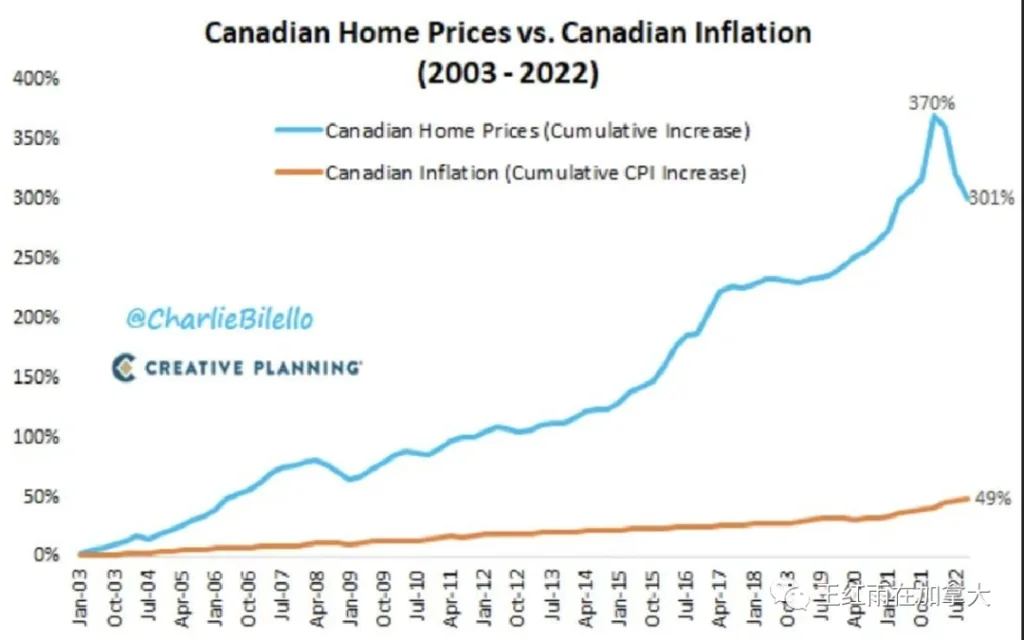
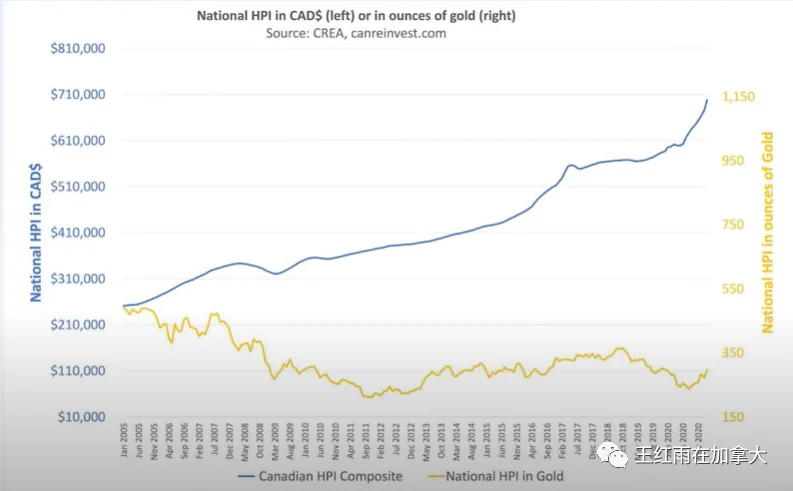
To sum up, the basic principles why house prices always adjust briefly, usually for 8 months, and then take off again, and the house price trend is in an upward channel for a long time:The population growth rate exceeds the speed of newly built houses, ensuring the long-term trend of housing prices; the funds for purchasing real estate are divided into two parts, the first part is the deposit of first-time homebuyers, and the second part is the funds withdrawn from the original property by house changers; the most important part of the funds to support the real estate price is the funds withdrawn by capable borrowers from their own properties. The cooperation between banks and homeowners in increasing mortgages creates new currency specifically used to buy houses, so real estate inflation is more serious than commodity inflation.In short, the driving force behind the rise in Canadian housing prices is the more severe depreciation of the currency used to purchase property. There is a chart that reflects this situation from the other side. That is, assuming that real estate can only be purchased with gold, then in Canada from 2005 to 2022, the price of real estate priced in gold fell, but if it was priced in Canadian dollars, it rose sharply. It can be seen from this that,The rise in Canadian housing prices is a typical phenomenon of currency depreciation, and the currency used to buy houses has depreciated very seriously.To answer the doubts raised above, why those institutions that shorted Canadian real estate have never succeeded. The reason is that those self-righteous institutions do not understand the causes of the rise in Canadian real estate prices. If they want to make a short profit, unless the Canadian dollar used to buy real estate appreciates, but this is impossible because Canadian homeowners are creating new currency used to buy houses day after day. In addition, Japan's lessons learned from the past tell all capitalist countries that deflation is the number one enemy of capitalism and has zero tolerance. Former Bank of Japan Governor Shirakawa confirmed in his autobiography that the past 30 years in Japan were the 30 years that the central bank fought desperately against deflation. Japan's QE policy has entered its 23rd year this year, and the shadow of deflation still lingers. Avoiding negative population growth and avoiding deflation are the most important guiding factors for long-term economic policies for all countries trying to cross the river by touching Japan.
03 Are there still opportunities for first home buyers?
The media is full of articles about "What is the minimum annual income needed to buy a house in major Canadian cities". The assumptions used in these articles to calculate the required income are all about the income required for first-time homebuyers to buy an average house price. This premise is actually not true. According to my observation,Most of the households buying average-priced properties in the Greater Toronto Area are downsizing households rather than first-time homebuyers.The current average house price in the Greater Toronto Area is 1.1 million, and most first-time homebuying families cannot meet the required income. Therefore, we have seen many people give up their efforts and instead go to the big trees at the entrance of the village to pray for house prices to be halved. In the past 10 months, many people have prayed online, and some politically correct intellectuals have followed suit and predicted that Canadian housing prices will fall back to pre-pandemic levels. According to the Pygmalion effect, if kowtow works, more people will kowtow at the entrance of the village to pray for rising housing prices. This is because Canada’s home ownership rate is 65%, and there are twice as many households owning houses as renting households. This will make it difficult for the gods to do. Should they let housing prices rise, or should they let housing prices rise?
In fact, first-time homebuyers don’t have to rely on God’s blessings; they can achieve halved house prices through their own efforts. The solution is to buy a property worth 550,000 yuan as your own home and get on board first, thereby cutting the house price in half by yourself. I asked my real estate agent friends whether I can buy a property that meets the bank's requirements for a price of 550,000 in the Greater Toronto Area, and everyone's answer was yes. Therefore, first-time homebuyers do not need to look far or move away from the Greater Toronto Area. They only need to find a property in the Greater Toronto Area that is "at half the price".
Above we analyzed the principle of rising house prices. For families with real estate, the value of their real estate is pushed by other homeowners. Currently, a property selling for 550,000 yuan in the Greater Toronto Area had a market price of only about 170,000 yuan 15 years ago. Suppose I bought this kind of entry-level home 15 years ago, and the current house price has risen to 550,000. The original loan was 136,000, and half of the principal was repaid in 15 years. The current loan balance is only 68,000. If you cash out the loan, you can use 372,000 as a down payment to buy a property, and keep the original home for rent; if the income does not support it, you can sell your home and cash out 482,000, which can be used for the down payment of the next property, which can also greatly improve living conditions. To buy a house worth RMB 1.1 million with a down payment of RMB 400,000, you only need a family income of RMB 140,000, not RMB 210,000 as the headline makers say. For first-time homebuyers, the down payment is their own savings, but the speed of saving money can never keep up with the speed of borrowing money. Therefore, becoming a homeowner as soon as possible is a top priority.
Everyone knows the principle of driving in the morning, but it is difficult to do it. The first-time homebuyer demographic has changed a lot in recent years due to down payment restrictions. Families with insufficient down payment but high income have an absolute advantage. The current first-time home loan policy is that the minimum down payment is 5%. If you want to buy a property worth 550,000 yuan as a home, the minimum down payment requirement is 30,000 yuan, but the household income requirement is as high as 120,000 yuan. This requirement is not high for new immigrants from India, but it is very high for new immigrants from China. We don’t need to look at statistics; we can use our naked eyes to discover which ethnic group of buyers is currently the most active in the real estate market. A few days ago, a real estate agent friend called me and asked me to give his client some advice on how to get into the car quickly. The buyer is a first-time home buyer and wants to buy his own home. The target price is 700,000, and the down payment is less than 20%. When the down payment is less than 20%, the borrowing capacity is only 4 times the annual income, so the annual income is at least 164,000, but the buyer does not have such a high family income. It’s obvious that the buyers have set high goals for the property they bought, which are difficult to achieve. I comforted this real estate agent friend by saying that your job is to adjust the customer's expectations and help the customer get on the car as soon as possible, which is a great merit.
For a property worth RMB 550,000, if a down payment of 20% is RMB 110,000, the household income is only RMB 88,000 to borrow the remaining RMB 440,000, which is much lower than the bank’s income requirements when the down payment is less than 20%. This borrowing capacity is not difficult for most first-time homebuying families. For real estate investors, it is easy to make a down payment of 110,000, and for properties within reach of first-time homebuyers, the return on investment is usually guaranteed. Don't look far when investing, you can find properties with great potential in the Greater Toronto Area.
Conclusion:
House prices are, ultimately, a monetary phenomenon. In the real estate market, currency depreciation is the fastest. Even if there is no commodity currency depreciation and no inflation, real estate inflation is particularly serious. The reason is that homeowners and banks can join forces to create new currency and significantly depreciate the currency used to buy houses. Turn the deposit into a down payment and put it into the property so that the deposit can maintain its value. The incomes of new immigrants who are buying their first homes are getting higher and higher, leaving old immigrants who have not yet bought a car like a thorn in their backs. Instead of thinking about cutting house prices in half, it is better to be proactive and buy a property that is "cut in half" to live in it first, allowing new immigrants and new capital to drive up house prices, and then wait for opportunities to change houses. The second-hand housing market is a free market with full competition. Housing prices are ultimately determined by the relationship between supply and demand. No one is bigger than the market. We hope to see more compatriots wake up from the wait-and-see situation as soon as possible and become beneficiaries of the continued rise in Canadian housing prices, rather than victims.