Toronto's real estate market in the first half of the year was, as predicted at the beginning of the year, lifeless, with sluggish transaction volume and no improvement in housing prices. From June 2024 to March 2025, the Bank of Canada cut interest rates by 2.25%, and the prime rate of commercial banks dropped from 7.2% to 4.95%. However, the transaction volume of the real estate market did not increase. In order to stimulate the continued sluggish real estate market, the government has launched programs to encourage first-time home buyers since the end of last year. In December 2024, the maximum repayment period for first-time homebuyers with a down payment ratio of less than 20% will be extended from 25 years to 30 years, and first-time homebuyers will turn a blind eye. The federal government launched a policy of exempting first-time homebuyers from GST on new homes on May 27, 2025, but first-time homebuyers are still indifferent. The current average price of condos in Toronto has dropped from a high of 800,000 in 2022 to 680,000 now, a drop of 15%. Buyers are still waiting and refusing to leave.
Compared with the past two years, interest rates have dropped significantly, and Toronto's housing price ratio has also declined in the first half of 2025 year-on-year, especially in CONDOs. Even though objective conditions have improved significantly, the indifference of potential property buyers shows a lack of market confidence, especially first-time homebuyers. There are many factors that lead buyers to wait and see. On the one hand, Toronto's working-class people are defined as the "invisible poor", so many people feel that they are victims of the housing problem and expect magical power to help solve the housing problem, resulting in subjective inactivity; on the other hand, the government proactively extends an olive branch, believing that providing affordable housing is the government's responsibility, and constantly refurbishing various ambitious plans to impress Canadians, reducing people's enthusiasm to solve the housing problem on their own; in addition, the tariff war has led to unclear employment prospects, and many people remain on the sidelines. The reduction in transaction volume has resulted in a large number of properties piling up on the market, making buyers suspicious that there is room for price declines.
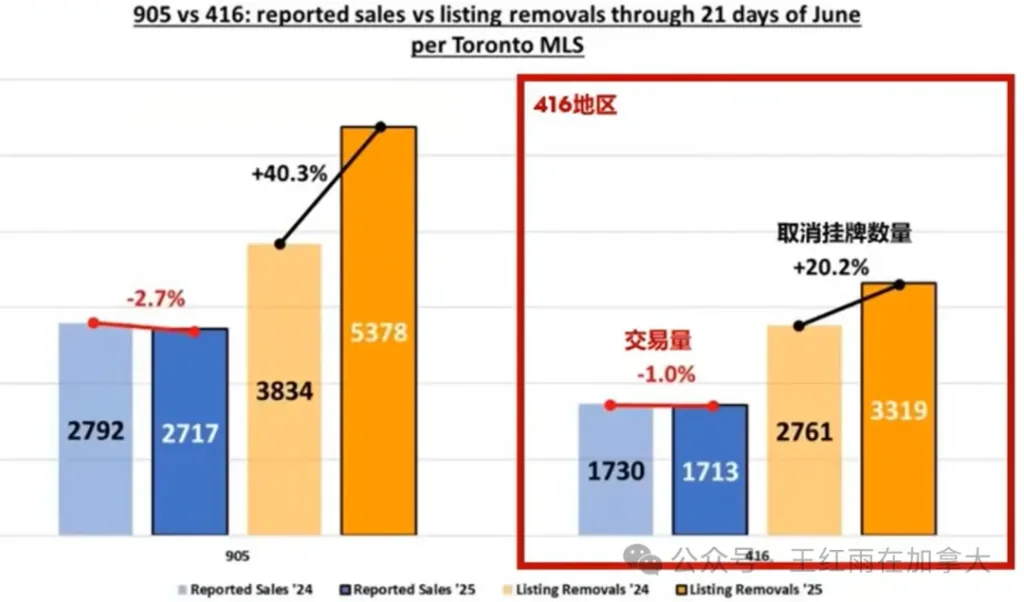
In the January 30th public account article "The Bank of Canada Cuts Interest Rates in Response to Trump's Tariff Threat: What is the Economic Outlook in 2025", I believed: "At present (January), the Ontario real estate market is still in a buyer's market. This situation can only be improved through the market process. This situation can be alleviated after properties that have been listed for a long time but cannot be sold gradually withdraw from the market." In the past June, the situation of sellers actively listing homes for sale and buyers not actively buying houses has finally changed. Recent data from Landlord.com shows that sellers are actively delisting and suspending properties. In June, the number of delisted and suspended properties in District 905 increased by 40%, and the number of delisted and suspended properties in District 416 increased by 20%. It shows that smart sellers are exiting the market. If this trend can continue, it will be very conducive to creating a balanced market, allowing buyers to start preparing to exit, rather than expecting house prices to fall further.Mature real estate investors should act earlier than first-time homebuyers to discover properties whose market price is lower than their replacement cost and seize the opportunity to buy a home.

01 Whose fault is it that Toronto’s “invisible poor” cannot afford housing?
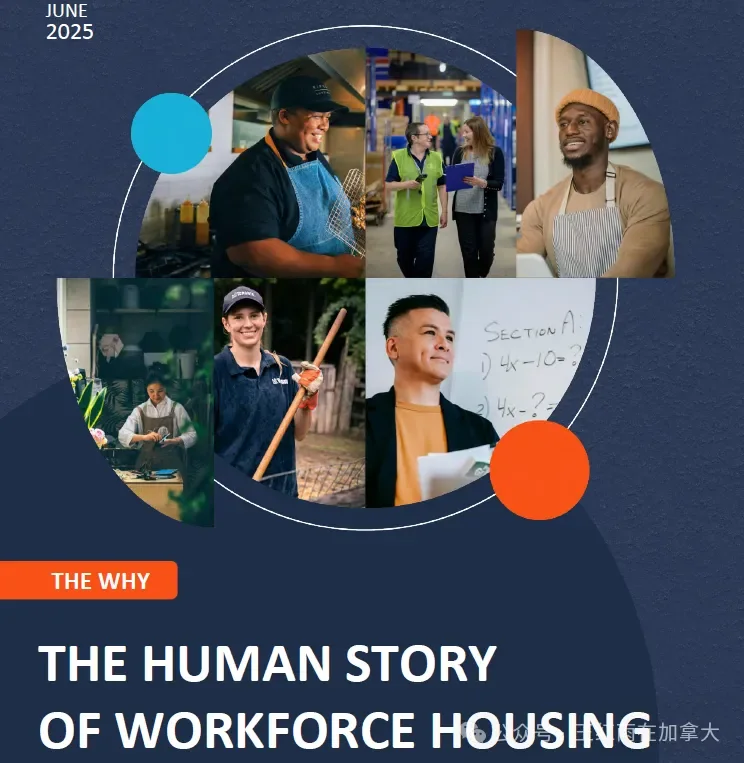
There was a report in June that was widely reproduced by mainstream Canadian media and sparked a round of discussion on the housing issue for working-class people. Titled “THE HUMAN STORY OF WORKFORCE HOUSING: THE WHY,” the report aims to raise public awareness of the middle-income workforce housing affordability crisis in Ontario’s Golden Horseshoe Area (GTHA) and mobilize leaders to promote policy reform. The report emphasizes that housing the middle-income workforce is not only an urgent social challenge, but also a long-term threat to the GTHA region’s continued economic prosperity. The "invisible poor" group, including middle-income workers such as nurses, teachers, technical workers, and first responders in GTHA areas, although they have stable jobs, are increasingly becoming "invisible poor" due to rising housing costs. Their income is too high, with a median household income of about 125,000, and they do not qualify for traditional affordable housing projects; but their income is not enough to obtain stable housing in the current market. Housing prices in the GTHA have soared over the past decade, but wage growth has remained relatively stagnant, leading to an unprecedented widening of the gap between incomes and housing costs. These middle-income workers face the difficult choice of either moving out of the region in search of affordable housing or remaining in unaffordable, inappropriate or crowded housing that impacts their personal health, productivity and the development of their children. The report lays out the impact on economies and businesses, on individuals and families, and even on communities and the climate. In short, it takes someone or some agency to solve the housing problem of the "invisible poor", not the people themselves.
On the basis of the above-mentioned reports, various media outlets continued to interpret and loudly declare: "The qualifying annual income to purchase a second-hand house in Toronto in 2024 will need to exceed CAD 200,000, which is much higher than the actual median household income." This became the news headline of many media. Canada is awash with the above-mentioned reports and news that only raise issues in order to attract the attention of “relevant departments” without any solutions. The appeals of these organizations have paralyzed families who could have bought a house to save themselves, and made these working-class people mistakenly believe that "if they keep thinking about it, there will be a response." In fact, there is no response at all. There has been no response before, and there will be no response in the future. Whenever something becomes a public case, Bao Qingtian will be the one to uphold justice. Mr. Bao will even build a house with his own hands to solve the housing crisis.
The starting property for first-time homebuyers in Toronto should be a CONDO. The current average price of a CONDO is 680,000. A minimum down payment of 43,000 is required and a household income of at least 128,000. If the down payment is 20%, the minimum income required is 110,000. With the current condo price, the above-mentioned "invisible poor" families can completely get into the condo. The dream of buying a house is not out of reach. It is just an opportunity within easy reach. Whether to buy a house or continue to rent is entirely your own decision and has nothing to do with the government. The monthly cash outlay after buying a house is higher than the rent.The decision to buy a house is actually a choice between two hardships: the hardship of buying a house now, or the hardship of not being able to rent a house in the future after retirement.
Toronto new home sales data in May shows that the average price per square foot of new CONDO homes being pre-sold is 1,324 Canadian dollars, and the corresponding living area of a new home priced at 680,000 yuan is 513 square feet. The second-hand CONDO currently on sale is priced at 680,000 units, and the living area is much larger than 513 square feet.All properties below replacement cost, regardless of current rents, have investment value.The reason is that the same house can never be rebuilt at the current second-hand house price in the future. A large number of families who rent have never had the experience of buying a house and do not know how to identify the value of the property. Real estate investors can make full use of first-time homebuyers' hesitation, hesitation, wait-and-see, and worry about gains and losses, and seize the precious opportunity when real estate prices are seriously undervalued.
The Royal Lepage 2025 Canadian Renters Report survey shows that among renting households, the main reasons for choosing to rent rather than buy a house this year are as follows: about 40% of respondents are waiting for housing prices to fall, and 29% choose to wait for interest rates to drop further; 28% believe they need to save more for a down payment; about 25% said they cannot qualify for a mortgage or financing. Judging from the survey results, the main reason why renting households do not buy a house is not an issue of affordability, but a matter of subjective decision-making. Real estate investors often have better judgment than renters and make early purchases. I personally believe property investors will return to the market earlier and faster than first home buyers in the second half of this year.

02 With a stroke of CMHC’s pen, housing affordability for everyone was improved overnight
Complaints about housing affordability have become as much a part of daily life as complaints about rising prices. If a family's housing expenses exceed 30% of their income, they are eligible to complain about housing problems. A man broke his leg and screamed in pain. There were two "treatment" methods, one was to heal the broken leg, and the other was to sew his mouth shut. When the Canadian government deals with the housing crisis, it usually uses the second method, which is to sew people's mouths shut. What constitutes unaffordable housing? The current standard is that housing expenses are greater than 30% of family income, which is considered unaffordable. Who stipulated this 30% is completely unverifiable now. If the indicator is changed from 30% to 60%, will the housing affordability of many people be improved overnight? The idea of improving housing affordability by modifying housing affordability indicators may seem absurd, but the Canadian government has done it!
The Canada Mortgage and Housing Corporation (CMHC) published a report in June, representing the Canadian government, which officially adjusted the housing affordability index for the Greater Toronto Area and Greater Vancouver Area to 59% and 71%. If you live in the Greater Toronto Area and your housing expenses account for less than 59% of your income, congratulations, your housing expenses are affordable; if you live in the Vancouver area, your housing expenses account for less than 71% of your income, congratulations, your housing expenses are affordable. Fellow veterans, you may be surprised or surprised, but your housing affordability has improved overnight, and you don’t even know it yet.
The CMHC report is titled “Canada’s housing supply shortages: moving to a new framework.” Within this new framework, we are all increasing housing affordability without even realizing it. Many people who have read this report feel that this report is unclear. That is because they did not understand the key table on page 9 of the report. Please search this report online, turn to page 9, and let me help you interpret it. Taking Toronto as an example, homeowners' housing expenses will account for 74% of their income in 2024. CMHC believes that this ratio is unaffordable. It also points out that if housing construction is accelerated, by 2035, this ratio may return to the level of 2019, that is, 59%. Page 9 lists the ratio of housing expenditures to income in each city in 2019. This ratio is the goal that the Canadian government wants to achieve in 2035. For example, Vancouver's housing affordability ratio will be 99% in 2024, and this figure was 71% in 2019. If housing construction is accelerated, Vancouver's housing affordability ratio will return to the level of 2019 in 2035, that is, 71%. With the stroke of a pen, CMHC changed Canada’s housing affordability to “The housing affordability level in 2019 is the affordability level."The affordability of each city is completely different. If you want to know the affordability of housing in your city, please refer to the level in 2019, or see page 9 of the CMHC report.
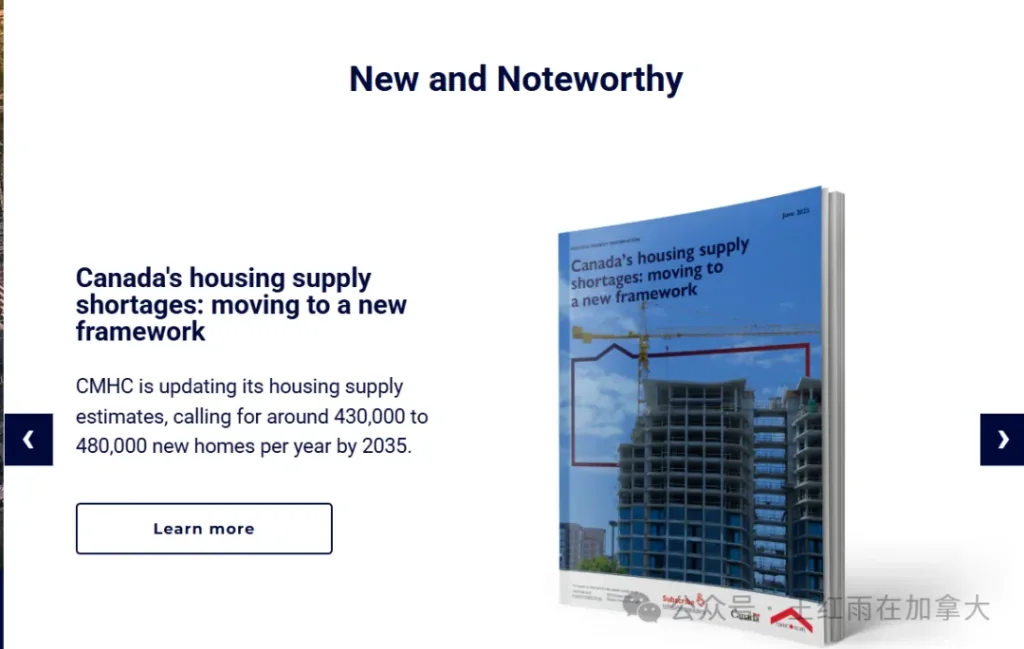
For Canadians, housing affordability is now worse than it was in 2019. To return to the affordability of 2019, CMHC believes that Canada needs to increase the speed of housing construction. It needs to build 430,000-480,000 new homes every year. Maintain this level every year. By 2035, we will be able to return to the affordability level of 2019. Since the founding of Canada, the number of newly built properties per year has never exceeded 260,000. According to National Bank's National Economic Outlook report in June this year, the number of new housing starts in Canada in 2024 is 245,100 units, and the number of new housing starts in 2025 is expected to be 244,100 units, and even less in 2026, 237,000 units. CMHC provides another set of data on page 14 of this report. Assuming that the housing construction speed does not increase to 430,000-480,000 new units per year, and still maintains the level of less than 260,000 new properties per year, by 2035, the predicted prices of housing prices in various cities. These figures will give real estate investors huge confidence. For example, the average house price in Toronto has increased from 1.19 million in the third quarter of 2024 to 1.94 million in the fourth quarter of 2035; in the Ottawa area, it has increased from 600,000 to 910,000; in Montreal, it has increased from 610,000 to 950,000; in Vancouver, it has increased from 1.5 million to 1.9 million... To know the housing prices in your city in 10 years, please see page 14 of this report.
Ever since I started doing mortgage business 15 years ago, CMHC’s loan guarantee policy has always been a high-profile mortgage policy guideline. In my impression, the main mission of CMHC is to provide loan guarantees to home buyers with a down payment of less than 20% and to help first-time homebuyers buy a home as soon as possible. Today, when we open the CMHC website, we can no longer find this mission. Instead, it read: "Promoting the health of Canada’s housing system: Canada Mortgage and Housing Corporation (CMHC) is committed to promoting the healthy development of the national housing system.We create stable mortgage funding channels for lenders by providing housing finance solutions; Provide a basis for optimizing decision-making in the housing field by releasing key research data; at the same time,We implement various housing programs on behalf of the Government of Canada, comprehensively protect the people’s dream of living in peace."CMHC's mission has quietly changed. In every year's CMHC annual report, we can find CMHC's explanation of its mission. Helping Canadians buy homes is its mission. The last time it appeared in CMHC's annual report was in 2019, and since then, it has never appeared again. In 2020, CMHC's mission is to provide Canadians with affordable housing before 2030. In 2021, CMHC's mission is to provide Canadians with affordable housing. Provide low-rent housing for Canadians. The mission in 2022 is to provide financing guarantees for the construction of multi-unit low-rent housing and rental apartments. The mission in 2024 is to provide stable mortgage financing to lenders and implement federal housing programs. The mission section of the 2025 website reads: Create a stable mortgage funding channel for lenders and implement various housing programs on behalf of the Canadian government.

fromJudging from the changes in the above-mentioned mission of CMHC, the Canadian government has given up on the goal of helping Canadians buy homes as soon as possible.Currently, CMHC, as the government's housing policy implementation agency, aims to help developers obtain government subsidies and provide construction loan guarantees for developers to build low-rent housing, social housing, and entire apartment buildings for rental. In other words, in more straightforward terms, the current mission of CMHC and the government on housing is: to improve the happiness of Canadians by revising the affordability index; to provide construction loan funds or guarantees for rental properties, and to replace the goal of "increasing the affordability of housing" with the goal of "increasing the ability to rent". Canada’s housing policy is to build a big rental country, learning from Germany and Singapore. The government provides low-rent housing so that the next generation of Canadians can realize “although they have nothing, they are happy.” "The goal of struggle.
It is recommended that families who are waiting for government help to realize their dream of buying a house should find CMHC’s company annual reports over the years, take a look at the mission section on the first page, grasp the policy pulse, and wake up from the dream of relying on government help to buy a house as soon as possible. The CMHC of today is no longer the CMHC of 6 years ago, and Canada is moving along the "Paranoid about renting"The policy direction is making great strides forward. In this process, each of us can gain a sense of happiness from the adjusted housing affordability index.
03 Will the “rental paranoia” housing policy help the “invisible poor”?
According to Canadian Central Television CBC, the Surrey City Council in British Columbia approved in June this year the conversion of three buildings originally planned for commercial housing apartment development into rental apartments to deal with the developer's ability to build housing under current market conditions. Councilor Linda noted that around 40,000 approved housing units in Surrey are yet to be built, indicating that developers are struggling to bring these projects to fruition. Real estate consultants have expressed concern that there may not be a large-scale supply of commercial housing apartments until early 2030 to 2035. Michael, a planner and real estate consultant, points out that the main difficulty in building apartments currently is the bank's "pre-sale" requirement, which means that developers must sell a certain percentage of units before the project can start construction in order to obtain financing. He believes that a simple solution is for the Prime Minister to instruct banks to relax pre-sale requirements and return to the past financing model of building first and selling later, which will greatly lower the threshold for developers and promote project progress. While Vancouver has been dominated by condominium construction over the past three decades, Geller believes the current pendulum has swung too far. He noted that there are currently about 20,000 new apartment proposals underway in the Broadway corridor, but less than 1,000 of those are commercial condominium units. This trend, in which the city government encourages developers to switch from commercial apartments to rental apartments, has led to a potential shortage of supply. Geller also mentioned that in the past, about 40% of new apartments were converted into rental units through the "secondary market" because only investors were willing to buy the apartments in the first four years of construction. However, public interest in new apartment investment has been "successfully killed" and pre-sales of new homes have basically stalled. He worries that the City of Vancouver has become "obsessed" with high-rise rental apartment development by reducing development fees, encouraging higher density, and even announced a new plan proposing to build 15 to 20 storeys of high-rise social housing anywhere in the city or in many neighborhoods.
The above-mentioned situation currently occurring in BC will soon spread to Ontario. Because the new home pre-sale model in BC and Ontario is the same. Unlike the strong capital markets in the United States, Canada's banking system is constrained by strict construction financing regulations and, therefore, relies primarily on pre-sale transcripts to obtain construction loans. Due to the long-term nature of property supply, pre-sales are extremely risky for the end user, the owner-occupier buyer. For example, market interest rates and home prices can change dramatically between signing and closing. Speculators and investors are the main group taking these risks, and they support the construction of new homes through "pre-purchasing". Without the influx of funds, developers will have difficulty completing the pre-sale targets required by banks. Usually, banks will only consider the possibility of construction loan financing after developers pre-sell 70% of their units. At present, the horrific handover situation of new homes has successfully scared off investors. Developers cannot get pre-sale transcripts at all, and therefore cannot get construction loans. As a result, the situation in Surrey emerged. Commercial housing projects were converted into rental apartment projects. They actively cooperated with the government's housing policy and vigorously developed low-rent housing and rental apartments. Otherwise, the livelihood of developers would be in doubt. The national housing policy of "renting paranoia" is spreading and taking effect.
CMHC is working on its latest mission to help developers obtain financing to build affordable housing or rental apartments. In this way, the traditional financing path required for the development of commercial housing can be bypassed. With the success of CMHC, a large number of low-rent rental apartments have been built in the Prairie and Petroleum provinces. After the construction loan was obtained, the developer discovered a new problem: after the property was completed, there was no buyer to help the developer withdraw from the construction loan, because the property could only be rented after it was built. If a developer relies on collecting rent to repay a construction loan, the developer becomes a landlord and will be locked into a low-rent property for decades, which is not the original intention of the developer to build the housing. If a construction loan guaranteed by CMHC cannot be repaid on time and the developer goes bankrupt, CMHC will be responsible for the guarantee, and the taxpayer will suffer the loss. Now, there are a lot of investment seminars popping up in Toronto that are actually selling real estate private equity funds that are collateralized by these types of rental properties. These funds are divided into 25,000 shares and promoted to "high-end" investors through lectures. The purpose of these real estate private equity funds being raised is to help developers exit construction loans.The risk of new homes is still there, but it has been transferred from the risk of off-the-plan properties to real estate private equity funds.In a recent offline lecture, I joked with the audience of real estate agents that in the future, your business of selling off-the-plan properties will be taken away by those who sell real estate private equity funds.
The "rental paranoia" policy is destroying the new home pre-sale market while nurturing the real estate private equity fund market. There has yet to be a boom in the construction of low-rent housing or rental apartments in metropolitan areas. The main reason is that according to the low-rent standards stipulated by the government, the rent is too low. Once completed, it is difficult for developers to find a successor to withdraw from the construction loan. Developers may also be forced to make a living and take the risk of developing such low-rent housing or rental apartments in metropolitan areas. It is estimated that developers will adopt shrinkflation in terms of living area. When inflation is high, people will find that although the price of some goods has not increased, the quantity has decreased. For example, the original price of a barrel of oil was 15 yuan for 10 liters. When the price remained unchanged, the merchant reduced the price of 10 liters of oil to 9 liters. This is deflationary inflation. If a developer wants to reduce the rent of a one-bedroom unit from 2,300 to the government-required 1,600, there is no other good way except to reduce the living area.
Obviously, the "invisible poor" living in metropolitan areas will not benefit from the "rental paranoia" policy. Many people stubbornly believe that house prices and rents will return to the level that families with average incomes can afford. Now they have finally got their wish. CMHC has manually increased the affordability index. If you live in Toronto, if the ratio of living costs to income is less than 59%, it is considered affordable. In other words, it’s an official announcement: Stop hoping that house prices and rents will fall. The result of this official announcement is consistent with the answer given by the market. Those who are stubborn will remain indifferent, continue to wait and see, and continue to wait. Social housing and low-rent housing have strict income requirements, and middle-income families are not eligible to apply for low-rent housing. If developers build low-rent rental housing in metropolitan areas, there will be "shrinking inflation" in living area, which may not be suitable for living. Therefore, the "rental paranoid" housing policy will not help the "invisible poor" in metropolitan areas.


Conclusion
Currently, the Toronto real estate market still has sluggish sales, high inventory, and a disconnect between new and second-hand housing market prices. From a national perspective, there is a huge tension between government policies and market reality, with the market and government working in completely opposite directions. Consumers, investors, builders and real estate professionals all need to adapt to this “new reality.” The real estate market in July 2025 is not a healthy market. Readers who are able to refrain from selling their homes for the time being are advised to remove their listings in order to restore balance to the market. I wish families who have been renting for a long time to return to reality as soon as possible from the hope that house prices and rents will return, seize this opportunity when the prices of a large number of second-hand houses are lower than the replacement cost, and realize their dream of buying a house. Especially the "invisible poor" who have made great contributions to metropolitan areas should not miss the current opportunity to buy a house.
There are many unbearable things in life. Long-term renting may bring less cash flow pressure when you are young, but rising rents after retirement will become a shackles and shackles for your old life. In the field of real estate, although the market has had ups and downs, it has always been about killing the rich and saving the poor, year after year, generation after generation, and so on. No one can escape personal choice and personal responsibility. High housing prices are no excuse, and the fact that the government has not suppressed housing prices and rents is no excuse. Responsibilities and burdens that are avoided now will be doubled back in the future. Everyone in the world is suffering. Either you have to suffer the hardship of buying a house when you are young, or you have to suffer the hardship of renting a house in old age. This is a multiple-choice question, and the answer lies in everyone's actions.