On September 17, the Bank of Canada announced a 0.25% interest rate cut, lowering the overnight rate from 2.75% to 2.5%. The prime rate at commercial banks correspondingly dropped from 4.95% to 4.7%. Borrowers who have chosen variable-rate mortgages see their rates fall automatically, and the actual rate for most variable-rate borrowers is currently about 4%. Borrowers with rates above 4% need to check their loan maturity dates, pay attention to the early renewal period of their lending bank, and renew as soon as possible.
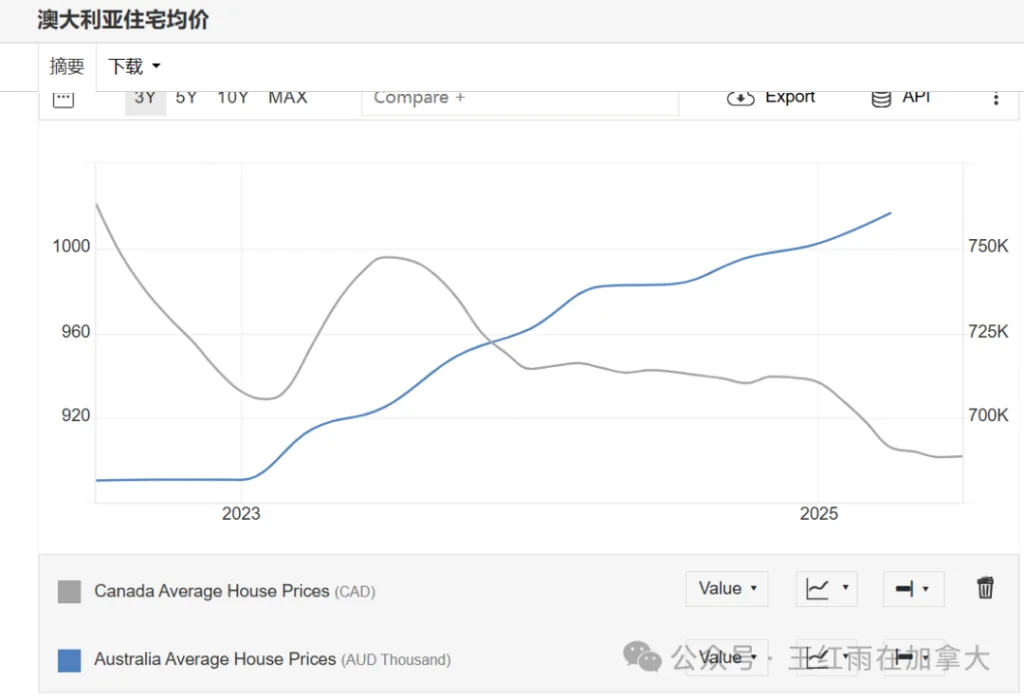
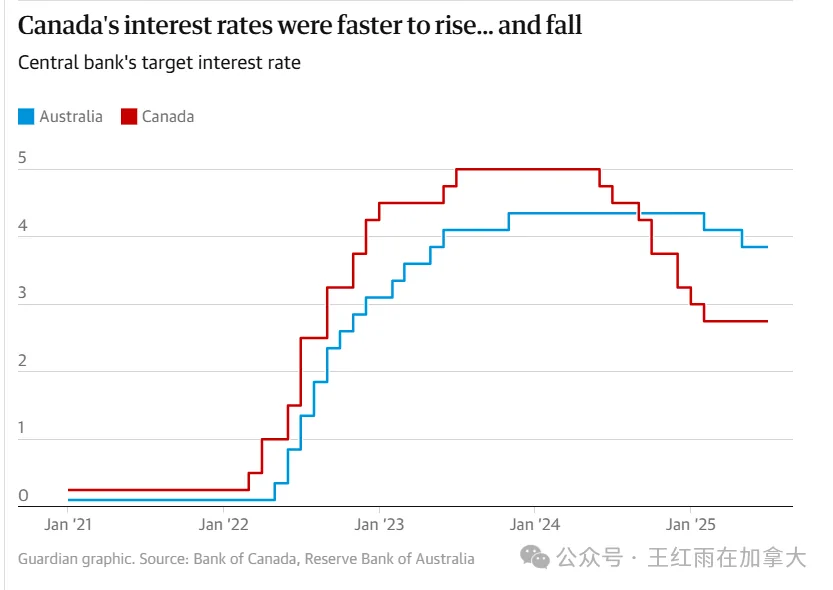
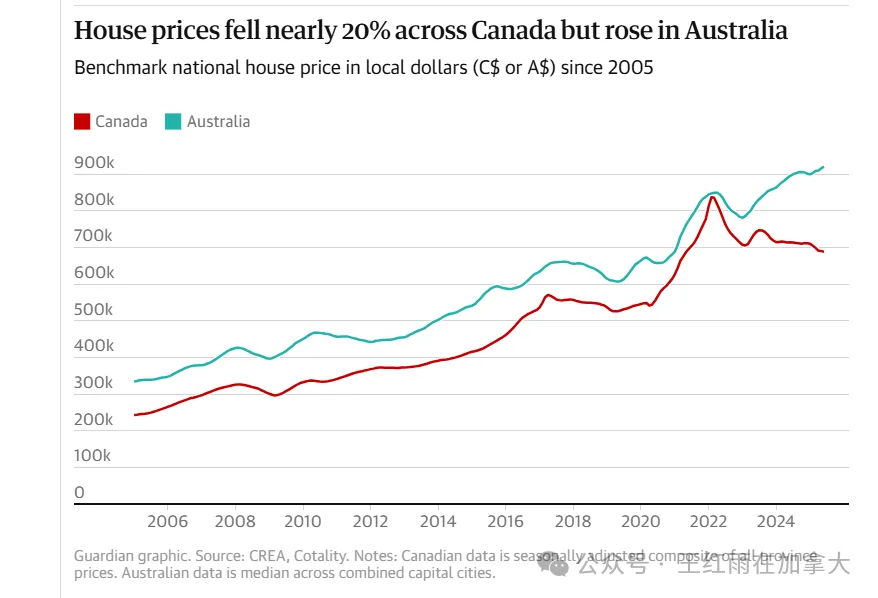
The impact of interest rates on Canada's real estate market is actually not very significant. Currently, the Bank of Canada rate is 2.5%, while the Reserve Bank of Australia rate is 3.6%. Canadian mortgage rates are around 4%, and Australian mortgage rates are around 5.5%. Based on interest rates, Canada's real estate market should be more active, but the reality is quite the opposite. The average house price in Canada has been falling for three consecutive years, while house prices in Australia have been rising for two consecutive years.
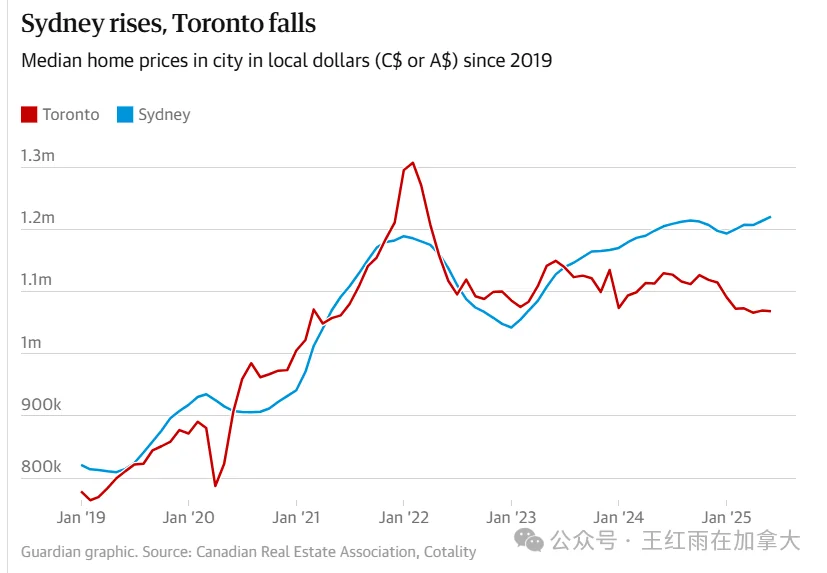
Sydney and Toronto are two of the hottest real estate markets in the English-speaking world, but the recent situation is like night and day. Since the Reserve Bank of Australia cut rates in February this year, it has reduced rates three times, with a cumulative reduction of 0.75%, and Sydney house prices have risen for seven consecutive months, with no signs of slowing down. The Bank of Canada has cut rates eight times, with a cumulative reduction of 2.5%, yet Toronto house prices are still falling. Besides the psychological shadow caused by the US-Canada tariff issues,the difference between the Sydney and Toronto real estate markets lies in government housing policies, not in interest rates.
01Housing policy incentives in the Sydney real estate market
Recently, new policies in the Australian real estate market have been frequently announced. The most notable is that the property price cap for purchasing with a 5% down payment will be raised to 1.5 million AUD, and mortgage insurance fees will be waived. That is, with a minimum down payment of 75,000 AUD, one can buy a property worth 1.5 million AUD. In comparison, in Canada, with a 5% down payment, the maximum property price is 500,000 CAD, requiring a mortgage insurance fee of 20,000 CAD plus GST on this fee; for a 1.5 million CAD property, the minimum down payment is 125,000 CAD, and a mortgage insurance fee of about 60,000 CAD plus GST on this fee is required.
One of the new policies in Australia is to relax the consideration of student loan debt, which makes it easier for young people to buy houses, without having to wait until the student loans are paid off. Canada does not have a corresponding 'benefit'; student loans, like car loans, are treated according to B20 requirements, where roughly for every 100 yuan of student loan monthly payment, the mortgage borrowing amount is reduced by 25,000 yuan.
With the combination of these two policies, it is foreseeable that low-priced housing in Sydney will face more competition, especially properties in the 1.2 to 1.5 million AUD price range. This is already the most sought-after segment in the Sydney market, and now with a new group of buyers supported by policies, the competition will only become more intense.
Faced with the surging demand for home purchases, Australia and Sydney have also introduced corresponding incentive policies for housing supply. At the end of February this year, the Sydney City Council implemented a medium- and low-density housing policy: within 800 meters of 171 transport hubs, more medium- and low-density residences are allowed to be built, such as small apartments, townhouses, and duplexes. Land that was originally only allowed to have a single detached house can now be demolished and rebuilt into five or six townhouses or even four- or five-story apartments. Another policy introduced by the state government where Sydney is located is the Housing Panel Book, which lists eight common house types, such as townhouses and two-story houses, in the manual. As long as developers build according to the models, they can pass through the fast-track approval process within 10 days. In the past, approvals often took half a year or even a year, and the capital occupation and interest costs accumulated to hundreds of thousands of Australian dollars. Now, with the approval period greatly shortened, it effectively saves developers both cost and time.
For new homes, Australia's incentive policies are very different from Canada's. The state government where Sydney is located announced that it will provide pre-sale guarantees of up to 50% for development projects, with a total scale of 1.1 billion Australian dollars. In the past, developers had to prove that they had sold more than half of the apartments before launching a project; otherwise, banks would not provide loans, which led to many projects being put on hold. Now the government underwrites directly, effectively giving developers a boost, allowing projects that were previously stalled to start more quickly. In Canada, no provinces currently have similar government support; developers need to pre-sell 70% of the units to obtain construction loans.
Australia's current housing policy is characterized by encouraging more people to achieve home ownership by stimulating demand despite continued rises in second-hand housing prices, allowing more people to have stable property and peace of mind, and making homeowners feel the wealth effect, thereby driving consumer demand; at the same time, by incentivizing commercial housing construction, it boosts employment and income. In contrast, Canada's housing policy, concerned about rising second-hand housing prices on the demand side, has not provided effective demand stimulus policies, and on the supply side, tends to favor government-led construction of low-rent housing. Clearly, the stimulative effect of housing policy far outweighs the stimulative effect of interest rates, creating the starkly contrasting real estate markets of Sydney and Toronto.
02Canada cuts interest rates: Can it cause widespread growth?
Compared with Sydney's flourishing real estate market, Toronto's real estate market remains depressed at present. Relying solely on interest rate cuts is insufficient to motivate first-time homebuyers and real estate investors. Currently, mortgage rates are 4% in Canada and as high as 5.5% in Australia. From the perspective of investment return and cost comparison, Toronto's real estate should be more attractive, but obviously, potential buyers lack confidence in Toronto properties, not because the interest rates are not low enough.
There are six factors hindering the revival of Toronto's real estate market: 1. Compared with the high interest rates from June 2023 to June 2024, buyers’ affordability has significantly improved, and they want to see more favorable conditions, so they are not in a hurry to exercise their options; 2. Some sellers are eager to list their properties, creating competition among sellers, which leads buyers to adopt a 'wait for the fish to die' observation approach; 3. The US-Canada tariff war hit Ontario hard, and the unemployment rate around Greater Toronto is significantly higher than the national average, making potential buyers worry about job loss; 4. Although there is a temporary oversupply and insufficient demand for condos, the government still restricts purchases by non-residents and lets the market repair itself; 5. Real estate investors are still recovering from the aftermath of high interest rates and have not yet fully healed; 6. The high-priced pre-sale condos continue to be cash-consuming beasts, absorbing a large portion of the cash in the market.
We hope to see the market immediately restart as soon as interest rates fall, but unfortunately, most of the six factors hindering the market's restart are unrelated to interest rates. Therefore, although there have been eight interest rate cuts, we still have not seen a situation where a whale falls and all life thrives.
03A rise relieves a thousand worries, a fall brings a hundred concerns.
Some people may worry that Australia's policy promotion will launch housing prices like a rocket, causing residents to take on too much debt, making it difficult for young people to afford housing costs, widening intergenerational wealth gaps, forming a society where real estate marks social classes, hollowing out the real economy, over-financializing the real estate industry, and high living costs suppressing innovation and entrepreneurial spirit, blah blah blah. I asked AI to write an analysis article on the real estate market, and AI wrote that long paragraph above. Doesn't it look very familiar to everyone?
Australia's housing policy has a clear idea: after a round of inflation, construction costs have risen significantly. If the price of new homes pre-sold by developers is higher than that of second-hand homes, developers cannot sell the new homes, so construction cannot start, construction companies will go bankrupt, and employees will become unemployed. The way to solve this vicious cycle is to drive up the price of second-hand homes, thereby breaking the ceiling for new home pre-sales.The price of second-hand houses, once it rises, solves a thousand worries.
In contrast, Canada, aside from cutting interest rates, lacks active policies to promote the prices of second-hand homes. The low down payment mortgage ceiling is too low, which is not suitable for Toronto and Vancouver. The B20 one-size-fits-all mortgage policy is not favorable for young people with student loans to buy homes. The federal government's housing policy not only falls into 'rental obsession' but also competes with private developers for construction resources. Most importantly, the oversupply caused by the concentration of high-priced presale condos in Toronto creates enormous pressure on transaction volumes and housing prices across the entire market. With the market price of second-hand condos at $900 per square foot, the cost for developers to build is already as high as $1,300 per square foot, so developers cannot pre-sell a single new home.The current market situation in Toronto is that one drop causes a hundred worries.Second-hand housing transactions are sluggish, leading to pressure on housing prices; the wealth effect disappears, resulting in weak consumption; even when property market prices are below replacement cost, buyers still hesitate, causing inventory to continuously rise. When buyers of high-priced pre-sale homes apply for mortgages at market prices, they need to supplement substantial down payments, draining cash from the market; new home pre-sale volumes by developers have dropped by 90%, which not only lays the groundwork for a housing supply shortage in four years but also causes a downturn in the construction industry.
The Australian and Canadian governments' interventions in the economy both fall under Keynesian demand stimulus policies. However, the stimulus methods of the two governments are very different. Australia's policy leverages government measures to stimulate the market, for example, providing guarantees to help developers obtain construction loans for building commercial housing even when pre-sale volumes are very low. Canada's policy, on the other hand, involves the government funding the construction of rental apartments and low-rent housing. Clearly, the Australian government’s measures are more conducive to the recovery and development of the market, whereas Canada’s policies have hindered market recovery.
Conclusion
On July 10, someone left a comment online saying that the real estate boom period is gone forever, and the same is true worldwide. This is an assertion that has not been fact-checked. Housing prices in Australia have been rising continuously for seven months this year. The government has the ability to support the market, but the Canadian government has chosen a different path: letting the market recover on its own, while taking an alternative approach by using taxpayers' money to build affordable rental housing. The delivery of high-priced pre-construction units in Toronto is a market failure that requires government assistance to quickly get out of the predicament, whereas relying solely on market forces would take a longer time to recover.The market is a kind of process.The more eager sellers are to sell, the more inventory accumulates in the market, leading to synthetic errors. Sellers will only exit the market after being disciplined by the market, and this process is slow and painful. A rate cut alone is not enough. Without government assistance, sellers need to see the situation clearly. If they insist on selling their homes in 2025, they will have to sell at a discount. Therefore,it is recommended that everyone2025do not sell their homes this year.
The Bank of Canada cut interest rates by 0.25% again without seeing clear data that inflation continues to fall. This is an optimistic estimate that prices in Canada will further decline after the repeal of retaliatory tariffs. The federal budget, which was supposed to be announced in April, was postponed to November 4. If the budget deficit significantly exceeds expectations, inflation will once again return to our list of concerns. Whether the 0.25% rate cut on September 17 was right or wrong, let history judge. In any case, camels with heavy debts now have one less straw after the rate cut, which is a cause for celebration.
Hoping that the Canadian government can make wise, market-friendly decisions is even harder than sellers being disciplined and voluntarily leaving the market. The restoration of balance and vitality in the Toronto real estate market is a matter of time, but it requires the completion of the market's disciplining process for sellers. A rate cut alone is still unlikely to trigger market awakening. Currently, the indicator of market rise and fall is the fluctuation of inventory levels. Only when the number of new listings decreases and the number of cancelled listings increases can the market restore balance. Hopefully, the rate cut can relieve the financial pressure on existing homeowners and encourage more sellers with properties on the market to reconsider, cancel listings, and help the market return to balance sooner.
September 18, 2025, Henry Wang, Toronto