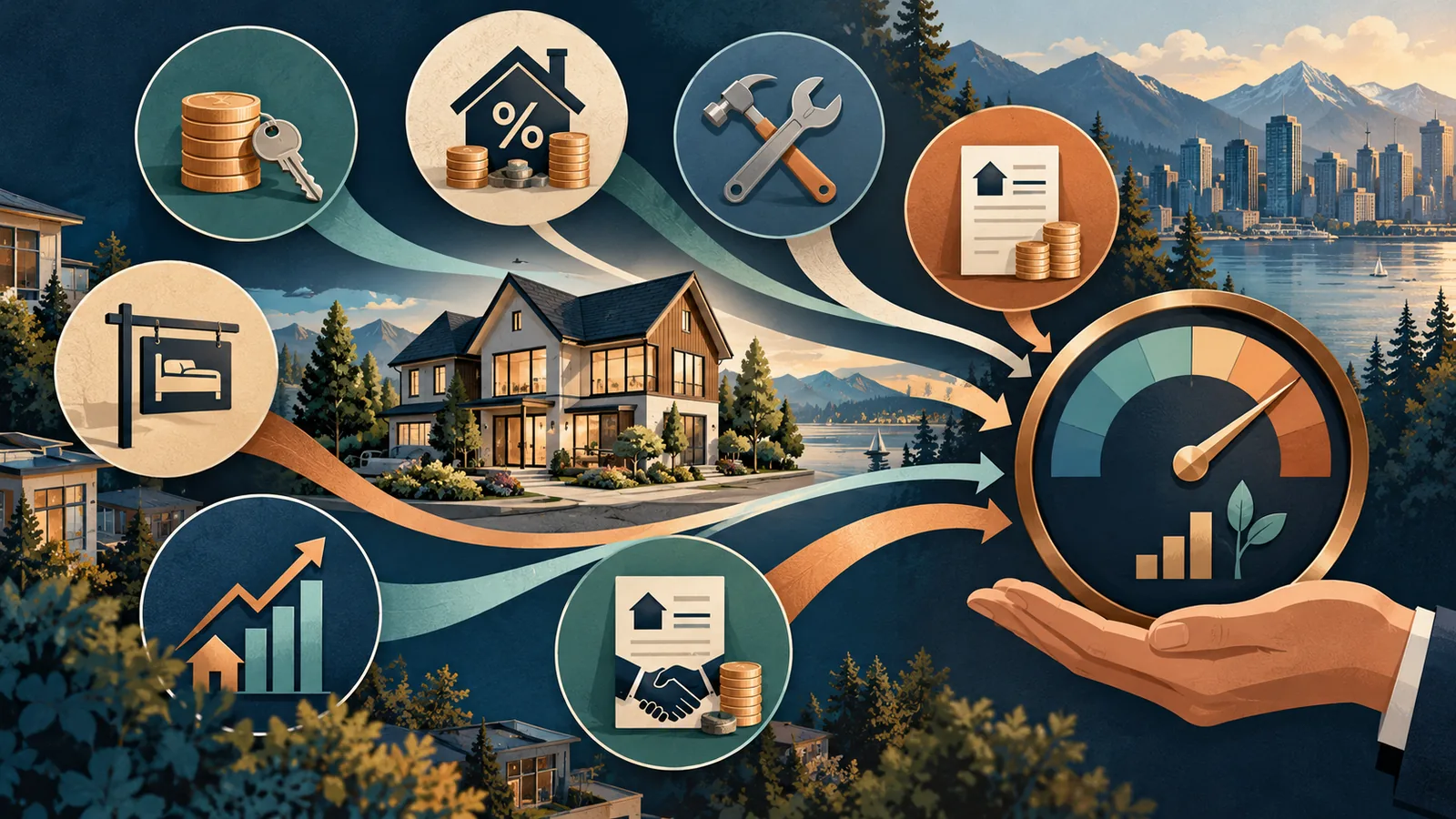
Historical article note: This article was originally published on 2019-05-16. Rates, policies, home prices, statistics, product names and qualification standards reflect the environment at that time and may have changed. This archive is for historical record and general education only. It is not mortgage approval, investment, legal or tax advice.
The real estate market, like the stock market, has a lot of data and indicators, but relying on data and K-lines alone will lead to poor results in both stock and real estate investments. People around me who are relatively successful in real estate investment neither look at data nor at indicators; those who keep staring at the numbers, calculating endlessly, rarely achieve significant investment returns. Stock investors are often addicted to listening to daily market news, and some even cannot live without Bloomberg information; meanwhile, Warren Buffett, who does not follow stock price movements, is a peerless stock guru worldwide. Those who check real estate data most frequently are usually people who do not own any property—they don’t know what they really need to pay attention to, and except for constantly hoping for lower housing prices, they just search for various data. To cater to this demand, some real estate agents enthusiastically provide such data—such as last month's second-hand housing transaction volume and average price, price comparisons with the same period last year, changes in average listing times for various properties, and so on. In fact, real estate transaction data is of little use; like stock K-lines, it reflects historical transactions, and last month’s data cannot predict what will happen this month or tomorrow. The ones who are constantly obsessed with real estate data are people with no property; those who occasionally check real estate data are people planning to buy or sell soon; nearly those who hardly ever look at real estate data are mature real estate investors. Quoting a line from the chapter 'Taboos in the Real Estate Investment Industry' in the book *How the Middle Class Protects Its Wealth*: 'The more precise the calculations, the more money you lose.' As Feng Lun says in *Fierce Years*: people who worry obsessively about the winter of the real estate market end up dying in the winter. Real estate data is rarely useful. I will share the data I frequently look at. When it comes to real estate investment returns, you don’t need to always be overly meticulous—a rough figure is sufficient. I will also introduce a few broad indicators that I often reference. Remember, if data and formulas were truly that important, the world's richest person should be a mathematician—but this is not the case. Humans can calculate the trajectories of rockets and successfully send satellites to designated locations, but no one can calculate the closing price of the Dow Jones Industrial Average next week. Why is that? According to Austrian economics, in economic activities, only human actions determine economic decisions. Every person, every minute and second, is making decisions. So, one might ask, how can a mathematician calculate the outcome of everyone’s behavior in the stock market? Newton once lost his shirt in the South Sea Bubble. Afterwards, he said: 'I can calculate the motions of heavenly bodies, but not the madness of people.'
Investing, the fun lies in the unpredictability of human nature; if it could be calculated, then all students good at math would have gotten rich, and people like us ordinary folks would be poor for a lifetime, wouldn't we?
01 Data That Canadian Real Estate Investors Need to Pay Attention To
I don’t care at all about real estate transaction data because in more than 200 years of economic research, no one has ever discovered what determines demand, so it’s impossible to predict demand. Last month’s real estate transaction numbers reflect the demand that has already been realized; they don’t represent the same level of demand this month. In other words, there is certainly demand and supply in the market, but the exact amount of demand is unknown. The reason is what I mentioned above: only human actions can make economic decisions. No one can predict when each person or household will decide to buy a house, how much money they will spend, or where they will buy. Therefore, transaction data is completely useless. For example, in Hong Kong in 2013, a new property development was launched and oversubscribed by 50 times—100 units received applications from 500 people. Suddenly, the government announced a tax on non-resident buyers. What was the result? In the end, only 50 units were sold, as fear scared away 450 applicants. Demand is built on human nature, turning instantly between greed and fear. Therefore, trying to predict demand by looking at K-line charts is completely unreliable.
Canada conducts a census every four years, with the most recent census being in 2016, and the data and analysis were gradually released before the end of 2018. In real estate, long-term trends depend on population, mid-term on land, and short-term on finance. Changes in population data are related to the development of the Canadian real estate market. In the 2016 census, Canada had a population of 35.2 million and 14.1 million households, meaning 2.5 people per household. There are 9.5 million households nationwide that own their own homes, accounting for 67.8% of total households, with Toronto's homeownership rate at 66.5%. In the Greater Toronto Area, 3.4% of properties are owned by non-residents. From 2011 to 2016, Canada's population grew by 5%, with Toronto experiencing the fastest growth among major cities at 6.2%. Since the population of Toronto surpassed Montreal in 1976, it has remained the largest city in Canada, and its population growth rate is accelerating. Based on the above data, Toronto is the top choice for real estate investment in Canada.
In the medium term, looking at land, if the land supply lacks elasticity, it indicates that housing prices will continue to rise. As for supply, one aspect is the number of new homes being put into use, and the other is the vacancy rate in the rental market. Every year, I compare the transaction data of new and second-hand homes. The transaction volume of second-hand homes only reflects the change of ownership of existing houses. The sales volume of new homes reflects the actual housing supply. If the supply is less than the population growth, housing will be in short supply, pushing up property prices. Additionally, new homes are pre-sale properties, i.e., futures; second-hand homes are completed properties, with transaction prices reflecting the current price. If the futures price is much higher than the current price, it indicates that future housing prices are likely to rise. From the data, in most regions, the increase in new homes has not kept up with population growth. The supply of housing can also be reflected by the vacancy rate in the rental market: in most areas, the vacancy rate has fallen from the normal 4% to 1-2%, and this has been the case for the past five years, with no room to decline further. The low vacancy rate has led to faster rent growth; in 2018, the annual rent increase in some areas reached 10%.
In the short term, look at interest rates. My personal view on interest rates is: the central bank has relatively strong and easy control over adjusting short-term overnight rates, but controlling long-term bond yields is very difficult, especially after implementing QE. Once QE is used, raising interest rates becomes particularly hard. For example, Japan first used QE in 2001 and has tried to raise rates for 18 years, but every attempt has failed. The United States used QE in 2009 to lower long-term interest rates, and now faces enormous resistance to raising rates. If interest rates remain low in the next 3-5 years, borrowing will be the way to accumulate wealth.
02 Misunderstood Liquidity and Cash Flow
Real estate investment is often criticized for two issues: 1) poor liquidity; 2) no cash flow. Let's first talk about the liquidity problem. If you consistently keep 50,000 yuan in your checking account and also hold 3 million yuan in real estate, do you think liquidity is poor? Do you have to hold 3 million in stocks or bonds for liquidity to be considered sufficient? Liquidity just needs to be adequate. The cash flow issue is even more interesting. I don’t know where the theory comes from that investing in real estate must have positive cash flow. Do you consider cash flow when investing in stocks? A good growth stock that pays little dividend but increases in value quickly is also worth investing in. "Housing prices are too high now, buying an investment property in downtown Toronto won’t give you cash flow, so buy in the suburbs." This is a TOTALLY wrong idea. Negative cash flow = installment payment of the down payment. For the same property, if the down payment is 20%, negative cash flow means you need to pay an extra 300 yuan per month; if the down payment is 30%, monthly income and expenses balance. Obviously, the extra 300 yuan per month comes from the additional down payment caused by the difference between 30% and 20%. If there is negative cash flow and the bank still approves your loan, it indicates that you have already greatly utilized the bank's leverage. "Real estate in City XX is very suitable for investment because it has positive cash flow." This is pure misinformation. The essence of real estate investment is: using leverage to hold property, continuously refinance, extract capital from every brick to buy more properties, then refine and buy again. It has nothing to do with whether the rent provides positive cash flow. The purpose of investment is to acquire wealth; no one accumulates wealth solely through rent or positive cash flow. As long as rental income plus the down payment you can afford allows you to hold the property, that is sufficient. Overemphasizing positive cash flow is a major strategic mistake. Samuel Butler has a famous saying: "The hen is merely a machine for turning an egg into another egg." We want eggs; if you bring back a rooster, can it lay eggs? Positive cash flow is not only unnecessary, but it is also a burden for many families: the income tax rate might increase due to real estate investment income.
For residential properties, when assessing the market value of a property, reference is made to the prices of recently sold properties in the surrounding area. For investors in residential properties, raising rents does not increase the market value of the house; protecting the community environment is the correct way to increase property prices.
For commercial properties, when evaluating the market price of a property, reference is made to the property's rental level and vacancy rate. By increasing rent and reducing vacancy, the property price can be increased. 'Cash-on-cash return' = annual cash income ÷ down payment. It is often used to calculate the return on investment in commercial real estate. For example, with an annual rental cash income of 100,000 and a down payment of 1,000,000, the cash-on-cash return is 10%. In commercial real estate investment, this indicator typically ranges from 10% to 20%, and the higher it is, the better. In Canada, because the corporate income tax rate is lower than the personal tax rate, it is reasonable for commercial real estate investments to pursue cash-on-cash returns.
03 Real Estate Investment Returns Available for Reference
One of the indicators I use most frequently to calculate investment return is the 'gross rent multiplier,' which is the ratio of the property price to the gross rent. The smaller the gross rent multiplier, the better. For example, Property A has a price of 500,000 and a monthly rent of 2,500, giving it a gross rent multiplier of 200; Property B has a price of 700,000 and a monthly rent of 2,500, giving it a gross rent multiplier of 280. The investment return of Property A is higher than that of Property B. In Toronto, the gross rent multiplier for condos is between 200 and 300. For detached houses, it ranges between 400 and 700. Many people also use this indicator as a measure of the size of a bubble—the larger the multiplier, the bigger the bubble. If you only look at this indicator, you will find that properties in remote areas are very suitable for investment, but remote areas have high vacancy rates and slow price appreciation. Therefore, this indicator can only be used to compare similar communities and the same type of properties, not two different properties.
"Capitalization rate," without considering loan factors, purely looks at the profitability of the property, that is, the ratio of operating income to the property sale price. It assumes the property is purchased fully in cash and measures the return on the invested funds. For residential properties, a low capitalization rate indicates a high sale price; the property is located in areas with rising housing prices, favored by the middle class and high-income groups, meaning lower investment risk. A high capitalization rate indicates a low sale price; the property is located in areas with declining housing prices, populated by low-income and impoverished groups, meaning higher investment risk. The capitalization rate can be modified, including loan factors, to determine the timing of selling the property. We all know that when interest rates rise to a certain level, holding investment properties can result in a loss, and this critical point is calculated using the modified capitalization rate. For example, if the annual rent is 120,000, expenses are 70,000, the net operating income is 50,000; if the property market value is 715,000, the capitalization rate is 7%. When the interest rate exceeds 7%, a "negative leverage effect" occurs, where the interest rate is higher than the capitalization rate, which is a strong signal to sell the property.
"Return on Investment (ROI)" refers to the ratio of income minus cost divided by cost. It is a tangible way to quantify investment performance and is used to compare real estate investments with other types of investments. For example, in investing in a condo, if it has a negative cash flow, the cost is the down payment plus any additional monthly payments, and the income is the net revenue after deducting various expenses from the gross rent. Here are two examples: Property A has an annual rental income of 12,640, insurance expenses of 137, interest payments of 4,542, building management fees of 2,101, maintenance costs of 900, property tax of 1,937, leading to a net income of 1,994, with a down payment of 40,000, resulting in an annual rental ROI of 4.98%. Property B has an annual rental income of 18,000, insurance expenses of 130, interest of 6,333, management fees of 3,096, property tax of 1,644, net rental income of 11,203, with a down payment of 71,000, resulting in an annual rental ROI of 16%. Real estate investors can refer to the T776 form "Statement of Real Estate Rentals" filed annually for taxes to calculate the rental ROI on their properties. Calculating after-tax ROI is difficult because everyone’s marginal tax rate is different. The overall ROI can only be determined upon selling the property after paying capital gains tax. For the same property, the ROI can differ for different investors due to varying loan-to-property price ratios; therefore, ROI cannot be compared with others, only with one’s own other investment options.
04 Real Estate Investment Returns and Taxes
From the initial investment to the sale of the property, the overall investment return depends on the total rental income and capital gains, as well as the corresponding tax rates. Net rental income must be taxed annually along with other personal income. High net rental income may lead to an increase in the family's overall marginal tax rate, meaning that excessively high net rental income can actually increase the family's total tax burden for the year. The capital gains tax rate is half of the income tax rate on salary or net rental income and only needs to be paid in the year the property is sold. High-income households do not need to pursue higher rental income and should aim to delay the payment of capital gains tax as long as possible. Faced with Canada's high tax rates, the most effective tools that taxpayers can use are the three Ds: Defer, Divide, and Deduct, with deferring tax payments being the best strategy of the best strategies. Therefore, holding real estate long-term and not selling if possible can maximize the ultimate return on real estate investment. At the same time, investors should continue to refinance investment properties to reduce net rental income, thereby lowering the current tax amount, with the additional funds used for the next investment. When the family’s overall income decreases in the future and cash flow is needed, the mortgage on the investment property can then be accelerated for repayment.
05 Unseen Places and Uncalculable Accounts
In "Poor Charlie's Almanack," Munger's friends described Buffett and Munger's investment strategy as carefully maintaining their compounding machine over the years. For real estate investment, it is necessary to maintain our leverage over the long term. For owner-occupied homes, leverage should be low, and it is best to pay off the mortgage early. For investment properties, too little leverage reduces returns. Refinancing investment properties allows one to extract capital, a step that is invisible to the naked eye and requires knowledge and experience to recognize. By refinancing investment properties and recovering the initial investment while continuing to hold the property, not only is the payment of capital gains tax delayed as much as possible, but the calculation of the investment return becomes difficult because the investment cost turns to zero or negative. From this perspective, the highest level of real estate investment is not about pursuing rental returns, but about seeing places others cannot see and not calculating accounts that are essentially incalculable. As long as interest rates are low, buy only and never sell.
Real estate is an asset that each of us is familiar with. We have lived in houses since we were small, so it’s not strange. Investing in real estate is simply buying a property and renting it out to others, collecting rent yourself; it doesn’t require flashy financial skills, even grandmas can do it. Investing in stocks requires long-term learning; leaving it to a financial advisor doesn't make it that simple. Given the same investment return, I would invest in assets I am familiar with. Thomas Carlyle once said: 'The task of man is not to see clearly into the distance, but to do well the things that are close at hand.'