On January 29, the Bank of Canada announced an interest rate cut of 0.25%, the sixth consecutive rate cut, with a cumulative interest rate cut of 2%, indicating that the central bank takes Trump's tariff threat seriously. What is surprising is that Canada's stock and bond markets completely ignored Trump's remarks and continued to go their own way. Although our ordinary families are worried about Trump's tariff threats, the capital market is very certain that Trump's impact on Canada will be limited.
Since Trump came to power for the second time, he has adopted a stick-and-stick policy toward allied countries, while he has adopted a carrot-and-stick policy toward other countries. Trump insists on promoting the "transactional" international relations he advocates among democratic countries, and is eager to realize the soft power accumulated by the United States over the years. Democratic countries cannot respond immediately to Trump's threats because their internal mechanisms do not allow it. This gives Americans the opportunity to wield a big stick and wave it around. No one can figure out which stick is imaginary and which stick is real. Therefore, in the next four years, democracies around the world will not be able to stop. Now it is just the beginning.
In any case, life goes on and the economic prospects are still promising.
01Impact analysis of tariff threats
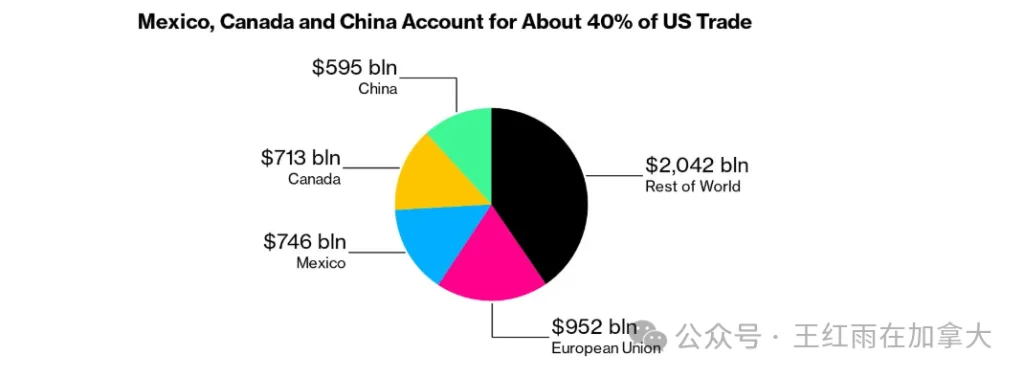
For Canada, Trump made three demands: 1. Manage the border; 2. As a member of NATO, increase military spending; 3. Trade balance, otherwise tariffs will be imposed. These three demands are like a powerful neighbor who uses threats and discrimination to ask us to manage our house, which is going to be run down. If we can't get better, the powerful neighbor will annex our house. Depending on how Canada responds, we can view these demands as threats from powerful powers or as incentives to better ourselves.
Canada is unable to make radical changes in a short period of time. During the nine years in power of the Liberal Party, the cost of trial and error has been too high, and the productivity gap between Canada and the United States has widened. Faced with these requirements of the United States, some can be achieved through hard work, some are definitely not possible, and some require bargaining.
At present, the per capita GDP of the United States is US$87,000, while the per capita GDP of Canada is only US$55,000. This is the comprehensive result of Canada’s long-term capital investment being too little, taxes being too heavy, and government efficiency being too low. It is unable to meet the military expenditures required by the United States.
For a long time, Canada has accepted many Middle Eastern refugees. If the border is not guarded, some people who are hostile to the United States will illegally enter the United States from Canada, posing a threat to U.S. security. Canada is a country that has legalized marijuana. If it does not control its borders, marijuana will flow into the United States. Therefore, the United States requires Canada to guard its borders, which is a reasonable request, and the Canadian government should be able to do so.
The trade deficit problem is most likely to be similar to the situation during Trump's first term from 2016 to 2020. Trump's tariff threat may occur in three situations: 1. If a 25% tariff is generally imposed on all Canadian goods, Canada will be in a similar situation to the outbreak of the epidemic, with rising unemployment and a surge in the number of people applying for unemployment benefits. Canada's response measures will be the same as when the epidemic broke out, with both fiscal and monetary policies; 2. It is just a verbal threat, and it will stop after seeing Canada's positive response. The possibility of this happening is low; 3. Like Trump version 1.0,Tit for tat, imposing tariffs on each other, forming a non-cooperative game, and eventually reaching a Nash equilibrium. This is the most likely scenario., how Canada did during the last four years of Trump’s term, how it will be in the next four years. The central bank's positive response to Trump's threat is because it is worried that businesses and households will have doubts about the outcome of the future game and will not dare to consume and invest. Therefore, it continues to cut interest rates despite the pressure of the Canadian dollar to continue to depreciate. The capital market is as stable as Mount Tai because this kind of game actually has little impact on investors.
02Canada 2025Economic outlook for the year
Regarding this year’s economic situation, in my recent YouTube video《2025Overview of Canada’s Economic Situation in 2017Henry Wang 2025Year 1Month 18dayWho is Carbon Tax Carney? Central bank stops shrinking QT balance sheetWhat does it mean? 》I expressed my opinion above: Canada’s economy will be in a relatively normal recovery period in 2025, as normal as before the epidemic. This is due to Canada’s interest rate environment, the end of the monetary policy of shrinking the balance sheet, new immigrants are releasing productivity, the Liberal Party’s unpopular policies, and the driving role of U.S. economic growth.
When companies decide whether to invest in loans, they will refer to the "critical interest rate", often called the "Marginal Efficiency of Capital (MEC) rate". Only when the investment return is higher than this interest rate will companies have the motivation to invest in loans. As interest rates gradually decrease, more and more companies will increase their demand for loans and capital investment, thereby promoting economic development and creating more job opportunities. The same goes for families. As mortgage interest rates fall, the balance between renting and buying a house will gradually tilt toward buying a house. Compared with buying a house, renting a house is an inferior good and its income elasticity is negative. Just like pickled mustard and instant noodles, the higher the income, the less consumption because there are high-end goods as substitutes. High interest rates will cause what Koo Chaoming calls a "lack of borrowers" balance sheet recession. In the past two years, the Canadian economy has been in a lifeless situation due to a lack of borrowers. With the central bank cutting interest rates, Canada will get out of this predicament in 2025.
After new immigrants arrive, they first increase overall demand and lower per capita GDP. However, as time goes by, new immigrants will gradually become productive forces, pushing up per capita GDP and alleviating the contradiction between supply and demand. The new immigration plan for 2025 is 395,000, which is similar to the number of new immigrants in 2019. This is the number of new immigrants that Canada can afford. According to statistics from the Bank of Canada, after new immigrants land, the proportion of self-occupied housing can reach 65% within 10 years. That is, 65 out of 100 new immigrants will buy a house 10 years after they land. The influx of new immigrants in the past three years will gradually release productivity and housing affordability, and initial results will be achieved in 2025.
Canada's carbon tax has been increasing every year since it began in 2019. I looked at my family's gas bill this month in 2019, and the federal carbon tax accounts for 31% of the expenditure. I really can’t understand how Canada, a country with a population of 40 million, can single-handedly change the global climate, and I don’t believe that such a high carbon tax can continue without causing public outrage. Families can't stand such a high carbon tax, and companies can't stand it even more. The Liberal Party's practice of shouldering the bill of its environmental ideals on every Canadian hopes to end in this summer's federal election. The policy of affordable housing has been revived during Trudeau's term. Due to profit trends, developers have stopped building commercial housing and instead built low-rent housing. This approach goes against common sense in economics - "New Housing Spurs Vacancy Chains". The future is slim, and it is hoped that it will be stopped after this year's election. Capital gains tax is specifically levied to discourage investment enthusiasm. Raising the tax scope is a perverse approach in encouraging investment and needs to be stopped.
In 2024, both the United States and Canada achieved soft landings. The interest rate hikes not only did not lead to large-scale unemployment, nor did they trigger economic stagnation. The economy did not land, but took off again. This caused many bears to miss investment opportunities. In 2025, as inflation is further suppressed and interest rates continue to fall, it is a high probability that the economy will return to the normal state before the epidemic. The main difficulties in moving forward are: 1. There is an oversupply of labor, and the number of jobs created by enterprises still lags behind the growth of new immigrants; 2. The depreciation of the Canadian dollar against the US dollar will lead to high living costs.
03Investors do not need to pay too much attention to macroeconomic conditions
A fish swimming in the sea does not need to care about the ebb and flow of the tide, just like investors do not need to care too much about macroeconomic conditions. The above-mentioned economic forecasts and outlooks are completely redundant for mature investors, just like ordinary people looking for social media content about tariff threats, while mature investors ignore the analysis and reports made by sensational social media in order to attract attention, and their investment decisions in the stock and bond markets cannot be affected by these noises. Content such as "In-depth analysis of whether Canada can become the 51st state of the United States" will be completely ignored by mature investors because this kind of content has nothing to do with investment.
Canada's full-year GDP in 2024 is expected to grow by 1.3%, and the Toronto stock index has risen by 21.7% for the whole year. Rather than analyzing and predicting in detail whether economic growth will be 1.8% or 1.2% in 2025, it is better to make your own investments carefully. The U.S. GDP is expected to grow by 2.5% for the whole of 2024, while the S&P 500 Index has already risen by 25%. It is the same all over the world. Economic growth and investment returns are two different things. Piketty has already concluded in "Capital in the 21st Century" that r > g. Here r: represents the average rate of return on capital, that is, the annual rate of return on capital (such as real estate, stocks, bonds, etc.); g: represents the economic growth rate, that is, the annual growth rate of a country or region's economic output (GDP). Piketty’s discovery was enough to win the Nobel Prize in Economics, but he has yet to win because the formula is too simple. Piketty draws a simple conclusion from this simple formula:Capital grows faster than labor, so the wealth gap between those with capital and those without capital will widen.For families, investment housing is a kind of capital. Currently, housing prices in the Greater Toronto Area are 46% higher than when the epidemic broke out, that is, the average increase over the past five years is 7.85%. The wealth gap between households with real estate and those without real estate will continue to widen. This has no direct linear relationship with GDP growth, whether there is an epidemic, whether there is inflation, or whether there is a significant interest rate cut or increase.For families with capital and multiple properties under their name, economic ups and downs do not affect their proportion of national wealth.For ordinary people, instead of staring at the news, it is better to read several basic economics tutorials carefully.
I hope that friends who are lucky enough to read this article can give up the logic of grand narratives and understand that our wealth does not automatically increase by 3% if the gross domestic income GDP increases by 3%. It is not that easy. Make your own investments and ignore the ups and downs of the economy. You can control your own destiny. Those with permanent wealth have perseverance, and families with wealth will not be affected by short-term economic factors; on the contrary, those without permanent wealth are closely following the ups and downs of the economy, being influenced by various news and comments, and like grand narratives and predicting the future, rather than creating the future.
04Canada Real Estate Market Outlook
As interest rates continue to fall, the balance between renting and buying a house will gradually tilt towards buying a house. This requires a process and takes time. Ontario's real estate market is currently performing worse than the rest of the country, mainly as homeowners rush to sell and the number of new listings remains high. While the sales rate in other regions has reached 50%, Ontario's sales rate is still below 40%, that is, less than 40 of the 100 properties listed for sale each month can be sold. At present, the Ontario real estate market is still in a buyer's market. This situation can only be improved through the market process. This situation can be alleviated after properties that have been listed for sale for a long time and are still unsold are gradually withdrawn from the market.
The current situation in the Ontario real estate market is the result of a large number of high-priced off-the-plan sales in the past few years, so it will not improve quickly. Since 2018, I have been warning about the risks of off-the-plan properties on this small public account, reminding people who can afford to buy existing houses not to buy off-the-plan properties, but the effect has been minimal. I will record a video recently to analyze the problem of off-the-plan properties in Toronto in detail and propose corresponding solutions, hoping to help some people make up for it.
Conclusion:
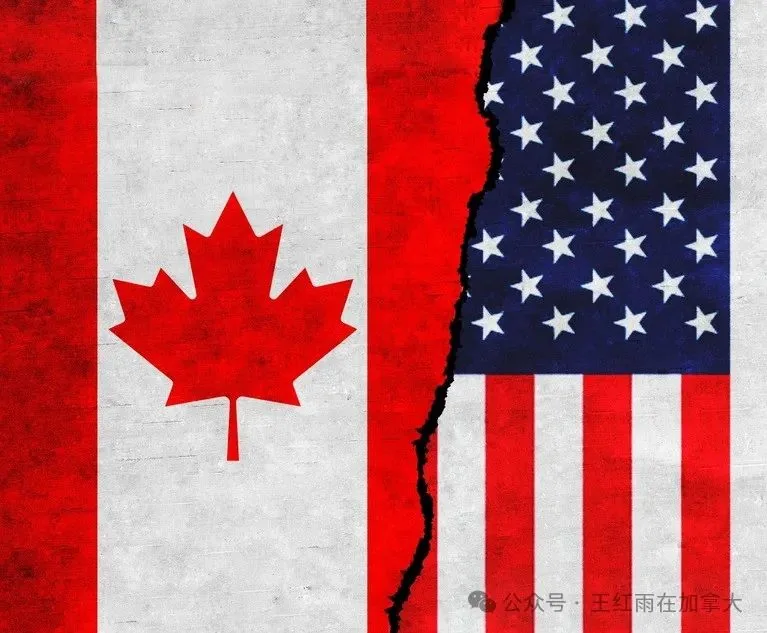
No one knows what Trump wants to do, let alone the outcome of the game between the United States and Canada. However, life must go on, and we cannot just lie down and let nature take its course. After experiencing the epidemic, unemployment, interest rate cuts, inflation, interest rate increases, and economic stagnation in the past five years, we can clearly see that uncertainty is always present, calmness is not the norm in life, and people have to experience many ups and downs in their lives. Tariff uncertainty is right around the corner, a reminder to each of us thatUncertainty is part of life, uncertainty exists as naturally as air, and we cannot hold our breath and do nothing. To overcome uncertainty, you need to have a clear goal and work persistently towards it. Some viewers left a message under my last video saying, "Canada will definitely have a good future." I completely agree with this. I believe that Canada’s tomorrow will be better than today. Facing the future with strength and an investor’s life attitude is the necessary life attitude to overcome uncertainty at this moment.
The Year of the Snake means a year full of wisdom and wealth. I wish every reader can grow in wisdom, accumulate wealth, and bravely challenge uncertainty in the Year of the Snake. When looking back on 2025, there will be no regrets, no wasted time, only full fulfillment and growth.
Henry Wang January 30, 2025 in Toronto