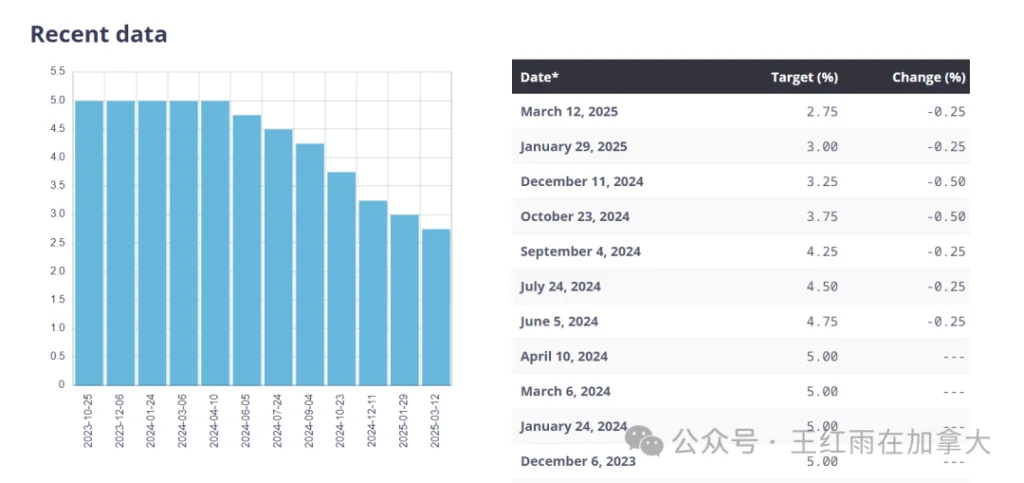
The U.S.-Canada tariff war started on March 6, 2025. The impact of increased tariffs on everyone, just like the epidemic, will gradually become apparent. Currently, families in the U.S.-Canada border area who frequently travel between the two countries have already felt the impact of tariffs on their lives. In order to deal with potential risks and follow the federal government's fiscal policy, the Bank of Canada cut interest rates again by 0.25% on March 12, 2025. Since the first interest rate cut on June 5, 2024, it has cut interest rates 7 times in a row, with a cumulative interest rate cut of 2.25%. The current central bank interest rate is 2.75%.
According to the United States-Mexico-Canada Agreement (USMCA) that took effect in July 2020, goods and trade within the scope of USMCA are not affected by this round of tariff wars. The market access and tariffs, rules of origin, labor standards, environmental standards, and digital trade agreements set by the USMCA remain in effect. Simply put, trade involving mutual supply chains between the three countries will not be affected until April 2 when it comes to the principle of friendly shore outsourcing in North America.
The Canadian Ministry of Finance officially announced the first round of financial rescue plan on March 7, 2025, the day after the tariff war started. Including the loan plans of the two policy banks EDC and BDC, as well as the flexibility principle of unemployment insurance EI. After announcing these policies on the afternoon of March 7, that evening, on March 8, Beijing time, China announced additional tariffs on Canadian imports. The Treasury Department's rescue plan has not yet considered the impact of China's tariff increases on Canada. Compared with the epidemic crisis five years ago, our current tariff crisis has not yet involved life safety or large-scale unemployment, but the degree of uncertainty is comparable to the lockdown, opening, closing, and opening again during the epidemic. Although the government's fiscal policy has responded, it is still relatively limited and restrained compared to the measures taken during the epidemic. Therefore, the central bank’s monetary policy coordination is also relatively limited, and it only cut interest rates by 0.25% on March 12.
01The possible direction of the tariff war
On April 2, the U.S. government will implementreciprocal tariffPolicy is the highlight of this round of tariff war. The current tariff war between the United States, Mexico and Canada is just the appetizer before the main course. "Reciprocal tariffs" are often called "reciprocal tariffs" or "mirror tariffs" in English. For example, the import tariff rate levied by the United States on alcohol imported from India is about 2%, and American consumers enjoy low-priced Indian products; the tariff rate levied by India on alcohol imported from the United States is approximately 150%, and Indian consumers pay higher prices. Trump said that this was bullying and insulting the United States, so he wanted to mirror India's approach and increase the tariff on alcohol imported by the United States from India from 2% to 150%. The imposition of reciprocal tariffs by the United States means a one-time correction of the existing unequal tariffs, regardless of which country the other party is, including of course Canada.
Take dairy products as an example. According to the USMCA, Canada implements a quota system for dairy products imported from the United States. For the portion exceeding the quota, cheese, extra-quota tariffs can be as high as 245%; butter, extra-quota tariffs are about 298%; milk powder, extra-quota tariffs are about 241%. According to the USMCA, the United States also implements a quota system for dairy products imported from Canada. For the portion exceeding the quota, cheese, extra-quota tariffs are usually between 10% and 20%; butter, extra-quota tariffs are about 20%; milk powder, extra-quota tariffs are about 10% to 20%. Obviously, there are indeed unequal tariffs between the United States and Canada on dairy products.After the United States implements reciprocal tariffs, it will quickly push up tariffs on most goods and trigger a global tariff war.
The U.S. Department of Commerce has stated that it hopes that Mexico and Canada can follow the United States and implement the same tariff policies as the United States. For example, it hopes that Mexico and Canada will synchronize with the United States after the United States imposes a 150% tariff on Indian alcohol. Otherwise, the "United States-Mexico-Canada Agreement" USMCA will be used. After all, Canada and Mexico are the northern and southern gates of the United States.
It is extremely challenging for Canada to succumb to the United States' global tariff war policy and follow the United States in imposing tariffs on other countries. On March 8, China imposed additional tariffs on Canadian goods, which was the first wave of impact. If we do not succumb to US policies, the tariff war between the United States and Canada will definitely escalate. In short, whether pro-American or anti-American, Canada's economy will be affected: exports will shrink, affecting employment; prices of imported goods will rise, raising inflation expectations. Canada is at a political crossroads when it comes to deciding whether to respond to a left hook or a right hook, but no matter which direction the impact comes from, Canada needs to meet the challenges posed by the threat of tariffs, and fiscal and monetary policy plans will be gradually introduced.
02Fiscal policy and monetary policy outlook
After the outbreak of the epidemic, the scale of fiscal policy adopted by Canada is unprecedented. In addition to using two policy banks, EDC and BDC, to provide loans, various subsidies were provided to residents and businesses, lasting as long as one and a half years. The following lists the most important fiscal policies from March 2020 to October 2021. These policies may be applied to this round of tariff crisis. At least we know that there are still many unused weapons of mass destruction in the arsenal of fiscal policy.
2020Year 3Month: Canada Emergency Response Benefit (CERB)), providing 2,000 per month to workers who have lost their jobs or had their income reduced due to the epidemic.Canadian dollar subsidy, lasting 4Month, total expenditure 740billion. wage subsidy scheme (CEWS)),Provide 75% to businesses affected by the epidemicwage subsidy, total expenditure 1110billion.
2020Year 4In September, the Canada Emergency Business Account (CEBA)), providing up to 4Interest-free loans of C$10,000, some of which are forgivable, can help small and medium-sized enterprises relieve cash flow pressure.
2020Year 5In March, the Rent Subsidy Scheme (CERS) to provide rent and mortgage interest subsidies to enterprises affected by the epidemic to reduce their operating costs. student support (CESB)), is not CERB compliantEligible students are offered 1250 per monthThe Canadian dollar subsidy supports student groups in coping with the financial difficulties caused by the epidemic.
2020Year 9In March, the Canada Recovery Benefit (CRB), replacing CERB, providing $300 per week to those who have lost their job or had their income reduced.Canadian dollar subsidy.
2020Year 11Month: Canada Recovery Recruitment Plan (CRHP)),Provide subsidies to companies that add employees or restore wages to encourage companies to re-hire and resume economic activity.
2021Year 1In March, the child benefit increased, and the Canada Child Benefit (CCB), provide more support to families with children and ease family financial pressure.
2021Year 10In March, wage and rent subsidies were extended, and the Extended Wage Subsidy Scheme (CEWS)) and Rent Subsidy Scheme (CERS) to 2021Year 10In March, the subsidy ratio was adjusted according to the epidemic situation to continue to support enterprises.
In addition to the above-mentioned fiscal policies, monetary policy has also been used to the extreme. On March 4, 2020, the first emergency interest rate cut was 50 basis points, and the adjusted benchmark interest rate was 1.25%; March 13, 2020: The second emergency interest rate cut was by 50 basis points, and the adjusted benchmark interest rate was 0.75%; On March 27, 2020, the third emergency interest rate cut was 50 basis points, and the adjusted benchmark interest rate was 0.25%. In just three weeks in March 2020, the Bank of Canada cut interest rates three times in a row, with a cumulative reduction of 1.5%, significantly lowering the benchmark interest rate from 1.75% to 0.25%. In the same month, the Bank of Canada launched a quantitative easing (QE) program, initially purchasing at least C$5 billion in Canadian government bonds per week. By buying bonds, it injects liquidity into the market and lowers long-term interest rates. In April 2020, the scope of asset purchases was expanded and corporate bonds and provincial bonds began to be purchased. In January 2021, the scale of quantitative easing was adjusted and the weekly asset purchases were reduced from CAD 4 billion to CAD 3 billion. In October 2021, the Bank of Canada announced the end of its quantitative easing program, but still maintained the benchmark interest rate at a historical low of 0.25% and continued to purchase government bonds to maintain market stability. In March 2022, interest rates will be raised for the first time until July 2023. In April 2022, the Bank of Canada officially launched quantitative tightening (QT) until March 2025 when it stopped shrinking its balance sheet.
The Bank of Canada's impact on monetary policy is mainly reflected in its impact on commercial banks and does not directly affect businesses and households. Money delivery to households and businesses is in the hands of commercial banks. The regulator of Canadian commercial banks is OSFI, and the tightness of its policies directly affects the amount of money released into society. OSFI's policies during the epidemic are summarized as follows: In March 2020, OSFI allowed banks and financial institutions to provide mortgage loan repayment deferrals (up to 6 months) to borrowers affected by the epidemic; in April 2020, capital buffer requirements were relaxed, and OSFI announced that it would temporarily reduce the capital buffer requirements of domestic systemically important banks from 2.25% to 1%, releasing approximately CAD 300 billion in additional lending capacity. In April 2022, OSFI announced that it would restore banks' capital buffer requirements and increase them from 1% to 2.5%. Currently, this ratio has increased to 3.5%, which is higher than before the epidemic, thus restricting the credit business and currency injection of commercial banks.
In the face of the tariff crisis, how large-scale fiscal and monetary policies need to be adopted, and what cooperative measures OSFI, the commercial bank regulator, will take, will depend on the government's judgment on the impact of this crisis.My personal opinion is: the intensity of fiscal policy indicates the actual extent of damage to the economy. Canada’s central bank has no independence, so monetary policy is guided by the government’s fiscal policy. If fiscal policy becomes stronger, monetary policy will keep up. Whether the central bank’s monetary policy can be implemented depends on the regulatory agencies of commercial banks.OSFIcooperation measures. The current fiscal policy is limited, so the central bank’s monetary policy is relatively conservative. 3Month 12Only cut interest rates by 0.25%. And OSFINo coordination measures were implemented at all. The fiscal policy is "targeted poverty alleviation", which is completely targeted at the people affected by the disaster. Those who are not affected will not receive a penny. During the epidemic, a total of 3,000 relief funds were distributed.billion, with an average of 7,500 per personYuan, but those families who kept their income and jobs unchanged did not receive a penny of assistance; monetary policy is to "save all living beings". As long as interest rates are cut, every family that can apply for a loan will benefit. Families who took loans to buy houses during the epidemic will receive monetary policy preferences.
Looking back at history is not to predict the future, but to avoid repeating the same mistakes. During the epidemic, many families neither received a penny of government subsidies nor took out loans to buy houses, and all preferential policies were ignored. Not only was a perfect crisis wasted, but also everyone sadly experienced the subsequent inflation and interest rate increases. It is recommended that everyone pay close attention to changes in the government's fiscal policy to judge changes in monetary policy, learn lessons from the epidemic, prepare early, and act decisively, so as not to miss this tariff crisis again.
03How ordinary families are coping with the tariff crisis
Buffett said that a tariff war is a war. The United States and Canada are at war, and no one can escape this reality. The tariff war may lead to serious unemployment in some industries, may lead to an increase in the price of consumer goods, and may cause the Canadian dollar to depreciate... These are the costs of the war, and everyone involved in it is involved. Currently, Canada has imposed additional tariffs on $30 billion in goods imported from the United States, and Canadians need to find substitutes for these increased prices. When everyone is shopping, please give priority to Canadian products and help us win this tariff war. No one knows how the tariff war will turn out. Tariff policies can even be different in the morning and afternoon. The plot always reverses, then reverses, and then reverses again. Ordinary families need to prepare for wartime conditions.
During the epidemic, I heard about a Canadian family. The husband and wife were both medical workers. They both quit their jobs and went into hiding. They also took advantage of the falling housing prices to sell their home.In times of crisis, there are four things you should avoid:1.Avoiding social and family responsibilities and failing to take responsibility; 2.Being smart, sell stocks at low prices and houses at low prices; 3.Being overly pessimistic and looking only at risks rather than opportunities; 4.Forget history and repeat its mistakes.History is never a map of the future. The future means that things will happen that have never happened before. What ordinary people can do is to keep history in mind, avoid repeating the same mistakes, and do not expect to be able to predict the future. Sell your house when house prices are low, sell stocks when stock prices are low, and buy lottery tickets after retirement. This is the three-piece package of "living more miserable". When farmers sell their land in lean years, who buys it? Landowners can buy land in famine years because they have a surplus of food and have already made preparations for the famine years. Famine years are dangers to farmers and opportunities to landowners. It is particularly easy to return to poverty, just to sell assets at low prices instead of buying them when the crisis comes. Many people say, "I only have one chance left in my life."So where do the opportunities lie? Opportunities are hidden in crises. "Crisis" and "opportunity" appear at the same time. It depends on how you choose.Why are most people not rich? Because when a crisis comes, most people tend to only see dangers but ignore the opportunities. They may even go astray and make wrong decisions, leading to a rapid return to poverty.
Conclusion:
The game between the United States and Canada is like a battlefield. Currently, Canada is in a state of trade war. The sword has no eyes and is surrounded by crises. Today, we don’t know what will happen tomorrow. For ordinary families, they need to pay attention to changes in Canada's fiscal policy in the coming period. Because the Bank of Canada is not independent, monetary policy needs to coordinate with fiscal policy, so interest rate changes will be synchronized with fiscal policy. Confrontations in the game may be true or false. Sometimes the thunder is loud and the raindrops are light, and sometimes there are thunderstorms. The actual damage needs to be assessed by the government. For example, if the number of new EI recipients increases significantly, financial assistance will be intensified, monetary policy will keep up, and even the policies of the banking supervisory authority OSFI will need to keep up with adjustments to central bank policies. There are two possible outcomes of the trade war: 1. An economic recession is accompanied by an increase in unemployment, so the central bank will cut interest rates; 2. Prices will rise, and the central bank may raise interest rates as a result. Both possibilities are possible, and it is likely to happen one after another, with interest rates being cut first and then raising interest rates, which is what we have all experienced since the epidemic.
During the crisis, what ordinary families need to avoid as much as possible is: do not sell houses when house prices are low, and do not sell stocks when stock prices are low. Whether to buy assets at low prices or not is a difficult question to answer, because each family has different financial capabilities, and more importantly, everyone has different psychological capabilities. When buying an asset, if you are lucky and hope that the price will reverse immediately, this kind of bargain hunting is a dangerous gamble; if you are sure when you buy the asset, you will sell the asset at least 5 years later, and your financial ability allows, you can consider making full use of the buying opportunities brought by the crisis.
There is great uncertainty about the epidemic. We don’t know what the outcome will be or when it will end. Uncertainty about inflation and trade wars is limited, because inflation and trade wars will definitely end, and the results are known, but we don’t know when they will end, and we don’t know what will happen in the process. The tariff crisis will definitely pass. What we need to do is not to forget history, not to repeat the same mistakes, and not to waste this crisis. No matter how the tariff crisis evolves, reviewing our common experiences during the epidemic will help everyone improve their ability to deal with the crisis. When readers encounter trade-offs in the future, I hope they will think of this article, review the past period of history, learn from history, and find their own certainty in an uncertain world, without fear of the past or the future.
Henry Wang in Toronto on March 12, 2025